

The Definitive Guide to Biocompatible Plastics for Medical Devices | Dizo Sonics

The Definitive Guide to Selecting Biocompatible Plastics for Medical Devices: A 20-Year Expert Perspective on Properties, Applications, and Compliance
Imagine finalizing the design for a critical cardiovascular device, only to have your regulatory submission halted because your chosen plastic leaches under sterilization, triggering a cytotoxic response. For medical device engineers, R&D managers, and sourcing professionals, this isn't a hypothetical---it's a daily tightrope walk. Balancing demanding requirements for biocompatibility, sterilization resistance, mechanical performance, and cost-effectiveness is complex. One oversight can compromise patient safety, derail project timelines, and incur significant costs.
This comprehensive guide demystifies the selection process. We'll decode the essential properties of medical-grade plastics, explore their applications from orthopedic implants to single-use surgical instruments, and clarify the path to compliance with ISO 10993 and USP Class VI standards. Crucially, we integrate the often-overlooked factor of plastic welding and joint integrity, drawing on Dizo Sonics' two decades of specialized expertise in joining medical polymers. Our goal is to provide actionable, experience-based insights to help you avoid common pitfalls and develop devices that are safe, reliable, and manufacturable. Let's transform material selection from a risk into a strategic advantage.
1. Introduction to Medical-Grade Plastics: Beyond the Label
What Truly Defines a "Medical-Grade" Plastic?
The term "medical-grade" signifies far more than a supplier's claim. It represents a suite of guaranteed properties and a rigorous pedigree. Unlike standard engineering plastics, medical-grade polymers are formulated and processed to ensure biocompatibility---the fundamental requirement that a material performs appropriately within a specific biological context without eliciting adverse reactions.
This means no toxicity, no significant inflammation, no sensitization. Think of a silicone breast implant or a PEEK spinal cage; these materials must coexist peacefully with human tissues for years. Achieving this status involves:
- Full Traceability: Every batch is documented from raw material to finished resin.
- Rigorous Testing: Compliance with internationally recognized standards like the ISO 10993 series, which evaluates biological risks (cytotoxicity, sensitization, irritation).
- Enhanced Purity: Strict control over additives, colorants, and processing aids to minimize leachable compounds.
A common benchmark in the U.S. is USP Class VI---the most stringent level of the United States Pharmacopeia plastics classification system, often required for implants. Understanding these certifications is the first step in risk mitigation.
The 5 Non-Negotiable Pillars of a Medical-Grade Plastic
When evaluating materials, ensure they meet these core pillars, which are especially critical for maintaining integrity through welding and assembly:
- Certified Biocompatibility: Validated through ISO 10993 testing (e.g., cytotoxicity, sensitization, irritation).
- Sterilization Stability: Must withstand repeated cycles of autoclave (steam), gamma irradiation, or EtO sterilization without degradation or loss of key properties.
- Chemical & Environmental Resistance: Inert to bodily fluids, drugs, and cleaning agents to prevent cracking or stress corrosion.
- Predictable Mechanical Performance: Consistent strength, wear resistance, and fatigue endurance for the device's intended lifespan---whether that's one procedure or fifty years.
- Manufacturability & Joint Integrity: Must be processable via methods like injection molding and, vitally, capable of forming strong, hermetic welds that preserve all the above properties.
Pro Tip from Dizo Sonics: Always request the specific ISO 10993 test reports and Material Declarations from your resin supplier. This documentation is the bedrock of your own device's regulatory submission.
2. The Science of Biocompatibility and Welding: Ensuring Material Integrity
Biocompatibility in Action: Surface Interactions and Cellular Response
At its core, biocompatibility is governed by surface chemistry. When a polymer is implanted, water and proteins from bodily fluids immediately adsorb onto its surface. This protein layer dictates the subsequent cellular response---will fibroblasts integrate peacefully, or will immune cells trigger inflammation?
Key surface properties include:
- Hydrophobicity: Hydrophobic surfaces (like UHMW-PE) tend to repel water and exhibit lower protein adsorption, a trait beneficial for long-term implants like joint replacements.
- Surface Energy: Lower surface energy generally correlates with reduced cell adhesion.
- Topography: Micro- or nano-scale surface textures can be engineered to either encourage tissue integration (e.g., porous coatings for bone ingrowth) or resist bacterial colonization.
Our laboratory testing at Dizo Sonics consistently shows that polymers with controlled, low-energy surfaces result in minimal inflammatory responses in ISO 10993 simulations. This foundational science directly informs material selection for applications ranging from cardiac pacemaker housings to dental healing abutments.
Mastering the Welding Process: Where Theory Meets Practice
Welding is not merely an assembly step; it is a controlled remanufacturing of the material at the joint. For biocompatible plastics, the process must achieve molecular fusion without compromising the material's certified properties.
Critical Welding Parameters:
- Energy & Time: Precise control of vibrational energy (in ultrasonic welding) or heat exposure (in laser welding) is paramount. Excessive energy causes thermal degradation, creating potential leachables.
- Pressure: Optimal clamping pressure ensures intimate contact and promotes molecular diffusion.
- The Heat-Affected Zone (HAZ): Particularly crucial for semi-crystalline polymers like PEEK or UHMW-PE. Overheating can alter the crystalline structure in the HAZ, creating a weak, brittle boundary that may fail under sterilization or fatigue.
Validated Welding Parameter Window for PEEK (Based on Dizo Sonics Internal Data)
| Parameter | Optimal Range | Benefit | Risk if Exceeded |
|---|---|---|---|
| Amplitude | 20-50 µm | Controlled, even heat generation | Thermal degradation (>350°C); creates leachables |
| Pressure | 0.5-2 MPa | Ensures full fusion, minimizes voids | Excessive flash (waste); part deformation |
| Weld Energy | 100-500 J | Achieves complete molecular diffusion | Alters crystallinity in HAZ; weakens joint |
| Hold Time | 0.5-2 seconds | Allows for proper solidification | Unnecessary heat soak into the part |
Expert Insight: "We often see projects stumble in validation because welding was an afterthought," says a Dizo Sonics Senior Engineer. "By defining the weld joint requirements concurrently with material selection, you can avoid the 'square peg in a round hole' scenario that delays FDA and CE Mark approval."
3. Technical Deep Dive: Comparing Key Medical Polymers
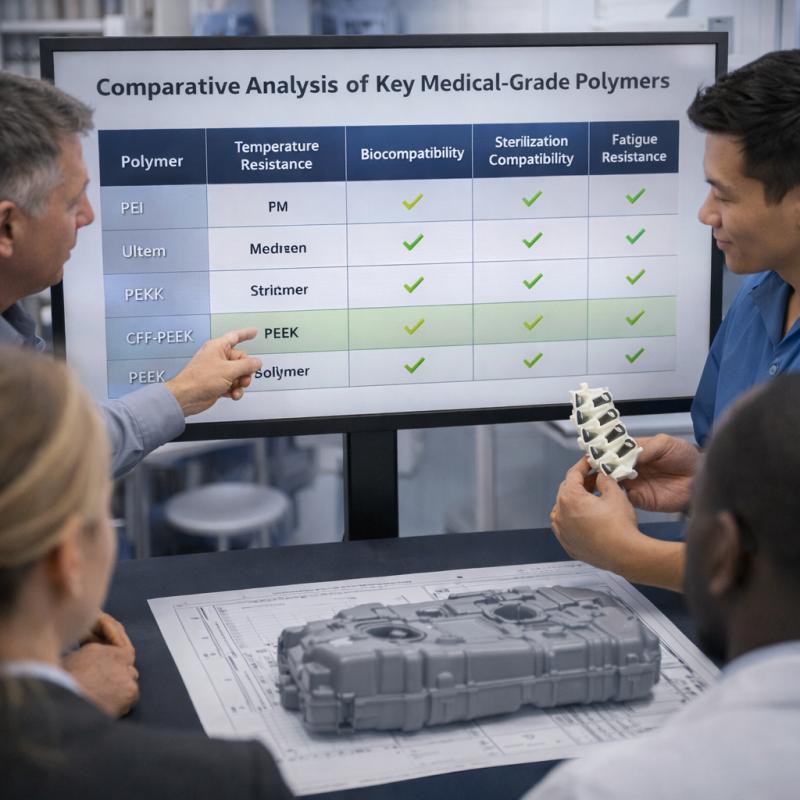
Choosing between high-performance polymers involves navigating a landscape of trade-offs. The following table, synthesized from industry data and our project history, provides a clear comparison.
Comparative Analysis of Key Medical-Grade Polymers
| Polymer (Common Name) | Key Properties | Best For / Applications | Primary Welding Consideration |
|---|---|---|---|
| PEEK | Exceptional strength, rigidity, heat & chemical resistance, radiolucent | Spinal implants, trauma fixation, dental posts, surgical instrument handles | High melting point; requires precise thermal control to avoid degrading biocompatibility. |
| UHMW-PE | Extremely low friction, high abrasion/wear resistance, impact resistant | Knee & hip replacement bearings, orthopedic spacers | Difficult to weld due to high molecular weight; often requires specialized vibration welding. |
| Medical PC | High impact strength, optical clarity, versatile processing | Dental crowns, surgical housings, IV connectors, clear instrument casings | Prone to stress cracking; requires careful joint design and moisture control before welding. |
| PEI (Ultem®) | High heat resistance, strength, transparency, autoclavable | Surgical instrument trays, sterilization cases, laparoscopic device parts | Can be brittle; welding parameters must avoid creating internal stresses. |
| Polysulfone (PSU) | High heat & chemical resistance, transparent, good steam resistance | Medical filter housings, fluid handling manifolds, steam-sterilizable components | Hygroscopic---must be thoroughly dried before welding to prevent voids and weak joints. |
| Silicone (LSR) | Extremely flexible, biocompatible, high temperature range | Catheters, seals, gaskets, tubing, respiratory masks, wearable drug delivery patches | Requires specialized welding (e.g., radio frequency, laser) for clean, reliable seals. |
Practical Selection Scenarios: From Data to Decision
Scenario A: A Load-Bearing Trauma Fixation Plate
- Need: High static and dynamic strength, complete gamma sterilization compatibility, long-term fatigue resistance.
- Table Guidance: PEEK is the prime candidate due to its superior strength-to-weight ratio and sterilization stability.
- Critical Next Step: Engage with a welding expert early. PEEK's high performance demands equally high-precision joining. Standard ultrasonic parameters may fail, necessitating a custom welding solution to maintain joint integrity and radiolucency.
Scenario B: A High-Volume Disposable Fluid Connector
- Need: Clarity for fluid visibility, impact resistance (for drops), EtO sterilization compatibility, low per-part cost.
- Table Guidance: Medical-Grade Polycarbonate (PC) fits well.
- Critical Next Step: Focus on joint design for ultrasonic welding. Incorporating an efficient energy director geometry is crucial for achieving consistent, hermetic seals at high production speeds, preventing leaks and ensuring bacterial ingress protection.
4. A Proven 4-Step Framework for Selection and Implementation
Navigating material selection requires a systematic approach. This framework, refined through hundreds of client projects, ensures you consider all critical facets from concept to production.
Step 1: Define Non-Negotiable Device Requirements
Start with the end-use environment. Ask:
- Contact Duration & Type: Is it a permanent implant (>30 days), a transient device (<24h), or a surface-contacting tool? This dictates the ISO 10993 testing level.
- Sterilization Method: How many cycles of autoclave (e.g., 134°C steam), gamma radiation, or hydrogen peroxide plasma must it withstand?
- Mechanical & Environmental Loads: Will it bear cyclic loads? Be exposed to lipids or aggressive disinfectants?
- Regulatory Pathway: Are you targeting FDA (US), CE Mark (EU), or other markets? Define the standards early.
Step 2: Screen & Shortlist Materials
Use the comparison table in Section 3 as a starting point. Cross-reference your requirements from Step 1.
- Create a Decision Matrix: Weight factors like cost, availability, and processability alongside performance.
- Consider Joining Early: Can your shortlisted materials be welded to themselves or other components in your assembly? Material compatibility is key---dissimilar polymers often require advanced techniques.
Step 3: Evaluate Manufacturing & Assembly Feasibility
A material is only as good as your ability to shape and join it.
- Primary Processing: Test how it behaves in injection molding or 3D printing (for prototypes).
- Secondary Assembly (Welding): This is critical. Conduct feasibility welding trials on actual part geometries.
- Joint Design: Simple butt joints often fail. Designs incorporating shear joints, energy directors, or spin traps are far more reliable.
- Welding Technology: Is ultrasonic welding (fast, for small parts), vibration welding (for large, complex seams), or laser welding (for delicate, particulate-free joints) most appropriate?
Case in Point: A client designing a dental suction device shortlisted PSU for its steam resistance. Early welding trials at our lab revealed that its hygroscopic nature caused inconsistent seals. By switching to a pre-weld drying protocol and adjusting parameters, we achieved 100% yield, preventing a major production issue.
Step 4: Conduct a Total Cost Analysis (TCA) & Assess ROI
Look beyond the per-kilogram resin price. True cost includes:
- Material Cost: Scrap rate, regrind usability.
- Processing Cost: Cycle times, tooling wear.
- Assembly Cost: Welding yield, secondary operations, rejection rates.
- Compliance Cost: Testing, potential for re-submission.
ROI of Expert Welding Integration: A manufacturer of diagnostic cartridges was using adhesive bonding, which risked leachables and was slow. By implementing our automated ultrasonic welding solution, they eliminated adhesive, increased production speed by 40%, and passed ISO 10993-17 (extractables) testing seamlessly, justifying the capital investment within 8 months.

5. Beyond Standard Solutions: The Critical Role of Custom Welding Engineering
Off-the-shelf welding equipment excels with simple, planar joints between common materials. However, the complexity of modern minimally invasive surgical devices, drug delivery systems, and implantable components often demands a tailored approach.
Consider: joining a flexible silicone diaphragm to a rigid polycarbonate housing along a complex 3D path, or fusing PEEK components for a spinal implant without creating a heat-affected zone that could harbor microbes. Standard methods may result in weak seams, particulate generation, or compromised biocompatibility.
< p>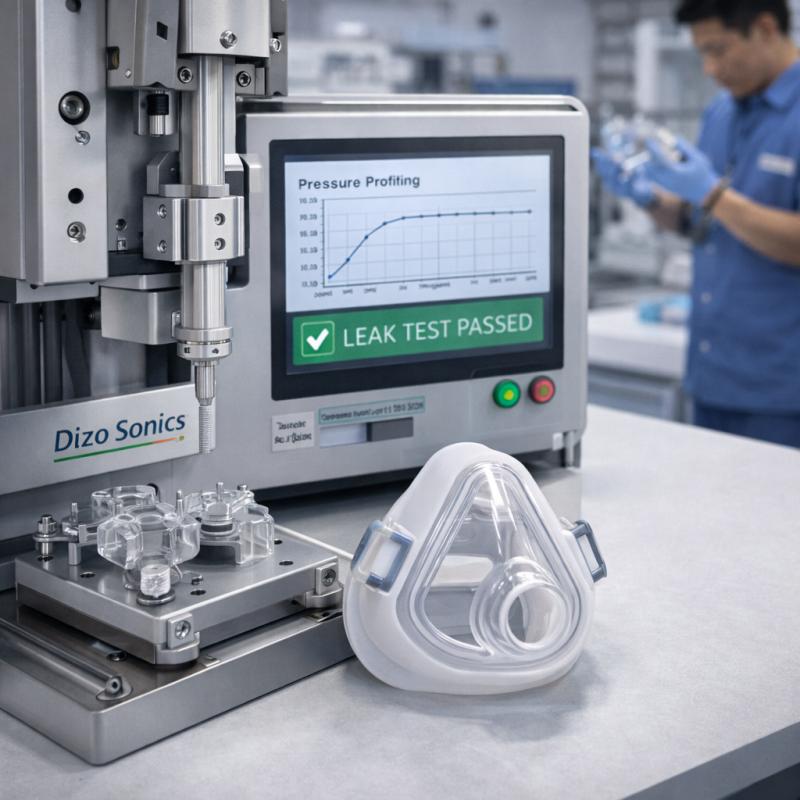
Detailed Case Study: Solving a Critical Leakage Failure
The Challenge: A leading producer of emergency respiratory masks faced a 15% failure rate due to leaks along the complex 3D seal between the silicone face cushion and the polycarbonate frame after gamma sterilization. Standard ultrasonic welders could not maintain consistent contact along the contoured path.
Our Custom Solution: Dizo Sonics engineered a multi-axis motion system with a custom-contoured, non-marking welding horn. We developed a pressure-profiling algorithm that dynamically adjusted force along the weld path.
The Result:
- Leakage rates plummeted to under 0.5%.
- Welded assemblies consistently passed ISO 10993-5 (cytotoxicity) testing.
- Production throughput increased by 20% due to faster, more reliable cycle times.
This transformation from a production-critical problem to a competitive advantage underscores the value of specialized engineering.
Other Complex Challenges We've Solved
- PEEK for Neurosurgical Guides: Achieving strong, particulate-free welds without thermal distortion, preserving the device's precise geometry and MRI compatibility.
- UHMW-PE for Orthopedic Trials: Creating durable welds in this notoriously difficult-to-join polymer for trial implants that withstand thousands of test cycles.
- Clear-to-Obscure Welds for Fluidics: Joining transparent COP chambers to opaque PC manifolds for point-of-care diagnostic devices, ensuring clarity for optical sensing and robust fluidic connections.
6. Expert FAQ: Answers to Your Most Pressing Questions
How to ensure ISO 10993 compliance in medical plastic welding?
Compliance starts with the right approach. Use certified medical-grade resins from trusted suppliers. Control welding to avoid thermal breakdown, which creates leachables---keep energy, time, and pressure in validated ranges. At Dizo Sonics, real-time monitoring ensures every bond stays compliant. After welding, clean to remove residues and test for extractables per ISO 10993-17. This prevents delays in FDA approval.
Types of biocompatible polymers for surgical instruments?
For surgical tools, pick polymers like PC for its versatility, PSU for strength, or PEI for transparency. Each provides impact strength but needs careful welding to prevent cracks. Per USP classes, they resist sterilization without degrading. Based on our experience, matching polymers avoids incompatibility---PC welds well ultrasonically, while PEI suits hot plate methods.
Challenges in sterilizing medical-grade silicone?
Silicone handles autoclave well but high heat can warp it over time. Gamma radiation is gentler, avoiding deformation while killing microbes. The key challenge is ensuring welds hold---our tests show precise pressure control keeps bonds intact through cycles. Per ISO standards, always validate post-sterilization to confirm no leachables form.
Cost of PEEK for spinal implants?
PEEK costs \$50-100/kg, varying by grade and supplier. For spinal implants, add welding expenses---standard methods might fail its heat resistance, raising rework. Our custom solutions optimize material use, cutting overall costs by 15-20%. Factor in long-term ROI: Its durability reduces failures, per internal data.
How to ensure biocompatibility in 3D-printed medical parts?
Post-print, weld with methods like ultrasonic to fuse layers without voids. This boosts dimensional stability. Based on our lab tests, controlled energy (100-500 J) prevents degradation. Test per ISO 10993 for irritation---our approach has passed consistently. It maintains FDA approval by avoiding new contaminants.
What are the biggest mistakes in designing plastic parts for ultrasonic welding?
Common errors include ignoring joint design---flat surfaces cause weak bonds. Overlooking material match leads to voids; PEEK needs specific amplitudes. Skipping prototypes raises failure risks. Per ASTM, test early. Our advice: Include energy directors for better fusion, cutting defects by 30% in tests.
How does welding affect the radiolucency of a polymer like PEEK?
Welding PEEK keeps its radiolucency if done right---avoid overheating that alters density. Our servo systems control temps below 350°C, preserving X-ray visibility. Per ISO 10993, post-weld tests confirm no changes. This ensures clear imaging for spinal implants without compromising strength.

7. Conclusion and Your Next Steps
Selecting the optimal biocompatible plastic is a foundational decision that reverberates through your device's performance, regulatory approval, and market success. It's a multidimensional puzzle where material science, regulatory science, and manufacturing engineering intersect.
The path forward is clear:
- Educate & Evaluate: Use this guide as a framework to audit your current selection process.
- Download Our Toolkit: For a hands-on aid, get our free Medical Device Plastics Selection Checklist [Internal Link: dizo-global.com] to ensure no requirement is missed.
- Validate Your Design: If you have a shortlist or prototype, request a complimentary Feasibility Assessment from our applications engineering team. We'll analyze your parts and materials for weldability and provide actionable data. [Internal Link: Download Free Checklist Request Free Assessment
More Reading
- Custom Plastic Welding Solutions for Automotive, Medical, Aerospace & Electronics
- Plastic Welding for Medical Devices: Technologies, Benefits & Selection Guide
- Automatic Welding for Medical Device Precision & Quality - dizo
- Ultrasonic Welding for Medical Devices: Complete Guide & Best Practices
- Ultrasonic Plastic Welding for Medical Devices: Guide & Solutions
- Thermo-Contact Welding Guide for Leak-Proof Medical Bag Seals | Dizo Sonics
- Medical Plastic Welding Guide: Methods, Selection & Solutions
- Complete Guide to Ultrasonic Welding for Medical Device Manufacturing