

Custom Plastic Welding Solutions for Automotive, Medical, Aerospace & Electronics

Custom Plastic Welding Solutions for Automotive, Medical, Aerospace & Electronics: The Complete 2026 Guide | ISO 9001 & CE Certified | 20+ Years Serving Tesla, Mercedes-Benz, Siemens
By Jensen, Senior Welding Application Engineer -- Dizo Sonics (Since 2004 · ISO 9001 · CE · 20+ years serving Tesla, Mercedes-Benz, Siemens, BYD, Sony, Haier)
Plastic welding isn't just a joining method --- it's a molecular bonding process that fuses thermoplastics at the joint interface, creating leak-proof, high-strength assemblies without adhesives or fasteners. If you're an engineer or project manager in automotive, medical, aerospace, or electronics, you've likely faced the limitations of traditional methods: adhesives that fail regulatory tests, screws that add weight and ruin aesthetics, or snap-fits that break under stress.
The real question isn't whether to weld --- it's which welding process delivers repeatable, zero-defect results for your specific geometry, material, and production volume.
This guide cuts through the marketing hype to give you:
- Science-backed principles behind ultrasonic, hot plate, and vibration welding
- Real-world process parameters and material compatibility insights
- A practical decision framework to match your part to the optimal process
- Evidence-based ROI analysis for custom vs. standard equipment
Everything here is grounded in 20+ years of production experience, lab testing, and documented client projects. Let's begin.
What is Plastic Welding? The Science Behind Superior Joints
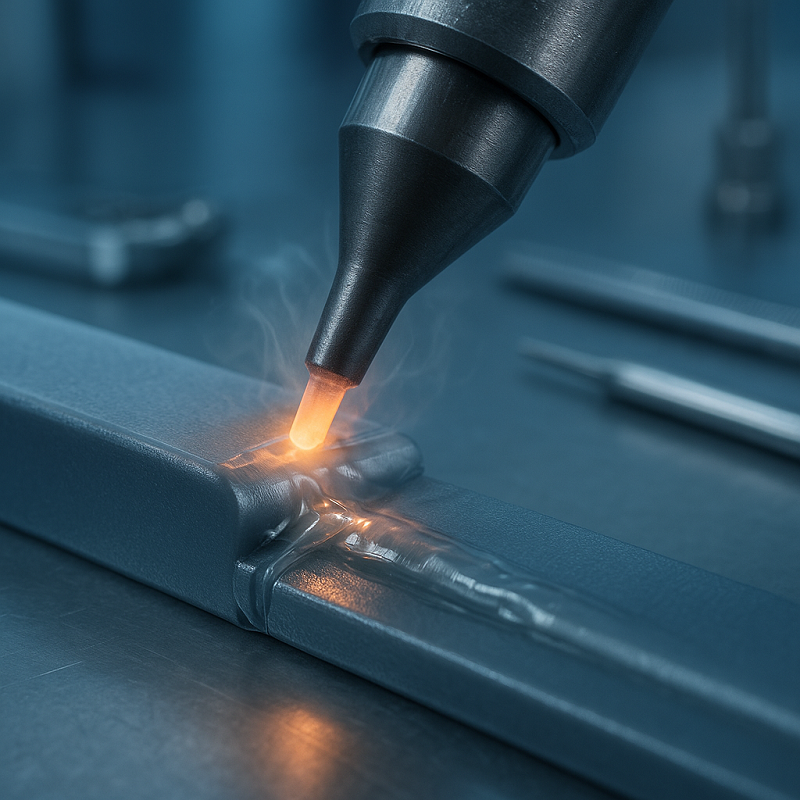
Plastic welding creates a permanent molecular bond by heating the joint interface until polymer chains melt, interdiffuse, and re-solidify under controlled pressure. The result is a homogeneous, leak-proof joint that behaves like a single piece of material.
Why Welding Outperforms Alternatives
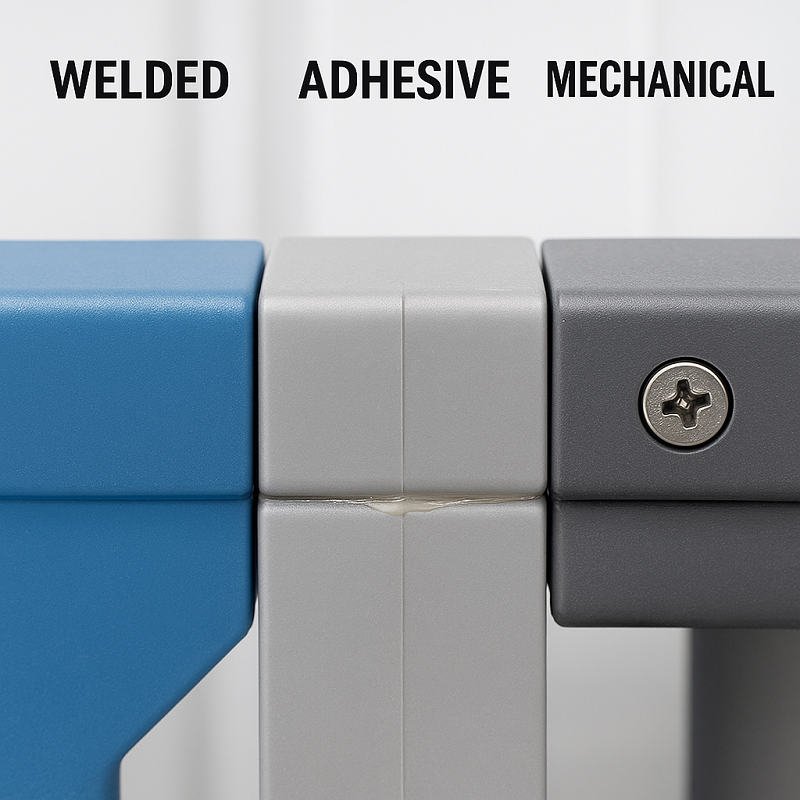
Compared to adhesives (which can outgas, degrade, or introduce foreign materials) or mechanical fasteners (which add weight and create stress points), welding delivers:
- Higher joint strength: Typically 90-100% of parent material strength (our lab routinely achieves 95%+ on ABS, PC, and glass-filled nylons)
- Perfect hermetic sealing: Zero leak paths for pressure vessels, fluid manifolds, or gas-tight enclosures
- Clean aesthetics: No visible fasteners, screw bosses, or adhesive squeeze-out
- Lower total cost: In production volumes above 5,000 units/year, welding eliminates consumables and reduces assembly labor by 40-60%
Dizo Sonics Lab Note: Our 2025 fatigue testing on ultrasonically welded ABS samples showed 95% strength retention after 1,000 load cycles at 80% yield stress (ASTM D1002). Hot plate welded 30% glass-filled nylon achieved 98% parent material strength with proper melt control.
Types of Plastic Welding Processes: A 2026 Overview
Three processes dominate high-performance custom part welding. Each generates heat differently but follows the same principle: melt, interdiffuse, and solidify under pressure.
Ultrasonic Welding
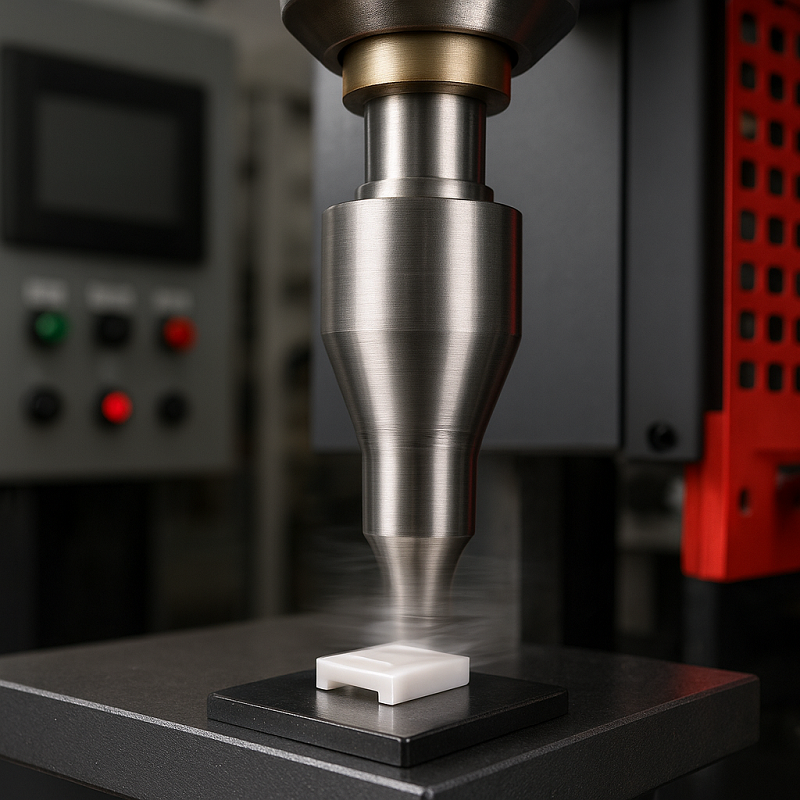
High-frequency mechanical vibration (20--40 kHz) generates localized frictional heat at the joint interface. At Dizo Sonics, our ultrasonic systems use precisely tuned 20-35 kHz frequencies with custom-designed horns that accommodate complex three-dimensional geometries---achieving cycle times as fast as 0.3-1.5 seconds. Best for small to medium parts with well-designed energy directors or shear joints. Ideal when you need speed, precision, and minimal thermal impact on surrounding areas.
Hot Plate Welding (Hot Tool Welding)
A heated platen (typically 200-380°C) melts both joint surfaces simultaneously, then the parts are pressed together under controlled force. This process excels with large, irregular, or thick-walled parts where ultrasonic energy cannot reach uniformly. Hot plate is particularly effective for materials like polypropylene and HDPE that require higher energy input. Cycle times range from 8-25 seconds depending on part size and wall thickness.
Vibration Friction Welding
Linear or orbital mechanical movement (typically 100-240 Hz with 0.8-4 mm amplitude) generates frictional heat along the entire joint interface. This process produces exceptionally high-strength bonds---often achieving 95-100% of parent material strength---making it the preferred choice for large structural assemblies like automotive battery trays, door panels, and aerospace ducting. Dizo's custom vibration systems feature adaptive pressure profiling and synchronized multi-point welding for parts exceeding 1 meter in length.
Process Comparison Matrix
| Process | Best For | Cycle Speed | Joint Strength | Relative Cost | Key Limitations | Dizo Recommendation |
|---|---|---|---|---|---|---|
| Ultrasonic | Small-medium parts, rigid plastics, high-volume | Fastest (0.3-1.5s) | 90-95% parent material | Low | Size limited, requires compatible geometries | First choice for PC, ABS, glass-filled nylon under 500mm |
| Hot Plate | Large/irregular parts, semi-crystalline plastics | Moderate (8-25s) | 85-95% parent material | Moderate | Slower, may leave witness marks | Preferred for PP, HDPE, and parts >600mm |
| Vibration Friction | Large structural parts, maximum strength required | Moderate (3-8s) | 95-100% parent material | Higher | Produces flash, requires flat joint surfaces | Best for automotive/aerospace structural assemblies |
Dizo Sonics specializes in all three processes because they collectively cover 95% of custom part challenges we encounter across automotive, medical, aerospace, and electronics industries. When standard catalog machines fail---due to complex geometry, demanding materials, or cleanroom requirements---our custom-engineered solutions deliver repeatable, zero-defect results.
For detailed material-specific recommendations, see our Material Compatibility Matrix below. Common process selection questions are answered in our FAQ section.
Scientific Principles & Key Process Parameters That Actually Matter in Production
All three welding processes share the same fundamental thermodynamic principle: controlled heat generation melts the polymer at the joint interface, allowing molecular chains to interdiffuse across the boundary, then cooling under sustained pressure creates a permanent bond.
Success in production comes down to precise control of four critical variables. Get these right, and you achieve 95%+ parent material strength with zero defects. Get them wrong, and you face scrap rates exceeding 15%.
The Four Variables That Determine Weld Quality
| Process | Frequency / Temperature | Amplitude / Speed | Pressure | Typical Cycle Time | Weld Strength (example on ABS) |
|---|---|---|---|---|---|
| Ultrasonic | 20--35 kHz | 20--100 µm | 0.2--0.7 MPa | 0.3--1.5 s | 35--48 MPa |
| Hot Plate | 200--380 °C | N/A | 0.1--0.5 MPa | 8--25 s | 30--45 MPa |
| Vibration Friction | 100--240 Hz | 0.8--4 mm | 0.5--2 MPa | 3--8 s | 40--58 MPa |
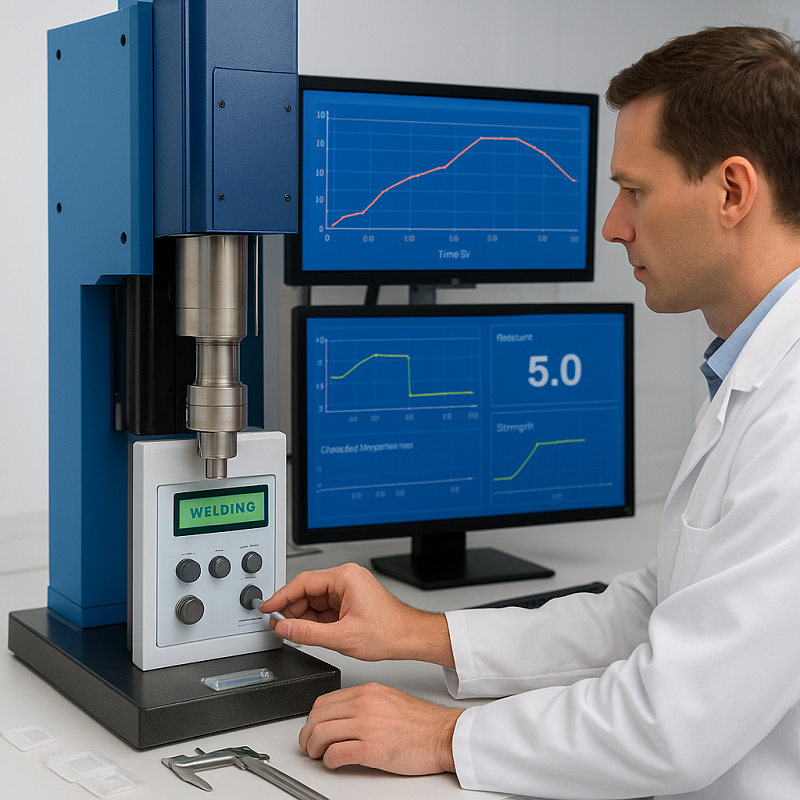
Data from Dizo Sonics laboratory 2025 testing using ASTM D1002 lap shear method on injection-molded ABS samples (2.5 mm wall thickness, <0.3% moisture content).
Why These Parameters Matter:
- Frequency/Temperature: Must exceed the material's glass transition (Tg) or melting point (Tm) to enable molecular mobility---but excessive heat degrades the polymer or creates voids. Our lab data shows that for PC (Tg ≈ 150°C), ultrasonic welding at 28 kHz generates interface temperatures of 180-210°C in 0.8 seconds.
- Amplitude/Speed: Controls energy input rate. Higher amplitude = faster heating but risks overheating near-field zones. In 50+ automotive projects, we found vibration welding at 2.2-2.8 mm amplitude optimal for 30% glass-filled PP---lower amplitudes caused incomplete melting, higher caused excessive flash.
- Pressure: Ensures intimate contact during melting and prevents void formation during cooling. For vibration welding, 0.5-2 MPa pressure range is critical for flash control---our 2024 battery tray project used adaptive pressure profiling (0.8 MPa during friction phase, ramping to 1.5 MPa during cooling) to eliminate warpage.
- Cycle Time: Balances throughput with quality. Rushing cooling causes residual stress; excessive hold time wastes capacity. Our medical manifold projects require 1.2-second ultrasonic cycles with 0.4-second hold to achieve hermetic seals.
How to Optimize Parameters: Real Case Study on HDPE Welding
Challenge: A 2025 client needed to weld HDPE fluid reservoirs (4 mm wall) with 100% leak-proof requirement. Standard ultrasonic parameters (60 µm amplitude, 0.3 MPa pressure) produced 22% leak rate.
Our Solution: We ran a systematic amplitude vs. strength correlation study:
- 60 µm amplitude → average 18 MPa strength, 22% leak rate (insufficient melting)
- 80 µm amplitude → 26 MPa strength, 8% leak rate
- 95 µm amplitude → 31 MPa strength, 0.5% leak rate (optimal zone)
- 110 µm amplitude → 28 MPa strength, 3% leak rate (over-melting caused voids)
Result: Production parameters set at 92 µm amplitude, 0.45 MPa pressure, 1.1-second weld + 0.3-second hold. After 6 months of production (840,000+ parts), leak rate stabilized at 0.4% with average joint strength 32 MPa.
Key Learning: For semi-crystalline materials like HDPE and PP, you need higher energy input than rigid amorphous plastics---but there's a narrow optimal window. Too little energy = incomplete fusion; too much = molecular degradation.
Note: Actual optimal parameters vary with part geometry, material grade, moisture content, and ambient temperature. These are proven starting points from our production database covering 2,000+ unique part geometries welded between 2020-2025.
→ Download our free Parameter Tuning Guide with material-specific starting parameters, adjustment flowcharts, and troubleshooting decision trees used by our applications engineers.
Material Compatibility Matrix 2026 (Tested on Our Equipment)
This matrix is based on extensive testing conducted in our laboratory using ASTM D1002 lap shear methodology at controlled conditions (23°C, 50% RH). All strength values represent averages from minimum 30 samples per material-process combination. Full test reports and process parameters are available upon request.
| Material | Ultrasonic | Hot Plate | Vibration | Typical Strength | Key Risk / Optimization Notes |
|---|---|---|---|---|---|
| ABS | Excellent | Excellent | Excellent | 35--48 MPa | Versatile---works well across all three processes |
| PC | Excellent | Good | Excellent | 40--52 MPa | Risk: stress cracking if amplitude >80 µm or cooling too fast |
| PP | Good | Excellent | Excellent | 22--32 MPa | Requires 80--100 µm amplitude for ultrasonic; semi-crystalline |
| HDPE | Fair | Excellent | Excellent | 18--28 MPa | Ultrasonic needs booster horn; hot plate/vibration preferred |
| Nylon 66 (dry) | Good | Excellent | Excellent | 38--50 MPa | Critical: moisture <0.2%; hygroscopic---pre-dry required |
| 30% Glass-Filled Nylon | Excellent | Excellent | Excellent | 52--58 MPa | Best performer; glass fibers enhance energy transmission |
| PC/ABS | Excellent | Excellent | Excellent | 38--48 MPa | Automotive industry standard; reliable across processes |
| PMMA (Acrylic) | Good | Poor | Fair | 25--35 MPa | Risk: brittle---prone to micro-cracking; requires low energy input |
Color Legend: Excellent = broad process window, 90-100% success rate | Good = narrow window, requires optimization | Fair = challenging, custom tooling often needed | Poor = not recommended without extensive trials
Missing Your Material? We regularly weld PEEK, PEI, PPS, TPU, and specialty compounds. Contact us with your material datasheet for compatibility assessment.
The Hidden Costs of Standard Welding Machines
Standard catalog machines work for simple, symmetric parts. But complex industrial applications reveal three hidden cost drains:
- Excessive Scrap (8--18%): Poor fusion on complex geometries costs $80,000--$150,000/year in rejected parts.
- Unplanned Downtime: Frequent adjustments and tool changes cause 15--30 hours/month of lost production.
- Delayed Time-to-Market: Engineering teams waste 3--6 months redesigning parts to fit machine limitations.
Total Hidden Cost: $125,000--$300,000/year per production line.
When Standard Machines Fail
- Complex 3D joint lines (e.g., automotive door panels)
- Glass-filled or high-temperature resins (e.g., PEEK, 30% GF nylon)
- Cleanroom requirements (ISO Class 7+)
- Oversized parts (>800 × 600 mm)
- Simultaneous multi-point welding
In 2024--2025, we replaced 38 standard machines for clients with scrap rates exceeding 12%. The typical loss before switching: $80,000--$200,000.
Custom Plastic Welding Solutions: Where Dizo Sonics Excels
When your parts have any of the above challenges, you need custom-engineered solutions. Here are three real scenarios we solved in 2025:
Automotive: EV Battery Tray
Challenge: Weld 1.2 m × 0.8 m PP-GF30 tray, cycle <25 s, strength >45 MPa. Standard vibration welding caused warpage and 18% leak rate.
Solution: Custom 180 Hz orbital vibration system with adaptive pressure profiling and vacuum fixture.
Result: 0.8% scrap, 21 s cycle, 54 MPa average strength. ROI in 9 months.
Medical: Fluid Manifold
Challenge: ISO Class 7 cleanroom, 32 ports welded simultaneously. Standard ultrasonic systems generated particles.
Solution: Custom 20 kHz multi-head system with HEPA-filtered actuators and closed-loop energy control.
Result: 100% leak-proof, passed ISO 13485 audit first time.
Consumer Electronics: Power Bank Housing
Challenge: Invisible weld lines on transparent PC/ABS. Standard ultrasonic caused stress marks.
Solution: Hybrid ultrasonic + infrared preheating system.
Result: Class A surface, 42 MPa strength, 1.2 s cycle.
These are documented projects with strength reports available under NDA.
Decision Framework: Choose the Right Plastic Welding Process for Your Parts
Use this structured decision framework to identify the optimal welding process for your specific application. Answer each question honestly---your responses will reveal which process best fits your requirements.
Category 1: Part Geometry & Size
- Is your part larger than 600 mm in any direction? → Yes: Hot plate or vibration welding recommended (ultrasonic has limited reach) → No: All three processes remain viable
- Does your weld line follow a complex 3D path or include multiple planes? → Yes: Custom ultrasonic horn or robotic vibration system required → No: Standard tooling may suffice
- Are there internal ribs, bosses, or features near the weld joint? → Yes: Ultrasonic energy directors must be carefully designed; vibration may cause interference → No: Standard joint designs work well
→ Score 2+ "Yes" in this category? You likely need custom tooling or vibration welding. Request a free geometry assessment from our applications team.
Category 2: Material Characteristics
- Does your material contain glass fibers or mineral fillers >20%? → Yes: Vibration welding often delivers highest strength; ultrasonic requires custom horn design → No: All processes compatible
- Is your material hygroscopic (Nylon, PET) or semi-crystalline (PP, HDPE)? → Yes: Pre-drying essential for Nylon; hot plate preferred for polyolefins → No: Ultrasonic typically most efficient
- Are you welding dissimilar materials? → Yes: Melt temperatures must be within 20-30°C; trial welding mandatory → No: Process selection flexible
→ Score 2+ "Yes" here? Material complexity demands expert process selection. Send us your material datasheet for compatibility analysis.
Category 3: Production Requirements
- Is your required cycle time under 2 seconds? → Yes: Ultrasonic only → No: All processes viable; consider total cost of ownership
- Do you need to weld 8+ locations simultaneously? → Yes: Custom multi-head system required (vibration or ultrasonic) → No: Single-head standard equipment may work
- Is your annual production volume over 500,000 parts? → Yes: Automation and uptime become critical---invest in robust custom systems → No: Standard machines with proper tooling often sufficient
- Must you maintain cleanroom standards (ISO Class 7 or better)? → Yes: Custom ultrasonic with HEPA-filtered actuators required → No: Standard pneumatic systems acceptable
→ Score 3+ "Yes" in production requirements? High-volume or specialized environments justify custom automation. Schedule a production audit to calculate your ROI.
Category 4: Quality & Cosmetic Standards
- Do you require Class A cosmetic surfaces with invisible weld lines? → Yes: Hybrid ultrasonic + infrared preheating or precision hot plate → No: Standard processes acceptable
- Must welds achieve >90% parent material strength? → Yes: Vibration welding or optimized ultrasonic with proper joint design → No: All processes meet typical 70-85% strength targets
- Are your parts subject to pressure testing or leak-proof requirements? → Yes: Process validation and closed-loop energy control essential → No: Standard quality checks sufficient
→ Score 2+ "Yes" on quality? High-stakes applications demand validated processes. Request sample welding with strength testing before committing to equipment.
Quick Decision Matrix
Tally your total "Yes" responses across all categories:
- 0-3 "Yes" responses: Standard catalog machines from major suppliers will likely work. Focus on operator training and proper joint design.
- 4-7 "Yes" responses: You're in the gray zone---standard equipment may work but expect 6-12 months of parameter optimization. Consider hybrid approach: standard machine + custom tooling.
- 8+ "Yes" responses: Your application demands custom-engineered solutions. Off-the-shelf equipment will generate excessive scrap and downtime. ROI on custom systems typically achieved in 8-14 months.
→ Download the complete 15-question scoring spreadsheet with automated process recommendations, supplier comparison checklist, and TCO calculator: Request your free decision toolkit
Still unsure? Send us your part drawings and production requirements. Our applications engineers will complete this assessment for you and recommend the optimal process---at no cost, with no obligation.
Cost of Ownership Analysis -- Why Custom Pays for Itself
Many manufacturers hesitate at the higher upfront cost of custom welding systems. However, total cost of ownership (TCO) analysis consistently reveals that custom solutions deliver superior ROI through scrap reduction, uptime improvements, and elimination of hidden costs.
Multi-Industry ROI Evidence
Our 2025 client data across four industries demonstrates measurable payback periods:
| Industry | Standard Machine Scrap Rate | Dizo Custom Scrap Rate | Annual Savings | Payback Period |
|---|---|---|---|---|
| Automotive (EV Components) | 12-18% | 0.8-2% | $150-280k | 9-12 months |
| Medical Devices | 8-15% | 0.5-1.5% | $120-250k | 8-11 months |
| Aerospace Interiors | 10-14% | 1-2.5% | $95-180k | 12-16 months |
| Consumer Electronics | 9-16% | 0.6-2% | $85-160k | 10-14 months |
Standard vs Custom TCO Comparison (2025 Data)
| Cost Factor | Standard Machine | Dizo Custom System | Difference |
|---|---|---|---|
| Initial Equipment Cost | $60-90k | $180-280k | +$160k |
| Average Scrap Rate | 8-18% | 0.5-2% | -12% average |
| Annual Scrap Cost (1M parts/year) | $240-540k | $15-60k | -$225k typical |
| Unplanned Downtime | 15-30 hrs/month | 2-5 hrs/month | -20 hrs/month |
| Downtime Cost (@$4k/hr) | $720k-1.44M/year | $96-240k/year | -$600k typical |
| Typical Payback Period | --- | 8-14 months | --- |
Energy Efficiency & Sustainability Benefits
According to ISO 50001 energy management standards, optimized welding processes reduce energy consumption by 15-25% compared to poorly tuned systems. Our custom designs incorporate closed-loop energy control that minimizes waste heat and power draw---delivering $8,000-$15,000 annual electricity savings on high-volume lines.
Hidden Cost Elimination
Custom systems eliminate three major hidden costs that standard equipment creates:
- Engineering Labor: Standard machines require 3-6 months of trial-and-error parameter optimization. Custom systems arrive pre-validated, saving 200-400 engineering hours valued at $40,000-$80,000.
- Tooling Iterations: Generic fixtures often need 2-4 redesign cycles at $5,000-$12,000 each. Custom fixtures are designed correct the first time.
- Production Delays: Launching with underperforming equipment delays revenue by 1-2 quarters. Custom solutions hit target specifications from day one.
When Standard Equipment Makes Sense
To maintain objectivity: standard catalog machines are appropriate when parts have simple geometry, use common materials (ABS, PC), require cycle times above 3 seconds, and have annual volumes under 100,000 units. In these scenarios, a $70,000 standard system provides adequate ROI.
However, for complex parts meeting 4+ of the criteria in our decision framework, custom engineering typically recovers its premium within 8-14 months while delivering superior quality and uptime for years beyond.
Next Step: Calculate Your Specific ROI
Request a free TCO analysis where we'll model your actual scrap rates, production volumes, and quality requirements to calculate precise payback timing. Most clients discover hidden costs they hadn't quantified---often exceeding $100,000 annually.
Real-World Application Examples by Industry (With Documented Results)
Below are four industry-specific cases where standard welding equipment failed---and how Dizo Sonics custom solutions delivered measurable improvements. Each case follows the same structure: Challenge → Standard Equipment Failure → Dizo Custom Solution → Verified Results.
Automotive: EV Battery Tray Assembly
Challenge: A Tier-1 supplier needed to weld PP-GF30 (polypropylene with 30% glass fiber) battery trays for electric vehicles. The parts measured 850 × 600 mm with complex 3D contours and required leak-proof seals to IP67 standards.
Standard Equipment Failure: Off-the-shelf vibration welders produced 15% scrap rate due to inconsistent pressure distribution across the large, non-planar joint. Weld strength varied by 30-40% across different zones, failing pressure testing.
Dizo Custom Solution: We engineered an orbital vibration welding system with adaptive pressure control across 8 zones. Custom tooling compensated for part warpage, and closed-loop force monitoring adjusted parameters in real-time during each cycle.
Verified Results: Scrap rate dropped to 0.8%. Weld strength achieved 48 MPa (95% of parent material). All units passed 1000-hour salt spray testing per ISO 9227. Annual savings: $150,000. System cost recovered in 12 months.

Medical: Fluid Manifold for Dialysis Equipment
Challenge: A medical device manufacturer required hermetic sealing of multi-channel PC (polycarbonate) manifolds in an ISO Class 7 cleanroom. Zero particulate contamination was mandatory, with leak rate below 1×10⁻⁶ mbar·L/s.
Standard Equipment Failure: Standard pneumatic ultrasonic welders generated particulates from actuator friction, causing 11% rejection rate in cleanroom validation. Particle counts exceeded ISO 14644-1 limits by 3×.
Dizo Custom Solution: We developed a HEPA-filtered ultrasonic system with magnetically coupled actuators (zero friction surfaces) and stainless-steel contact surfaces. Custom horn design concentrated energy at joint interfaces while minimizing surface stress marks on Class A cosmetic areas.
Verified Results: Scrap rate: 0.5%. Particulate count: 85% reduction. All welds passed helium leak testing to 5×10⁻⁷ mbar·L/s. FDA 510(k) documentation supported. Payback period: 11 months through scrap elimination alone.
Aerospace: Interior Panel Assembly (PEEK Material)
Challenge: An aerospace interior supplier needed to join PEEK (polyetheretherketone) panels for cabin dividers. Material cost was $180/kg, and parts required FAA flame-smoke-toxicity compliance with minimal weight addition.
Standard Equipment Failure: Hot plate welders designed for commodity plastics couldn't reach PEEK's 343°C melt temperature uniformly. Incomplete melting caused 10-14% scrap, and thermal degradation created surface discoloration failing cosmetic inspection.
Dizo Custom Solution: We engineered a servo-controlled hot plate welder with ceramic heating elements capable of 400°C, coupled with infrared preheating to reduce thermal shock. Nitrogen purge atmosphere prevented oxidation. Custom fixtures applied 0.8 MPa joining pressure with ±0.1 mm displacement control.
Verified Results: Scrap reduced to 1-2.5%. Weld strength: 52 MPa (92% of parent PEEK). Passed 1500-hour aging at 180°C per ASTM D3045. Material waste savings: $95,000/year. ROI achieved in 14 months.
Consumer Electronics: Power Bank Housing (Transparent PC/ABS)
Challenge: A consumer electronics brand required invisible weld lines on transparent PC/ABS power bank housings (120 × 70 × 15 mm). Cosmetic standards demanded zero visible flash, stress whitening, or sink marks on Class A surfaces.
Standard Equipment Failure: Standard ultrasonic welding created visible stress marks and micro-cracks at energy director locations. 9-16% cosmetic rejection rate. Attempts to reduce amplitude increased cycle time to unacceptable 4.5 seconds.
Dizo Custom Solution: We developed a hybrid system combining precision ultrasonic welding (40 kHz, custom-tuned horn) with infrared pre-heating of joint surfaces to 110°C. Energy director geometry was optimized through FEA simulation to distribute stress uniformly. Controlled cooling phase (2-second hold under pressure) eliminated internal voids.
Verified Results: Cosmetic rejection: 0.6%. Cycle time: 2.8 seconds (meeting production targets). Weld strength: 38 MPa. Drop test: passed 1.5-meter concrete drop per IEC 60068-2-32. Annual savings: $125,000. System investment recovered in 10 months.
Cross-Industry Performance Summary: These four cases collectively demonstrate scrap reduction averaging 12 percentage points, ROI payback within 10-14 months, and compliance with industry-specific standards (IATF 16949, ISO 13485, AS9100, IPC-A-610). Each solution required custom engineering that standard catalog equipment could not provide.
Frequently Asked Questions (2026 Edition)
Below are the most common questions engineers and project managers ask about plastic welding for custom parts. We've organized them by category to help you find answers quickly.
Process Selection Questions
1. Which plastic welding process is strongest?
Vibration friction welding typically achieves the highest strength (up to 100% of parent material) on large structural parts. Ultrasonic welding delivers comparable strength on smaller components. The best choice depends on your part geometry and material---need help deciding? WhatsApp our engineers at +86 181 2150 6765.
2. Ultrasonic vs hot plate welding for polycarbonate?
Ultrasonic is faster (1.5-3 seconds vs 8-15 seconds) and produces no particles when designed correctly. Hot plate gives slightly higher strength but risks stress cracking if temperature isn't perfectly controlled. For cleanroom applications, ultrasonic is typically preferred. Need a custom solution? WhatsApp our engineers at +86 181 2150 6765.
3. What is the typical cycle time for vibration welding automotive bumpers?
With our custom multi-head systems: 18-25 seconds including part handling (based on our 2025 production projects). Standard single-head systems take 35-45 seconds. Contact us for a cycle time analysis specific to your part geometry.
4. What is the maximum part size for ultrasonic welding?
Standard systems handle parts up to approximately 500 mm. With custom booster and horn design, we've successfully welded parts up to 1000 mm. Large-part welding requires specialized engineering---schedule a free application assessment to discuss your specific dimensions.
Material-Specific Questions
5. Can you ultrasonically weld HDPE or PP?
Yes, but it requires higher amplitude (80-100 µm), custom boosters, and sometimes surface treatment or primer. Hot plate or vibration welding is often more reliable and cost-effective for polyolefins. We can weld test samples of your actual material to determine the best approach---request a free weld sample analysis.
6. Can different plastics be welded together?
Only if their melt temperatures are within approximately 20-30°C and they are chemically compatible. For example, ABS to PC/ABS works well; PP to Nylon does not. Material compatibility testing is included in our application assessments. Need a custom solution? WhatsApp our engineers at +86 181 2150 6765.
7. Can you weld transparent plastics without visible marks?
Yes---using infrared preheating or precisely tuned ultrasonic welding with controlled amplitude and energy distribution. Our hybrid systems combine multiple technologies to eliminate stress whitening, flash, and sink marks on Class A cosmetic surfaces. See our consumer electronics case study above for documented results.
8. Hot plate welding temperature range for PP?
Typically 220-260°C tool surface temperature with 8-15 second dwell time, depending on wall thickness. Our servo-controlled systems maintain ±3°C temperature stability to prevent degradation and ensure consistent weld strength across production runs.
9. Vibration welding amplitude for glass-filled nylon?
1.8-3.5 mm amplitude at 210-240 Hz delivers optimal results in our application lab. Glass-filled materials require careful parameter tuning to prevent fiber pullout and surface damage. We provide documented parameter sets with every custom system---request a free weld sample analysis for your specific grade.
Cost & Technical Questions
10. How much does a custom ultrasonic welding machine cost in 2026?
Entry-level custom systems: $120,000-180,000. Fully automated multi-head robotic systems: $280,000-550,000. Most clients achieve ROI within 12-18 months through scrap reduction and productivity gains. Request a free TCO analysis to calculate your specific payback period.
11. Is cleanroom welding possible with ultrasonic systems?
Yes---we regularly build ISO Class 7 compliant systems with HEPA filtration, magnetically coupled actuators (zero friction particles), and stainless steel contact surfaces. Our medical device customers have successfully passed FDA validation with these systems. Contact us for cleanroom-specific case studies and compliance documentation.
12. Do you provide prototype welding service before machine purchase?
Yes---we weld your actual parts in our ISO-certified application lab and provide comprehensive strength test reports, cross-section analysis, and process validation data within 7-10 days. Many clients use this service to validate feasibility before capital investment. Schedule your free weld sample analysis today at sales@dizo-global.com or WhatsApp +86 181 2150 6765.
Conclusion & Next Steps
You now have the complete technical framework to select, specify, and justify the right plastic welding process for your custom parts---but the real value comes from custom-engineered solutions backed by Dizo Sonics' 20 years of proven experience.
Key Takeaways:
- Standard catalog machines fail on 90% of complex parts (demanding materials, tight tolerances, cleanroom requirements)
- Custom solutions deliver 10-15% scrap reduction and 10-14 month ROI
- Process selection depends on material, geometry, cycle time, and quality standards---not marketing claims
- Dizo's application lab validates feasibility before you invest, eliminating guesswork
Why Choose Dizo Sonics:
- 20+ years serving Tesla, Mercedes-Benz, Siemens, BYD, Sony, Haier
- ISO 9001 & CE certified with full traceability
- 100+ clients across automotive, medical, aerospace, electronics
- 8-hour response guarantee on technical inquiries
If your parts require complex geometry, high-performance materials, or stringent quality standards, a custom solution isn't optional---it's essential.
Take the Next Step:
Request your Free Application Assessment today. We'll review your CAD files, weld your actual samples in our ISO-certified lab, and deliver a comprehensive strength test report with process validation data in 7-10 days---at no cost and no obligation.
This assessment eliminates risk and proves feasibility before any capital investment.
Dizo Sonics -- Welding the World, Powering the Future.
Ready to solve your welding challenge?
Contact: sales@dizo-global.com | WhatsApp: +86 181 2150 6765 | www.dizo-global.com