



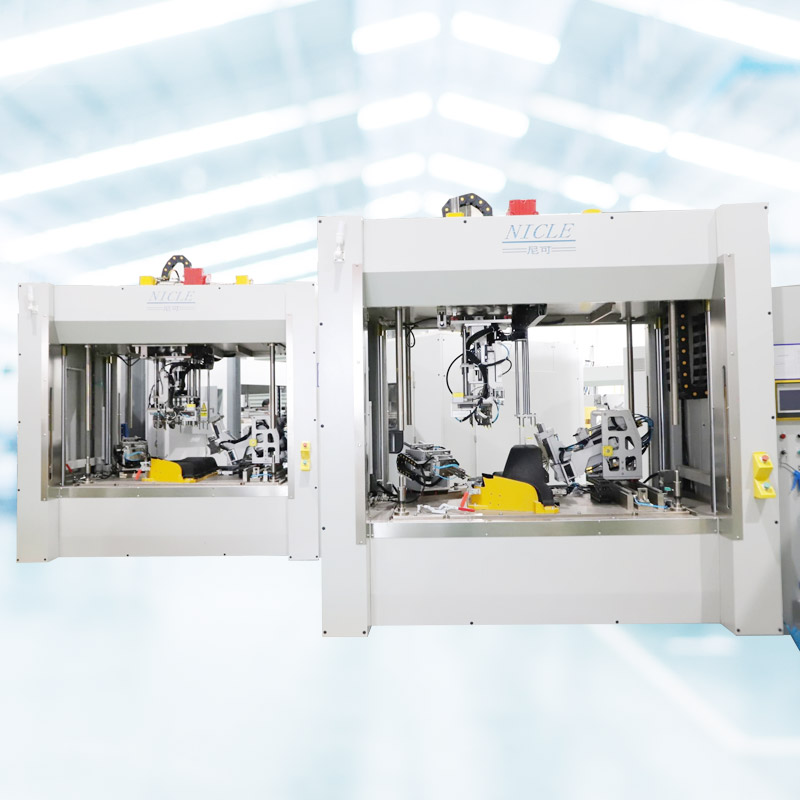
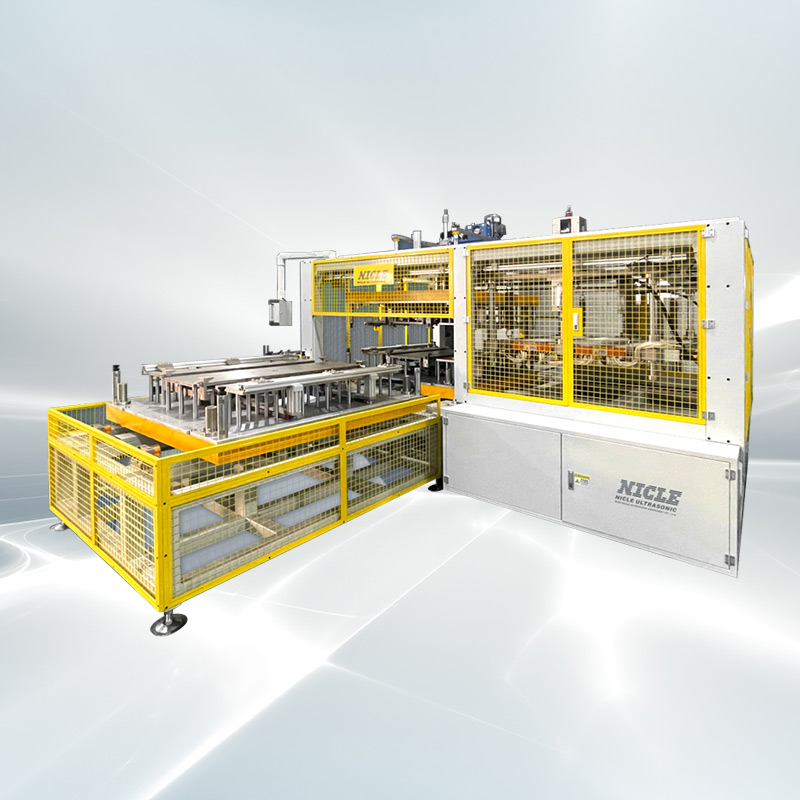
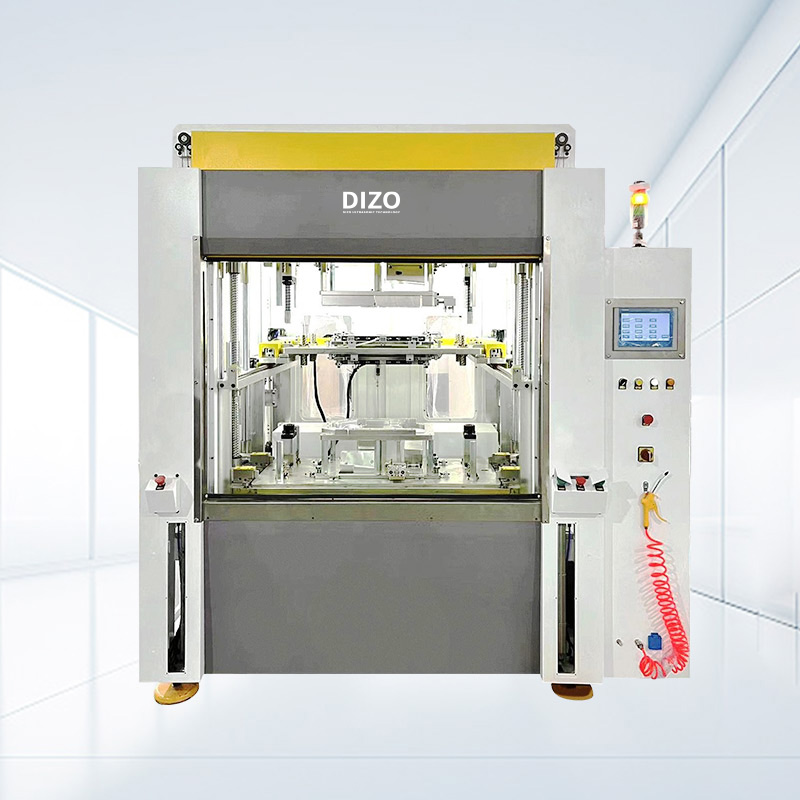
Custom Auto Interior Automatic Ultrasonic Welding Machine
● Integrated Monolithic Architecture:
Automatic ultrasonic welding machine featuring single-frame construction with vibration-isolated components reduces maintenance intervals by 40% while achieving >98% uptime in 24/7 production environments.
● Multi-Position Welding Units:
Each welding head features 360° adjustable positioning with mechanical buffer stops, enabling material-specific parameter optimization (20+ preset recipes) for ABS, PC, and composite thermoplastics.
● Precision Angular Control:
Micrometer-grade adjustment (±0.25°) with real-time force feedback ensures perfect energy coupling across complex 3D contours (tested to 50N/mm² weld strength).
● Smart Vision-Guided Alignment:
High-speed CMOS sensors (0.1mm resolution) detect workpiece deviations within 15ms, triggering both HMI alerts and automatic production pauses to prevent non-conforming welds.
● Adaptive Process Optimization:
AI-driven power modulation maintains ±2% amplitude stability at 20-40kHz, delivering 30% faster cycle times versus conventional welders without compromising IP67-rated seal integrity.
Request Your Free Welding Test & Proposal- Description |
- Advantages |
- Technology |
- Appilications |
- Customer Reviews/ Related Products
What Is an Automatic Ultrasonic Plastic Welding Machine?
Dizo’s automatic ultrasonic plastic welding machines utilize high-frequency vibrations (20-40kHz) to create precise, durable bonds between thermoplastic components through localized frictional heating. This advanced process transmits ultrasonic energy via a welding horn to melt and fuse materials at the contact point without bulk heating, eliminating common thermal deformation and discoloration issues while achieving rapid cycle times as short as 0.5 seconds. Unlike traditional welding methods, this non-contact technique ensures consistent weld quality with minimal energy consumption, making it ideal for high-volume production environments.
In automotive manufacturing, these machines excel at joining critical components that demand both structural integrity and aesthetic perfection. They are extensively used for dashboard assemblies requiring vibration-resistant bonds (tested to 100,000+ cycles), exterior components like bumpers and lighting systems needing seamless Class-A finishes, and functional parts including window motors and ADAS sensor mounts. The technology's precision and repeatability make it particularly valuable for EV battery housings and HVAC fluid systems where leak-proof seals are essential. Beyond technical performance, ultrasonic welding supports sustainable manufacturing initiatives through 30-40% energy savings versus thermal methods and completely eliminates VOC emissions or consumable waste.
These systems combine operational efficiency with robust quality control. Real-time weld verification and adaptive controls with ±2% amplitude stability ensure compliance with IATF 16949 and SAE J1488 standards. Ultrasonic welding reduces waste and rework, lowering costs while improving quality - enhancing competitiveness in the automotive market. The process's small carbon footprint and 100% recyclable joints support the industry's green manufacturing initiatives.
Request Industry-Specific Case StudiesWhy Choose Dizo Custom Machine

Custom Solutions
Tailored solutions customized to your specific needs, backed by a team of 21 engineers ready to assist you anytime.

Save Your Time
Full project oversight — from initial requirements to final delivery — ensuring maximum efficiency and time savings.

Guaranteed Quality Assurance
Compliance with ISO standards ensures consistent and reliable quality throughout the process.

Professional Service Team
Our professional 20-member service team ensures seamless plastic welding machine installation and complete customer satisfaction.
Get Transparent Pricing & Custom Solutions for Your Production Needs
Every automated welding system we build delivers rapid ROI through three core advantages: ✓ Precision Engineering (±0.1mm repeatability ensuring consistent weld quality across all production runs), ✓ Customized Integration (tailored tooling, automation interfaces, and material-specific parameters), and ✓ Production-Ready Performance (cycle times 80% faster than manual welding processes)
"24/7 Technical Support | Price Match Guarantee | Onsite Installation | ISO 9001 Certified"
Request Your Custom Quote
Automatic Ultrasonic Plastic Welding Techniques in the Automotive Industry
The automotive industry has increasingly adopted automatic ultrasonic welding as a preferred joining method for thermoplastic components due to its precision, efficiency, and material versatility. This advanced technique utilizes high-frequency vibrations (typically 20-40kHz) to create molecular-level bonds through localized frictional heating, achieving cycle times as fast as 0.3 seconds while maintaining consistent weld quality. Unlike traditional thermal welding, the non-contact process eliminates thermal distortion and pigment degradation, making it ideal for sensitive applications like lighting assemblies and electronic housings. Modern systems incorporate adaptive control algorithms that automatically adjust amplitude and energy output based on real-time sensor feedback, ensuring compliance with stringent automotive standards such as IATF 16949 and SAE J1488 vibration testing protocols.
From structural components to aesthetic finishes, ultrasonic welding delivers unmatched performance across critical automotive applications. The technology produces vibration-resistant bonds for dashboard assemblies (withstanding 100,000+ fatigue cycles), leak-proof seals for EV battery housings, and Class-A surface finishes for exterior trim components. Its ability to join dissimilar materials (e.g., ABS to PC) enables lightweight designs while reducing component count by up to 30%. As the industry shifts toward sustainable manufacturing, ultrasonic welding's eco-friendly advantages - including 40% lower energy consumption versus hot plate welding and zero VOC emissions - have made it indispensable for next-generation vehicle production.
The integration of Industry 4.0 capabilities has further enhanced ultrasonic welding's value proposition in automotive manufacturing. Smart systems now feature IoT-enabled monitoring with predictive maintenance alerts, while AI-driven quality control detects microscopic defects using high-resolution CMOS sensors (0.05mm accuracy). These advancements, combined with the technology's inherent speed and reliability, position ultrasonic welding as a cornerstone process for electric vehicle architectures and autonomous driving systems requiring millimeter-perfect component alignment and long-term durability under extreme operating conditions.
Schedule a Technical Consultation + Free Application Analysis
Other Automatic Ultrasonic Plastic Welding Applications
Аutomatic ultrasonic welding has become indispensable across industries requiring high-precision, clean, and efficient thermoplastic joining.

Medical Device Industry
This technology creates ISO 13485-compliant hermetic seals in medical devices including IV sets, instruments, and diagnostic equipment. Precision welds withstand sterilization while remaining particulate-free, ensuring biocompatibility with human tissue—critical for implantable and patient-contact devices.

Consumer Electronics Industry
The electronics industry relies on ultrasonic welding for smartphone housings, wearables, and circuit board components, where its ability to join delicate parts without thermal damage (maintaining tolerances within ±0.1mm) aligns with miniaturization trends.

Packaging Manufacturing Industry
Packaging manufacturers use this technology for tamper-evident closures and sterile barriers (25N/15mm+ seal strength, 200+ cycles/minute). It maintains package integrity during distribution while meeting FDA and ISO 11607 requirements, with precise controls ensuring quality across different materials and conditions.

Home Appliance Industry
In appliance industry, it assembles dishwasher components, water tanks, and control panels with IP67-rated waterproof seals that withstand repeated washing cycles and temperature fluctuations. The rapid cycle times and consistent joint quality support high-volume production in manufacturing facilities.n.

New Energy Industry
In renewable energy, the technology creates low-resistance bonds in battery tabs lasting 1,000+ charge cycles, improving performance. It also forms ventilation channels in solar panel frames without degradation, enhancing thermal management and extending operational lifespan.on.
Tips For Why Choosing Automatic Welding Machine for Automotive Plastic Components
Here are some key tips to help you choose automatic welding machine for automotive plastic components. It's important to consider factors beyond just the price.
What is an auto plastic components welding machine?
An auto plastic components welding machine is specialized equipment designed for joining plastic parts in automotive manufacturing. These machines use various welding technologies—including ultrasonic, hot plate, vibration, laser, and infrared—to create strong, precise bonds between thermoplastic components. Modern automotive plastic welding systems feature automated controls that precisely manage temperature, pressure, and weld time to ensure consistent quality in high-volume production.
These machines are designed specifically for automotive-grade plastics like polypropylene, ABS, polyamide, and polycarbonate. They include advanced features such as programmable weld profiles, quality monitoring systems, and quick-change fixtures to handle different component designs. Automotive plastic welding equipment must meet strict industry standards for weld strength, appearance, and reliability, as these components often serve critical structural and aesthetic functions in vehicles.
+
How can I determine which custom auto body plastic welder is suitable for my project?
To select the right custom auto body plastic welder, assess these key factors. First, identify your specific automotive plastics (PP, ABS, PC, etc.), as each requires different welding technologies and temperature settings. Then, evaluate the size and complexity of your components to determine the necessary working area and fixture capabilities.
Consider your production volume needs—high-volume operations benefit from automated systems with faster cycle times, while lower volumes may be better served by more economical semi-automatic options. Pay attention to welding precision requirements; automotive components demand both aesthetic quality and structural integrity, so look for machines with advanced parameter controls and monitoring features.
Balance initial budget constraints with long-term operational costs. Premium machines may cost more upfront but often provide better consistency, fewer rejects, and lower maintenance expenses over time. For optimal results, consult with experienced welding equipment suppliers who understand automotive industry requirements and can help identify the best solution for your specific application.
+
What is meant by plastic welding robots?
Plastic welding robots are automated systems that use robotic arms with welding technology to join thermoplastic components. These sophisticated machines combine precision robotics with various welding methods (ultrasonic, infrared, or laser) to create consistent, high-quality bonds in plastic assemblies.
In automotive manufacturing, these robots enhance production efficiency by operating continuously with minimal human intervention while maintaining precise control over welding parameters such as temperature, pressure, and timing. They can be programmed to follow complex paths and create welds in geometries that would be difficult to achieve manually, ensuring uniform results even on three-dimensional parts.
Modern plastic welding robots typically integrate with manufacturing execution systems (MES) and include vision systems for quality verification. This makes them valuable assets in Industry 4.0 smart factories, where they contribute to higher throughput, reduced labor costs, and improved product consistency.
+
Is plastic welding the best option for automotive plastic components?
Plastic welding stands as one of the best options for automotive plastic components due to several significant advantages. It creates strong molecular bonds that withstand vibration and impact—crucial for vehicle safety and durability. The process offers exceptional efficiency with rapid cycle times (often just seconds per join), meeting the high-volume production demands of the automotive industry. Additionally, it's environmentally friendly, requiring no adhesives or solvents while producing minimal waste.
This technology offers remarkable versatility, accommodating various thermoplastics common in automotive applications (PP, ABS, PA, PC) and handling complex three-dimensional geometries. Modern welding systems ensure excellent quality control through precise parameter management and monitoring capabilities.
When compared to alternatives like adhesive bonding or mechanical fastening, plastic welding delivers superior strength-to-weight ratios, better aesthetics (with minimal or hidden join lines), and lower per-unit costs at scale. These advantages have made plastic welding the preferred joining method for numerous automotive components, including instrument panels, fluid reservoirs, lighting assemblies, and interior trim elements.
+
Advantages of automatic plastic welding machine
Automatic plastic welding machines offer significant advantages for manufacturing operations. They provide exceptional consistency through precise computerized control of welding parameters, eliminating human variability and ensuring uniform joint quality. This leads to dramatically reduced rejection rates and improved product reliability. With high production speeds—often completing welds in seconds—these machines substantially increase throughput compared to manual processes.
These systems reduce labor costs by minimizing operator involvement while improving workplace safety by limiting exposure to hot surfaces and repetitive motion injuries. They also deliver superior resource efficiency by optimizing energy usage and reducing material waste during the welding process.
Modern automatic welders feature comprehensive data logging capabilities for quality assurance and traceability, crucial for meeting automotive manufacturing standards. Their programmability enables quick changeovers between different components, supporting flexible manufacturing environments. Though requiring higher initial investment than manual alternatives, automatic welding machines typically deliver excellent ROI through improved quality, efficiency, and reduced labor costs throughout their operational lifetime.
+
What types of automatic plastic welding machines are available?
Automotive manufacturing employs several types of automatic plastic welding machines. Ultrasonic welding machines generate friction heat through high-frequency vibrations, making them ideal for small to medium parts requiring precise, clean welds. Hot plate welders use heated plates to melt plastic surfaces, perfect for larger components that need strong hermetic seals.
Vibration welding machines create friction through linear or orbital movement, suitable for large, complex geometries. Laser welding systems deliver precise, non-contact joining of compatible plastics with minimal material disturbance. Infrared welders use radiant heat to create contaminant-free joints.
Spin welders generate friction heat by rotating one part against another, making them excellent for cylindrical assemblies. Each technology offers specific advantages for different component sizes, materials, and production requirements. Modern systems typically include programmable controls, quick-change tooling, and integrated quality monitoring.
+
What safety precautions are needed for automatic plastic welding machines?
Operating automatic plastic welding machines requires comprehensive safety precautions. Operators must receive thorough training on machine operation, emergency procedures, and potential hazards. Physical safeguards are essential—including machine guards, light curtains, pressure-sensitive mats, and two-hand controls—to prevent access to moving parts during operation. Thermal protection is critical, with insulated surfaces and warning labels around hot elements to prevent burns.
Appropriate Personal Protective Equipment (PPE) is mandatory, including heat-resistant gloves, safety glasses to protect against plastic particulates, and hearing protection for noise-generating processes like ultrasonic welding. Proper ventilation systems must remove potentially harmful fumes generated during welding.
Electrical safety measures include proper grounding, insulated wiring, regular electrical inspections, and GFCI protection. Emergency protocols must be clearly established, with easily accessible emergency stop buttons and regular safety drills. All machines should undergo scheduled maintenance according to manufacturer specifications to prevent mechanical failures that could cause accidents.
+
Customer Reviews
Related Products




Ready to Transform Your Plastic Welding Process?
Get Expert Guidance, Custom Solutions, and Competitive Pricing - All in One Place
-

Free Application Analysis
Not sure which technology fits your needs?
"Get a professional assessment of your materials, joint design, and production requirements." -

Expert Solution Consultation
Need technical guidance?
"Schedule a one-on-one consultation with our senior welding engineers." -

Custom Quotation
Ready for precise pricing?
"Receive a detailed proposal with specifications and delivery timeline."
Free Technical Consultation & Application Analysis
Leave Your Inquiry - Customized solutions for your specific applications
- Email: sales@dizo-global.com
- Whatsapp: +86 18121506765