

Automotive Plastic Fuel Tank Design: HDPE Materials & Advanced Welding Guide

The Complete Guide to Automotive Plastic Fuel Tanks: Design, Materials & Advanced Welding
For automotive engineers and designers, the fuel tank is no longer just a passive container. It\'s a critical component in the race for efficiency, safety, and performance. The central challenge? Achieving significant weight reduction for better fuel economy and EV range, without compromising on crash safety or exceeding stringent evaporative emission standards. This is where modern plastic fuel tanks, primarily made from High-Density Polyethylene (HDPE), have become the industry standard.
Yet, the material choice is only half the story. The true determinant of a plastic fuel tank\'s reliability---its ability to withstand crashes, internal pressure, and decades of fuel exposure---lies in the quality of its seams. As Jensen from Dizo Sonics, with over two decades of expertise in precision plastic joining, I've seen how advanced welding technology transforms HDPE from a good material into a great solution. This guide provides a clear, actionable roadmap, from material science and direct comparisons to a practical selection framework and real-world solutions for your most complex design challenges.
1. Why Plastic? The Evolution of the Automotive Fuel Tank
The automotive fuel tank has undergone a quiet revolution. From heavy, rust-prone steel to today\'s sophisticated, blow-molded plastic systems, the drive has been toward integration, efficiency, and safety.
The Rise of HDPE and Blow Molding
Modern automotive plastic fuel tanks are almost exclusively made from High-Density Polyethylene (HDPE). This thermoplastic polymer offers a unique combination of properties essential for fuel containment: excellent chemical resistance to gasoline and diesel, high impact strength (fracture toughness), and good low-temperature performance.
The manufacturing process of choice is blow molding. This technique allows for the creation of complex, three-dimensional shapes that can be molded around chassis components, maximizing vehicle space and fuel capacity. A typical passenger vehicle fuel tank holds between 45 and 75 liters, with wall thicknesses strategically varied from 3mm to 6mm during molding to balance weight and structural needs. Compared to equivalent steel tanks, HDPE tanks can be up to 30% lighter, directly contributing to improved fuel efficiency and lower CO2 emissions.
The Critical Role of Welding in Plastic Tank Assembly
While blow molding creates the main tank body, no tank is a single piece. It requires the integration of multiple components: sending units, rollover valves, brackets, and often complex internal baffles to prevent fuel slosh. These are attached via welding, creating permanent, molecular-level bonds.
This is where many designs succeed or fail. A poorly welded seam is a liability---a potential point for fuel leaks, permeation, or catastrophic failure in a crash. Advanced welding processes like ultrasonic welding and hot plate welding are therefore not merely assembly steps; they are foundational to the tank\'s integrity, safety, and long-term durability.
2. The Science of Strength: How Welding Ensures Fuel Tank Integrity
Understanding why welding works is key to specifying it correctly. For HDPE, it\'s all about harnessing its molecular structure.
Molecular Interlocking: The Basis of a Strong Weld
HDPE consists of long, linear polymer chains packed closely together. When you heat the material at the joint interface to its melting point (typically 130-150°C for HDPE), these chains gain mobility. Applying precise pressure forces the molten polymer from both sides to mix. As the joint cools and solidifies, the chains from each part interdiffuse and re-crystallize together, creating a bond that can approach the strength of the parent material itself.
This process, when controlled precisely, results in a homogeneous, leak-free seam that is resistant to fuel, chemicals, and mechanical stress. It\'s a stark contrast to mechanical fastening or adhesives, which create stress concentrations and can degrade over time.
Key Welding Processes for Fuel Tank Manufacturing
Several specialized welding methods are employed, each suited to different part geometries and production requirements:
- Ultrasonic Welding: This high-speed process uses high-frequency (typically 20, 30, or 35 kHz) mechanical vibrations. The vibrations create friction at the joint interface, generating heat and melting the plastic. It\'s ideal for welding small to medium-sized components like fittings, valves, and sensor mounts directly onto the tank shell. Cycle times are often under 3 seconds.
- Hot Plate (or Hot Tool) Welding: For large, planar seams---such as joining two tank halves or attaching large internal baffles---hot plate welding is the standard. A heated platen melts the joining surfaces, which are then pressed together. It offers excellent strength and sealing capability for long, continuous welds.
- Vibration Welding: Similar in principle to ultrasonic but on a larger scale, vibration welding uses linear or circular friction to generate heat. It is excellent for welding larger parts with complex contours where hot plate access is difficult.
The Bottom Line: The selection isn\'t arbitrary. It\'s a calculated decision based on joint design, production volume, and required strength, guided by standards like ISO 527 for tensile testing and SAE J2260 for non-integral fuel tank requirements.
3. Plastic vs. Metal Fuel Tanks: A Data-Driven Comparison
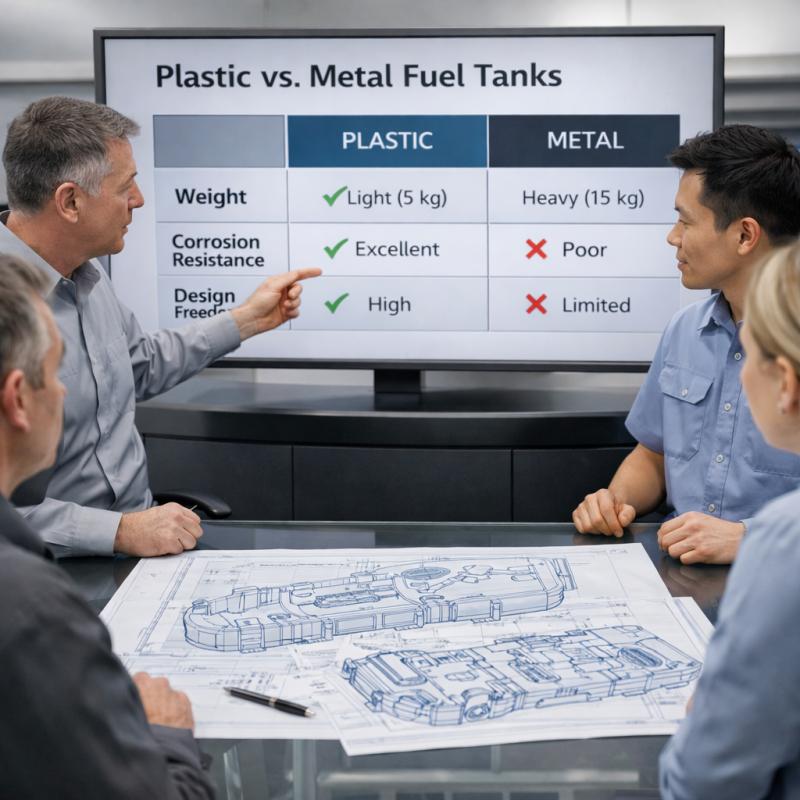
The choice between plastic (HDPE) and traditional metal (steel or aluminum) tanks is fundamental. The following comparison, based on industry data and lifecycle performance, highlights why plastic has become dominant for passenger vehicles.
| Feature | Plastic (HDPE) Fuel Tank | Metal (Steel/Aluminum) Fuel Tank | Key Implication for Design |
|---|---|---|---|
| Weight | Significantly Lighter (Up to 30% saving) | Heavier | Plastic directly boosts fuel economy and EV range. |
| Corrosion Resistance | Excellent - Inert to fuel and road salts. | Poor (Steel) / Good (Aluminum) | Eliminates a major failure mode, reducing warranty claims. |
| Design Freedom | Very High - Complex 3D shapes via blow molding. | Limited - Formed from stamped/welded sheets. | Enables optimal packaging in tight chassis spaces. |
| Manufacturing Cost | Lower tooling cost for mid-volume; efficient for complex shapes. | High tooling/stamping costs; simpler shapes are cheaper at very high volumes. | Plastic favors the flexible, platform-based models of modern automakers. |
| Impact/Crash Safety | Good - Ductile; can deform and absorb energy without brittle fracture. | Very High (strength), but can be prone to brittle tearing if compromised. | Both can meet FMVSS 301 crash integrity standards when well-designed. |
| Fuel Permeation | Low with single-layer HDPE; Ultra-Low with multi-layer (e.g., HDPE/EVOH/HDPE) construction. | Negligible - Metal is a perfect barrier. | Multi-layer plastic tanks meet the strictest SULEV/PZEV emission standards. |
| Repairability | Generally not repairable; replaced as a module. | Can often be repaired by welding. | Impacts service strategy and total cost of ownership. |
Decision Checklist: Is Plastic the Right Choice for Your Application?
Answer these questions to guide your material selection:
- Is weight reduction a top priority for efficiency/range? → Lean toward HDPE.
- Does the tank need to fit an irregular, space-constrained area? → HDPE's blow-molding flexibility is ideal.
- Are you targeting the strictest evaporative emission standards (e.g., for PHEVs/EVs)? → A multi-layer HDPE tank with barrier layers is required.
- Is the application for heavy-duty or military use with extreme puncture/ballistic requirements? → Steel may still be necessary.
- What is your annual production volume and expected model lifecycle? → HDPE blow molding scales efficiently for typical automotive volumes.
4. A Practical Framework for Fuel Tank Design & Process Selection
Moving from concept to a reliable, cost-effective fuel tank requires a structured approach. This framework ensures all critical factors are considered, with welding positioned as a core design parameter, not an afterthought.
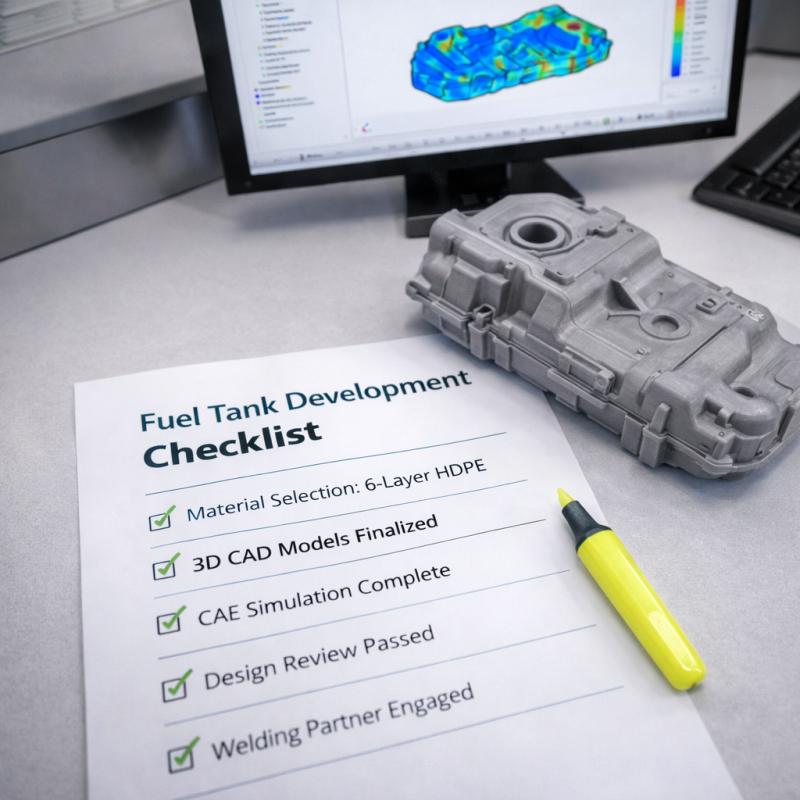
Step-by-Step Fuel Tank Development Checklist
Phase 1: Define Requirements & Constraints
- Functional Specs: Fuel capacity, required range, operating pressure, fluid type (gasoline, diesel, ethanol blends).
- Packaging: Obtain accurate 3D space constraints from the vehicle chassis team.
- Regulatory Compliance: List all applicable standards (FMVSS 301, EPA/CARB evaporative emissions, ECE R34).
Phase 2: Material & Construction Design
- Material Selection: Choose single-layer HDPE for cost, or 6-layer co-extrusion (e.g., HDPE/Regrind/Adhesive/EVOH/Adhesive/HDPE) for ultra-low permeation.
- Wall Thickness & Ribbing: Use CAE simulation (like Altair HyperWorks or Abaqus) to optimize thickness distribution for weight and crash performance.
- Joint & Fixture Design: Design weld joints with proper energy directors (for ultrasonic) or shear/melt zones (for hot plate). Involve your welding partner early in this phase.
Phase 3: Manufacturing & Joining Process Strategy
- Primary Welding Process Selection:
- Ultrasonic: Best for small, numerous components (valves, vents, mounts). Prioritize for automation.
- Hot Plate: Best for large, structural seams (tank halves, major baffles).
- Vibration: Best for large, non-planar parts where hot plate access is limited.
- Production Analysis: Forecast volume, calculate takt time, and plan for in-line leak testing (e.g., pressure decay or helium sniffing).
- Supply Chain: Decide on make-vs-buy for the welded sub-assembly.
5. Solving Real-World Challenges with Advanced Welding Solutions
Standard welding equipment works for conventional designs. However, the push for electric vehicles, stricter emissions, and more complex vehicle architectures presents new challenges that demand customized, advanced welding solutions.
Challenge 1: Hermetic Sealing of Multi-Layer Tanks for PHEVs/EVs
The Problem: Plug-in Hybrid and Battery Electric Vehicles often use pressurized fuel systems and have near-zero tolerance for hydrocarbon emissions. This requires tanks with an internal Ethylene-Vinyl Alcohol (EVOH) barrier layer. Standard welding can degrade this sensitive layer.
The Advanced Solution: Precision Hot Plate Welding with Multi-Stage Profiles. The process uses a precisely timed temperature profile: a lower temperature to melt the outer HDPE layers, followed by a brief, controlled peak to activate the tie-layer and fuse the barrier without destroying it. Result: A seam that maintains the ultra-low permeation rating of the base material, validated per ISO 15156 test protocols.
Challenge 2: Leak-Free Welding on Complex 3D Contours
The Problem: Modern SUV and EV platforms use fuel tanks with dramatic curves and recesses to maximize battery space. Ensuring consistent weld pressure and energy along a non-linear seam is nearly impossible with standard machinery.
The Advanced Solution: 6-Axis Robotic Ultrasonic Welding Cell. A robot arm holds a custom-designed ultrasonic horn, precisely tracing the 3D weld path programmed from the tank\'s CAD model. Real-time force and amplitude monitoring provides closed-loop control, adjusting parameters mid-weld to account for material thickness variations.
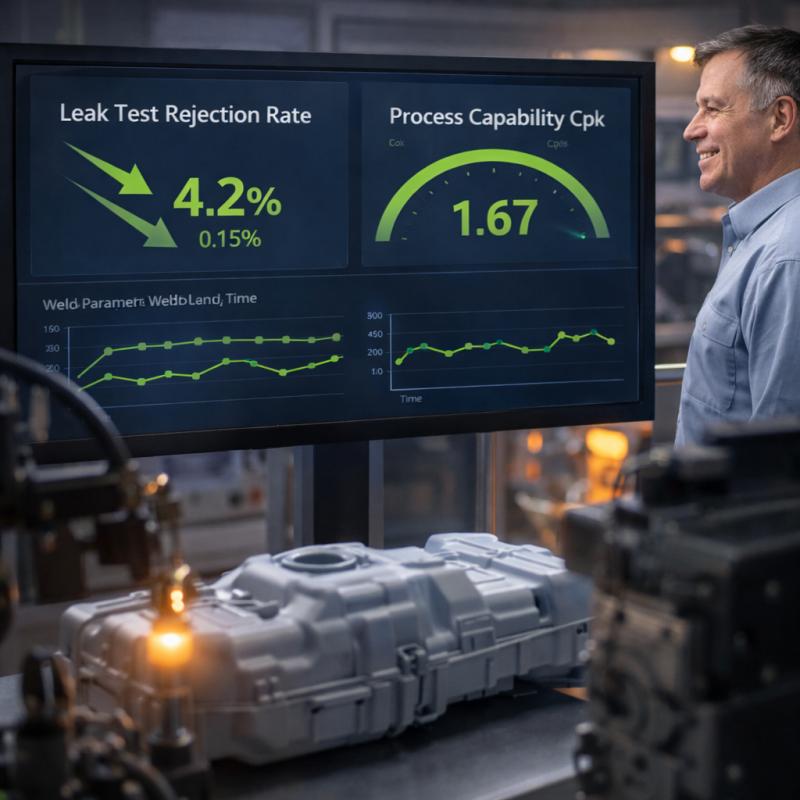
Case Study: A European OEM reduced leak-test rejection rates from 4.2% to 0.15% on a complex SUV tank by switching from a fixed fixture to our robotic ultrasonic system, achieving full IATF 16949 process capability (Cpk > 1.67).
Challenge 3: High-Volume Production with Zero Defects
The Problem: Producing 500,000+ tanks per year with a 0ppm leak defect goal. Manual loading/unloading and inconsistent clamp pressure create variability.
The Advanced Solution: Fully Automated, Servo-Driven Hot Plate Welding Line. Integrated with vision systems for part verification, servo actuators for repeatable clamp force, and immediate in-station pressure decay testing. All weld parameters (temperature, pressure, time) and test results are logged for full traceability per IATF 16949 requirements.
6.Frequently Asked Questions (FAQ)
Here are answers to common questions about automotive plastic fuel tanks, drawing from design and welding insights earlier in this guide.
How thick is a plastic fuel tank?
Typical wall thickness in blow-molded HDPE tanks ranges from 3-6mm. This balances weight reduction with burst pressure resistance and permeation control. Thinner walls suit lightweight goals, but localized reinforcements via welding help maintain strength at seams---as discussed in the welding principles section.
What are the benefits of HDPE in automotive tanks?
HDPE offers excellent corrosion resistance, lighter weight (up to 30% less than metal), and flexibility for complex shapes. It improves fuel efficiency while handling impacts well, though strong welds are essential for long-term durability and low emissions.
Plastic fuel tank vs steel---which is better?
Neither is universally superior---it depends on priorities. Plastic excels in corrosion resistance and design freedom; steel in high-temperature or extreme pressure scenarios. For most modern vehicles, HDPE with precision welding provides the best overall performance, as shown in our comparison table.
What welding process is best for high-volume fuel tank production?
Robotic ultrasonic welding stands out for speed, consistency, and flexibility in automated lines. It handles multiple variants quickly with minimal defects, making it ideal for high-volume runs while ensuring seam integrity.
How does welding reduce fuel permeation in multi-layer tanks?
Precision processes like hot plate welding fuse barrier layers (e.g., EVOH) without damage, creating tight seals that limit vapor escape. This meets strict emission standards without extra components.
Have a specific fuel tank welding or design challenge?
Our engineers specialize in custom solutions for complex geometries or high-strength needs. Share your details for a free, no-obligation feasibility review---we\'ll suggest the optimal approach tailored to your project.

7.Conclusion: Your Next Step Toward Optimized Fuel Tank Assembly
The journey from HDPE resin pellets to a safe, reliable, and compliant fuel tank is defined by precision. As we\'ve explored, the choice of material sets the stage, but it is the advanced welding process that delivers the performance---sealing in fuel and sealing out risk.
For standard applications, begin with a clear analysis using the selection framework in Section 4. For projects pushing the boundaries---whether through complex geometry, multi-layer barriers, or extreme volume demands---a customized welding solution is not an expense; it\'s an investment in quality, reliability, and brand protection.
Ready to move from design to durable reality?
Download our free "Plastic Fuel Tank Welding Process Audit Checklist" to evaluate your current or planned production line against industry best practices.
For a tailored solution: Share your tank CAD model and production requirements with our engineering team for a confidential, no-obligation Feasibility Review. We\'ll analyze your specific challenges and outline a precise welding strategy.
Contact us at sales@dizo-global.com or visit our resource center at Download the free checklist
More Reading
- HDPE Welding: Techniques, Machine Types & Key Advantages
- Plastic Auto Parts Guide: Materials and Fabrication
- Car Plastic Tank Hot Plate Welding: Process, Benefits & Tips
- Top Automobile Manufacturing Companies in 2025
- Hot Plate Plastic Tank Welding: The Key to Strong, Leak-Proof Joints
- Hot Plate Plastic Welding: The Perfect Solution for Automotive Hydraulic Reservoirs Welding
- Advanced Aluminum-Plastic Radiator Welding Guide for Vehicle Cooling Systems