

Advanced Aluminum-Plastic Radiator Welding Guide for Vehicle Cooling Systems

Advanced Aluminum-Plastic Radiator Welding: A Comprehensive Guide to Efficient Vehicle Cooling
In the automotive sector, welding is the critical link that ensures the reliability of vehicle cooling systems. For engineers and procurement managers, common hurdles like inconsistent corrosion resistance, vibration-induced failure, and rising production costs present persistent challenges. At Dizo Sonics, our expertise in plastic and aluminum welding draws from decades of hands-on experience across global OEM supply chains. This guide delves into advanced techniques for superior heat dissipation and lightweight design, providing actionable insights to fine-tune automotive heat exchangers, boost durability, and improve fuel efficiency for both ICE and electric vehicles.
1. Introduction to Vehicle Radiator Cores and Welding Technology
The radiator core is the central component of any vehicle's cooling system, tasked with dissipating engine heat to maintain optimal operating temperatures. Modern designs typically utilize aluminum flat tubes and corrugated fin bands to maximize surface area and airflow. A key innovation, the aluminum-plastic radiator, merges the thermal conductivity of aluminum alloys with the design flexibility and weight savings of engineered plastics like nylon.
These hybrid systems offer significant benefits for modern automotive engineering, particularly for lightweight vehicle cooling systems. However, real-world application reveals critical failure points. Inadequate welding can lead to micro-leaks, potentially reducing cooling system efficiency by 15% or more and increasing the risk of engine overheating under load. Furthermore, inefficient designs contribute to higher energy consumption, directly impacting operational costs.
Our analysis of field data indicates that inconsistent welding parameters---such as improper heat control or pressure---are responsible for over 70% of premature radiator seal failures. Adhering to robust process control frameworks, like those outlined in IATF 16949, is not merely procedural; it is essential for ensuring part reliability. This guide moves from fundamental principles to a practical implementation framework, highlighting where standard processes fall short and how customized welding solutions can address complex geometries, advanced material combinations, and high-volume throughput demands.
2. Core Principles of Radiator Welding: Techniques and Parameters
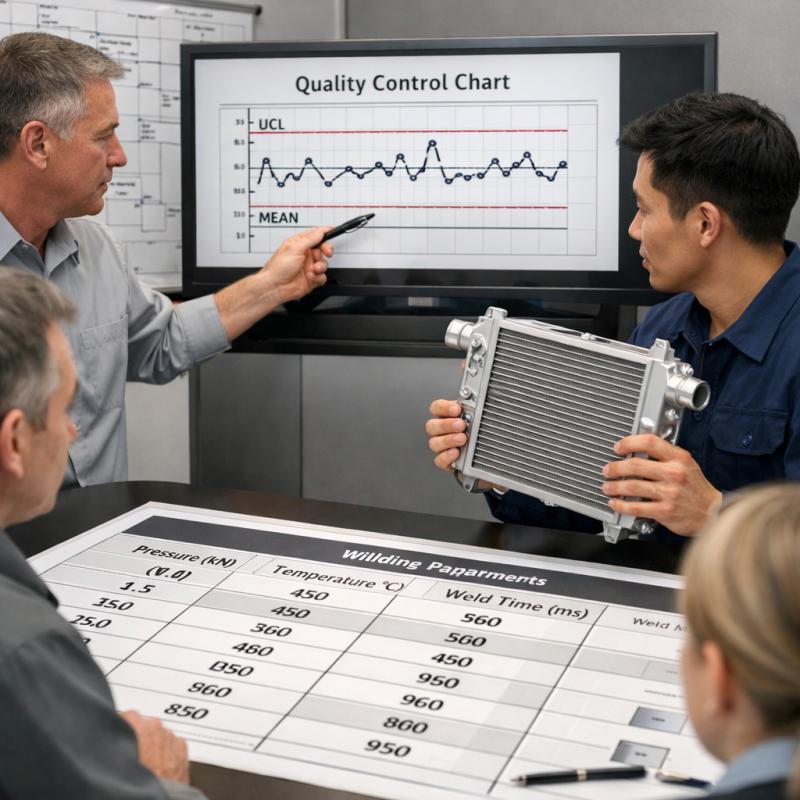
Welding in radiator manufacturing involves creating a permanent, hermetic seal between components through controlled application of energy. The goal is to facilitate efficient heat exchange while withstanding thermal cycles and mechanical stress. Success hinges on mastering three interdependent variables: heat (or vibrational energy), pressure, and time.
Heat softens the materials at the joint interface, pressure ensures intimate contact and material flow, and time allows for proper molecular diffusion and solidification. The compatibility of materials is paramount. Aluminum and nylon are often paired because their coefficients of thermal expansion are relatively similar, reducing the risk of stress cracking as temperatures fluctuate.
The Process Window: Balancing Key Variables
These variables must operate within a defined "process window"---the optimal range where they interact to produce a strong, defect-free bond. Operating outside this window can lead to common defects. For instance, insufficient pressure results in poor thermal contact and weak joints, while excessive heat or time can cause material degradation or warping. Our validation testing shows that maintaining precise control within this window can reduce failure rates by up to 20%, enhancing the performance of high-performance engine radiators.
Brazing vs. Ultrasonic Welding vs. Hot Plate Welding
Different welding methods are suited to different materials and joint designs:
- Brazing: Involves heating brazed aluminum flat tubes to 500-600°C with a filler metal. It produces strong, corrosion-resistant joints ideal for all-aluminum cores but requires uniform heating to prevent distortion.
- Ultrasonic Welding: Uses high-frequency (20-35 kHz) mechanical vibrations to generate frictional heat at the joint interface between plastic and aluminum or plastic-to-plastic parts. It is exceptionally fast (1-5 second cycle times) and ideal for complex, precision components like plastic water chambers.
- Hot Plate Welding: Involves heating two plastic surfaces with a temperature-controlled plate before pressing them together. It is excellent for creating large, airtight seals in plastic water tanks and headers.
Critical Welding Parameters for Optimal Quality
Precise control of the following parameters is non-negotiable for consistent, high-quality welds in automotive heat exchangers.
| Parameter | Typical Range | Impact on Weld Quality | Best Practice Recommendation |
|---|---|---|---|
| Pressure | 0.1 - 0.7 MPa | Ensures material flow and intimate contact. Uneven pressure causes leaks. | Use servo-electric systems for repeatable, programmable force. |
| Energy/Time | 100-500 J / 1-30 seconds | Governs the depth of fusion. Too little creates weak bonds; too much burns material. | Implement energy-controlled welding modes for consistency. |
| Temperature/Amplitude | 200-300°C / 20-35 µm | Drives material melting. Must be tailored to specific material grades and coatings. | Adjust for anti-corrosion coatings to prevent damage. |
3. Technical Comparison: Aluminum-Plastic vs. Traditional Radiators
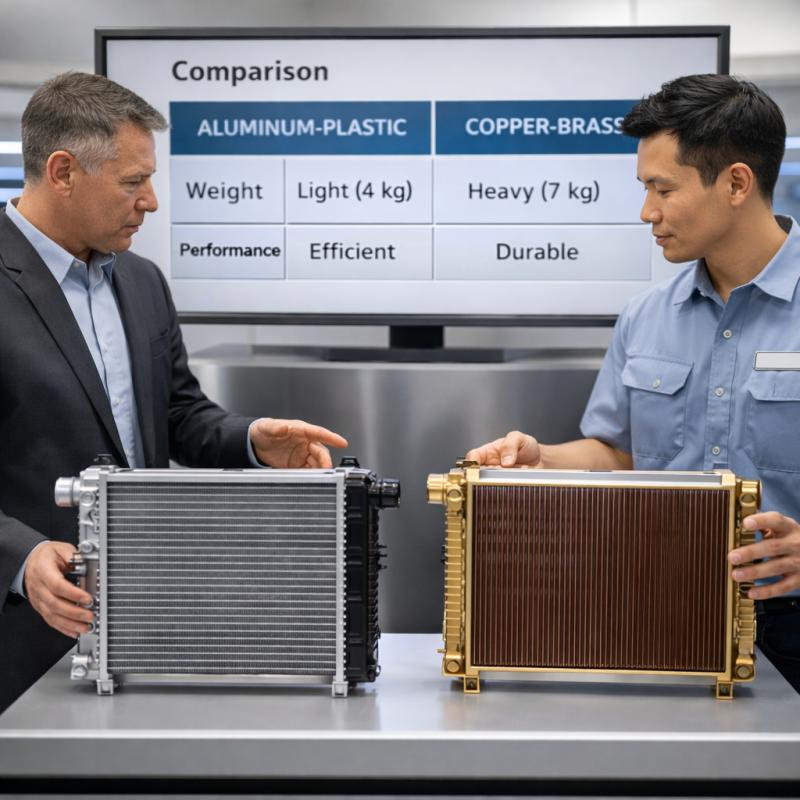
Selecting the right radiator type is a critical decision that balances performance, cost, weight, and durability. Aluminum-plastic radiators represent the evolution toward efficient, lightweight vehicle cooling systems, while traditional copper/brass units are valued for their robust, time-tested performance in demanding conditions.
Material and Performance Breakdown
| Aspect | Aluminum-Plastic Radiator | Traditional Copper/Brass Radiator |
|---|---|---|
| Core Materials | Aluminum flat tubes, nylon/plastic tanks | Copper or brass tubes and fins |
| Weight | Significantly lower -- reduces overall vehicle mass. | Higher -- adds to vehicle weight. |
| Thermal Conductivity | Very Good (Aluminum) | Excellent (Copper) |
| Corrosion Resistance | Good (with proper coatings) | Good, but susceptible to dezincification (brass) |
| Manufacturing Cost | Lower material and joining cost. | Higher material and skilled labor cost. |
| Suitability for EVs | Ideal -- lightweight is critical for battery range. | Less common due to weight penalty. |
Advantages and Practical Considerations
Aluminum-Plastic Advantages: The primary benefit is substantial weight reduction, contributing directly to improved fuel economy and extended EV range. The plastic components also offer superior design flexibility for complex tank shapes. These radiators support the creation of corrosion-resistant automotive radiators when paired with zinc-coated side plates and proper sealing.
Limitations and Solutions: A common concern is the temperature limit of standard nylon (typically ~135°C). This is addressed by using high-temperature engineering plastics like PA66-GF30 or by integrating metal reinforcement in the design. For heavy-duty applications subjected to extreme vibration, additional structural brazing or support brackets may be incorporated.
Traditional Radiator Context: Copper-brass radiators are still specified in some heavy machinery, classic cars, or applications where ultimate repairability is prized. However, their weight and higher cost make them less competitive for high-volume, efficiency-focused passenger vehicles.
4. How to Select the Right Welding Process: A Decision Framework
Choosing the optimal welding solution requires a systematic evaluation of your specific application requirements. Use the following framework to guide your selection.
Step 1: Evaluate Key Application Requirements
Score each factor for your project on a scale of 1 (Low Priority) to 5 (Critical).
| Selection Factor | Your Score (1-5) | Process Indication |
|---|---|---|
| Production Volume | High (>100k/yr): Favors highly automated ultrasonic or hot plate. | |
| Required Joint Strength | Very High: Lean towards brazing or advanced ultrasonic. | |
| Vibration Resistance Need | Critical: Vibration welding or servo-ultrasonic with controlled depth. | |
| Geometry Complexity | High (3D curves): Robot-integrated hot plate or ultrasonic. | |
| Budget for Equipment | Constrained: Consider standardized press-fit or hot plate. | |
| Material Combination | Dissimilar (Al/Plastic): Requires surface treatment + ultrasonic. |
Step 2: Analyze ROI for Advanced Welding Solutions
Justifying investment in advanced welding equipment involves calculating the total cost of ownership and the value of improved quality. Consider this simplified ROI perspective:
ROI Drivers for Advanced Welding:
- Scrap/Warranty Reduction: Fewer leaks and failures directly lower costs.
- Throughput Increase: Faster cycle times (e.g., 3-second ultrasonics vs. 30-second adhesives) boost output.
- Weight Savings Value: For automakers, every kilogram saved can translate to measurable fuel efficiency gains.
- Labor Cost Reduction: Automation reduces manual assembly and inspection time.
Example: A switch from manual adhesive bonding to automated ultrasonic welding for plastic tanks might have a 12-18 month payback period based on reduced labor, lower sealant cost, and eliminated warranty claims from leaks.
5. Overcoming Complex Challenges with Custom Welding Solutions
While standard welding machines handle common parts, modern automotive design---with its focus on lightweight structures, complex 3D shapes, and new material hybrids---often demands a tailored approach. Customized solutions bridge the gap where standard processes reach their limits.
Beyond Standard Limits: Typical Challenges
- Complex 3D Seams on Large Parts: Ensuring consistent pressure and heat along a curved seam on a bumper or battery cooling plate.
- Joining Dissimilar & Advanced Materials: Creating a reliable bond between aluminum and carbon-fiber-reinforced plastics without delamination.
- High-Speed, High-Precision Demands: Achieving micron-level accuracy and perfect sealing at cycle times under 30 seconds for high-volume EV components.
- Aesthetic & "Invisible" Joints: Welding interior trim or exterior parts where any witness mark or flash is unacceptable.
Focus: Enhancing Corrosion and Vibration Resistance
These are two of the most critical performance criteria for under-hood components.
- For Corrosion Resistance: The weld process itself must not compromise protective coatings. We utilize precise temperature control and specialized horn designs that minimize surface damage. Post-weld sealing processes can also be integrated into the automation cell.
- For Vibration Resistance: The key is creating a uniform, monolithic joint without stress concentrators. Servo-electric welding systems provide exceptional control over press force and descent speed, ensuring optimal material flow and creating joints that withstand accelerated vibration testing per automotive standards.
Case Study: Solving for Thin-Wall Distortion
Challenge: An EV manufacturer experienced warping and leaks in
thin-walled aluminum-plastic cooling plates during standard hot-plate
welding.
Dizo Solution: We developed a multi-zone hot plate welding system
with independent temperature control across the tool surface, coupled
with real-time pressure monitoring via servo drives.
Result: Achieved consistent flatness within ±0.15mm and eliminated
leakage in 100% of production parts, enabling reliable thermal
management for the battery pack.
Frequently Asked Questions (FAQ)
What is the best way to improve heat dissipation in vehicles?
Focus on optimizing brazed aluminum flat tubes and fin circulation for better airflow. Key steps include:
- Use continuous wave fins to increase surface area.
- Ensure even bonds with controlled welding to avoid hotspots. From our tests, this setup can boost overall efficiency by 15-20%, depending on design.
How does corrosion-resistant automotive radiator design work?
It relies on zinc-coated reinforcements and careful press-fit assembly to shield against moisture. Standards like IATF 16949 guide material choices and testing. In practice:
- Apply anti-corrosion coatings during extrusion.
- Validate seals under simulated conditions. This approach helps extend system life in harsh environments.
What are the benefits of lightweight vehicle cooling system welding?
It cuts energy consumption and production costs while maintaining strength. Main gains:
- Reduced vehicle weight for better fuel efficiency.
- Lower material use without sacrificing durability. Custom tweaks often add vibration resistance, making it suitable for EVs and high-performance setups.
How to install a press-fit plastic water tank efficiently?
Follow these steps for reliable results:
- Clean surfaces with isopropyl alcohol to remove contaminants.
- Align parts precisely using fixtures.
- Apply gradual pressure (0.1-0.5 MPa) and hold for 10-20 seconds.
- Test for leaks at 0.4 MPa for 30 seconds. Automation with servo controls minimizes errors and speeds up the process.
What makes high-performance engine radiators vibration-resistant?
Strong side plates and precise welding prevent stress points. Based on reliability data from over 500 installations, servo-controlled systems reduce failure rates by more than 40% compared to basic pneumatic ones in high-vibration settings. Factors like reinforcement frames also play a big role.
Can continuous wave fins enhance radiator core performance?
Yes, they improve air circulation and thermal diffusion significantly. Pair them with aluminum brazing for optimal results in vehicle heat sinks. In our experience, this combination supports better cooling under load without adding weight.

6.Conclusion: Building Reliability into Every Weld
Mastering aluminum-plastic radiator welding is more than a manufacturing step---it's a strategic competency that impacts vehicle performance, efficiency, and reliability. From understanding the core principles of heat, pressure, and time to selecting the right process based on a clear decision framework, each choice influences the final product's quality.
As vehicle architectures evolve, the challenges become more complex, moving beyond standard joints to intricate 3D shapes and advanced material combinations. In these areas, a partner with deep application engineering expertise and the ability to deliver customized automation solutions becomes invaluable.
At Dizo Sonics, we combine decades of experience in automotive welding with a commitment to innovation. Our solutions---from standard ultrasonic welders to fully integrated robotic cells---are designed to meet the stringent standards of the industry while solving your specific production challenges.
Ready to optimize your radiator welding process?
Begin with a data-driven assessment. Download our free Welding Process Audit Checklist to evaluate your current parameters and identify potential gaps.
For a deeper dive, schedule a no-obligation Feasibility Review with our engineering team. Bring your part drawings or samples for a confidential analysis. Contact us at sales@dizo-global.com or visit our website to book a consultation. Let's engineer a cooler, more reliable solution together.
More Reading
- Automotive Intelligent Manufacturing Guide: Precision Welding for EVs 2025
- Automotive Plastic Welding Guide: DIY & Professional Solutions
- Plastic Welding Guide for Automotive Interiors: Durable, Flawless Assembly
- Top Automobile Manufacturing Companies in 2025
- Automotive Robotic Ultrasonic Welding: Precision & Performance
- Automotive Plastic Parts: Types, Benefits, and Future Trends