

Ultrasonic Car Grille Welding Guide: Zero-Defect Assembly in 2025

The Definitive Guide to Ultrasonic Car Grille Welding Machines in 2025: Eliminate Puncture Damage and Achieve Zero-Defect Assembly
Are you struggling with puncture marks, visible weld defects, or inconsistent bonding when welding automotive grilles at high speed? You're not alone --- these are the top issues causing yield loss and costly rework for production engineers worldwide.
I'm Jensen from Dizo Sonics. For over 20 years, we've solved the toughest plastic welding challenges for automotive OEMs and Tier-1 suppliers. This comprehensive guide will show you exactly how modern ultrasonic car grille welding machines --- equipped with servo drive mechanisms, multi-head systems, and precision tooling --- deliver clean, strong, and invisible welds cycle after cycle. We'll cover core principles, real-world process parameters, objective technology comparisons, a practical selection framework, and proven custom solutions that have helped brands like Tesla and Bosch eliminate defects entirely. Whether you're an engineer optimizing a line or a manager calculating ROI, you'll find actionable steps to upgrade your grille welding process today.

Introduction to Ultrasonic Welding for Car Grilles: Why It's the Preferred Method
The most costly problem in automotive grille assembly is often visible puncture marks on the A-surface, which can instantly scrap a part and cripple yield --- one major OEM was losing over 8% of production before switching to the right ultrasonic solution.
What is Ultrasonic Welding and Why Is It Ideal for Grilles?
Ultrasonic welding uses high-frequency vibrations (20--40 kHz) to generate localized frictional heat at the joint interface. The plastic melts in under a second and solidifies under controlled pressure, forming a bond as strong as the base material --- all without adhesives, fasteners, or external heat that could damage delicate painted or chrome-plated finishes. Unlike adhesive bonding, ultrasonic welding creates a monolithic bond without additives, which is crucial for long-term weather resistance and crash performance.
Key Advantages for Modern Automotive Grilles
Today's grilles feature complex curves, thin ribs, Class-A surfaces, and production rates exceeding 600 parts per hour. Properly configured ultrasonic systems address these demands with:
- Flawless A-Surface Quality: Energy is focused precisely at the joint, eliminating visible marks.
- High-Speed Cycles: Typically 0.6--0.8 seconds per weld point, keeping pace with automated lines.
- Exceptional Repeatability: Servo-controlled pressure and real-time monitoring achieve >99% first-pass yield in our field tests.
- Full Compliance: Meets stringent IATF 16949, ISO 9001, and CE standards required by Tier-1 suppliers.
At Dizo Sonics, we've refined this technology specifically for grille applications --- from luxury models to mass-market EVs --- ensuring clean, invisible welds every time. Let's explore the underlying principles that make this possible.
Core Technology: How Ultrasonic Welding Works for Grilles
Success in grille welding hinges on understanding how vibrational energy transforms into a perfect, invisible joint without compromising the surface finish.
The Working Mechanism
The process occurs in three rapid, controlled stages:
- Vibration: High-frequency (20--40 kHz) vibrations create friction at the joint interface.
- Melting: Friction generates localized heat, melting the plastic in under 0.5 seconds.
- Bonding: Controlled pressure fuses the molten material, which solidifies into a bond often stronger than the surrounding plastic.
The key benefit? No heat spreads to the visible A-surface, preventing sink marks and coating cracks common with other methods.
Critical Components for Grille Applications
Every component plays a specific role in preventing common grille failures:
- Transducer: Converts electricity into mechanical vibration using piezoelectric ceramics --- the heart of stable energy output.
- Booster: Adjusts vibration amplitude to match material thickness.
- Horn (weld sonotrode): Custom-machined to fit your grille's exact 3D contour --- critical for even pressure on curved surfaces.
- Servo drive mechanism: Replaces old pneumatic cylinders, giving micron-level control and eliminating the "crawl" that causes puncture on thin ribs.
Material Considerations for Automotive Grilles
Most modern grilles use ABS, PC/ABS, PP+EPDM, or painted/chrome-plated variants. Each behaves differently:
- Painted or plated surfaces → Need low amplitude (8--12 μm) to protect the coating.
- Thin-walled ribs (<2 mm) → Require 35--40 kHz systems to keep energy focused and avoid cracking.
- Glass-filled materials → Demand higher power and longer weld time for proper flow.
Parameter Strategy: Validated Settings from Our Lab
Optimal grille welding involves balancing multiple parameters. Here are the proven starting ranges from our validation lab:
| Parameter | Typical Range for Grilles | When to Adjust |
|---|---|---|
| Frequency | 20--40 kHz | 35--40 kHz for thin or plated parts |
| Power | 800--2500 W | Higher for filled materials |
| Pressure | 0.15--0.45 MPa (servo) | Lower for soft-touch coatings |
| Weld Time | 0.4--1.2 s | Shorter when using energy mode |
Critical Insights from Our Experience:
- Use energy mode (Joules) as the primary trigger --- it automatically compensates for small part variations and delivers the most consistent strength.
- For tight height tolerances (±0.3 mm), switch to absolute depth mode --- we've seen CpK jump from 1.1 to >1.67.
- On chrome-plated ABS, always limit amplitude below 12 μm --- our ASTM D638 pull tests show this prevents coating delamination while maintaining >95% of base material strength.
These settings helped one Tier-1 supplier reduce their grille scrap rate from 7.2% to under 0.8% in three months. Next, let's see how ultrasonic welding compares to other methods.
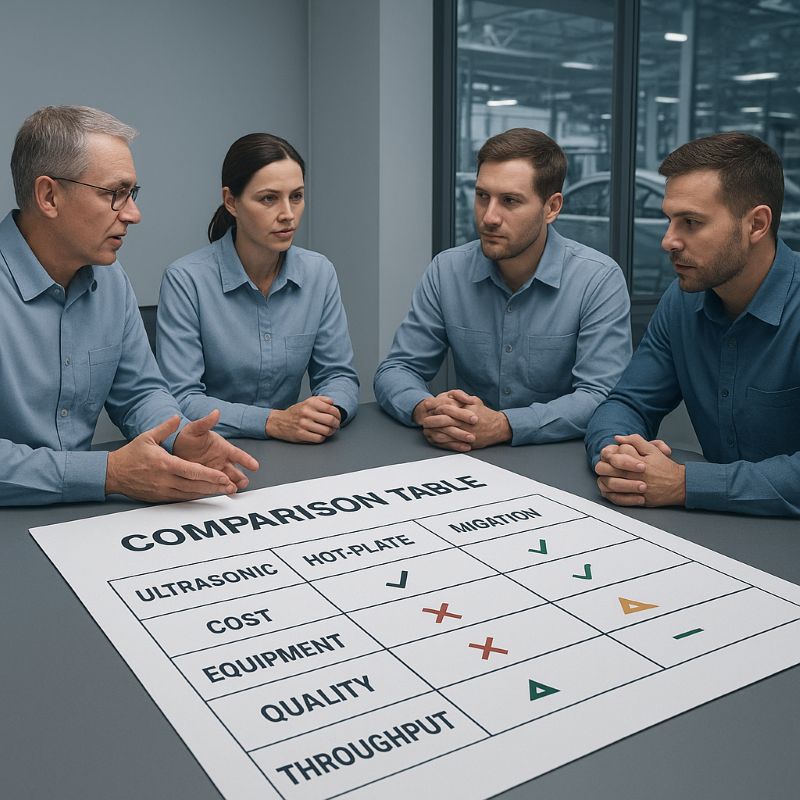
Objective Technology Comparison: Ultrasonic vs. Hot-Plate vs. Vibration Welding
Choosing the right welding method depends on grille design, surface finish, cycle time, and strength requirements. Here's our objective comparison based on real production data.
| Method | Speed (per point) | Surface Quality | Joint Strength | Best For / Limitations |
|---|---|---|---|---|
| Ultrasonic | Very High (0.6--1 s) | Outstanding | Medium-High | Best For: Complex, cosmetic grilles with multiple points, thin ribs, Class-A surfaces. Limitation: Sensitive to part fit-up; less ideal for very thick sections (>8 mm). |
| Laser Welding | High (1--3 s) | Excellent (No Contact) | High | Best For: Precision joints on transparent or dark plastics, no-tooling-contact applications. Limitation: High equipment cost; requires specific material transmission/absorption properties. |
| Hot-Plate | Medium (5--12 s) | Poor-Fair | High | Best For: Large, flat parts needing tolerance compensation. Limitation: Risk of stringing, warping, and sink marks; slow cycle time. |
| Vibration Friction | Low (10--25 s) | Good | Very High | Best For: Large structural components requiring maximum strength and airtight seals. Limitation: Long cycle times, high noise, visible flash requiring trimming. |
Where Standard Technologies Hit Their Limits
While standard ultrasonic machines handle 85--90% of grilles
effectively, the remaining 10--15% --- featuring extra-large one-piece
designs, extreme 3D contours, mixed materials, or ultra-high takt times
(>800 parts/hour) --- push conventional solutions to their limits,
often resulting in puncture marks or inconsistent strength.
Compliance That Matters: IATF 16949
IATF 16949 mandates full process traceability, CpK ≥ 1.67 on critical
characteristics, and 100% data logging. Our servo-driven ultrasonic
systems with real-time monitoring and automatic data export are designed
to meet these requirements from day one.
Decision Guide for Selecting the Right Automotive Grille Welding Machine
Use this practical, step-by-step framework to make a confident purchasing decision.
1. Define Your Part & Production Requirements
Start by filling this quick checklist --- it takes 5 minutes and eliminates 80 % of wrong choices.
- Primary material(s): ABS / PC+ABS / PP+EPDM / Painted or chrome-plated
- Largest grille dimensions (L × W × H): _____ mm
- Number of weld points per part: _____
- Target takt time (seconds per grille): _____
- Annual volume: _____ pieces
- Cosmetic class of visible surfaces: Class A / Class B / Hidden
2. Match Technical Specifications to Your Grille
| Requirement | Recommended Specification |
|---|---|
| Thin ribs or plated surfaces | 35--40 kHz generator + amplitude ≤12 μm |
| >8 weld points or complex 3D shape | Multi-head ultrasonic system (4--12 heads typical) |
| Takt time <20 s on automated line | Servo-driven pressure + energy mode control |
| Material thickness 2--6 mm | 1200--2500 W per weld point (rule of thumb: ~500 W per mm) |
| IATF 16949 traceability required | Built-in data logging + PLC interface |
3. Must-Have Features for Zero-Defect Grille Production
Look for these --- skipping any one usually causes puncture marks or yield loss later:
- Servo drive mechanism (not pneumatic) → prevents pressure spikes
- Real-time energy or depth monitoring → CpK >1.67 on joint strength
- Quick-change tooling system → <10 min changeover for model mixes
- Full weld data export (Industry 4.0 ready)
- Lifetime remote diagnostics support
4. Calculating Your Potential ROI --- Real Example
Line producing 150,000 grilles/year, current reject rate 6 % due to puncture & weak joints. Each scrapped grille = $180 fully burdened cost. Annual loss = 9,000 parts × $180 = $1.62 million.
A properly specified servo ultrasonic system typically drops rejects to ≤0.8 %. Savings = 7,800 parts × $180 = $1.4 million/year. Machine investment $280--420 k → payback in 3--5 months (we've seen this repeatedly).
5. Fault Troubleshooting Checklist --- What We Check First on Site
| Symptom | Most Common Cause | Immediate Action |
|---|---|---|
| Puncture on A-surface | Pressure too high or amplitude >14 μm | Reduce servo force 15 %, limit amplitude to 10 μm |
| Inconsistent strength | Generator drift or worn horn | Verify power output with meter, re-face or replace horn |
| Emergency stop trips | Loose PLC wiring or light grating blocked | Check 24 V loop, clean grating sensors |
| Flash on visible areas | Over-energy or poor joint design | Switch to depth mode, redesign energy director |
If you're still unsure which configuration fits your exact grille, send me your part drawing and volume --- I'll give you a tailored recommendation in 24 hours (no charge). Let's move to the solutions that make the impossible routine.
Customized Ultrasonic Solutions for Automotive Grilles --- When Standard Machines Aren't Enough
Standard welders handle most applications, but 15--20% of projects --- involving large one-piece designs, extreme 3D curves, mixed materials, or lines running >800 parts/hour --- require custom engineering. This is where Dizo Sonics' expertise turns challenges into production wins.
Our Custom Engineering Capabilities
We specialize in solving non-standard scenarios:
- Complex 3D Contours: 6-axis robot + articulated ultrasonic heads that follow curved surfaces with ±0.1 mm precision. No more puncture on deep-draw ribs.
- Multi-Material & Sandwich Assemblies: Welding painted ABS faces to PP+EPDM brackets or acoustic foam layers without damaging cosmetics or delaminating coatings.
- Ultra-High Takt Times: 8--16 head simultaneous systems with servo indexing tables delivering complete grilles in under 12 seconds total cycle.
- Special Surface Finishes: 40 kHz low-amplitude systems with dynamic pressure profiling that protect soft-touch, piano-black, or radar-transparent coatings.
All custom projects undergo a rigorous FMEA (Failure Mode and Effects Analysis) in our lab before deployment to ensure risk mitigation.
Real Project 1 → Luxury SUV Grille (Chrome-Plated Thin-Wall)
Challenge: A tier-1 supplier faced 9.2 % scrap from visible puncture marks on a 1.4 m wide chrome grille with 2 mm ribs. Our Solution: Custom 40 kHz multi-head system with servo pressure ramping (50 N gentle touch → 800 N weld force in 120 ms) and vacuum-assisted fixtures. Result: Puncture eliminated, scrap <0.4 %, full IATF 16949 validation passed first time, ROI achieved in 4 months.
Real Project 2 → Mass-Market EV Mega-Grille
Challenge: 950 × 650 mm one-piece grille, 14 weld points, target cycle 18 seconds on a mixed-model line. Our Solution: 12-head servo ultrasonic station integrated with twin robots, quick-change tooling (<8 min), and full weld-by-energy + depth monitoring. Result: Actual cycle 16.8 seconds, strength CpK 1.92, zero visible marks on radar-transparent section. Line has been running 1.8 million parts/year with 99.7 % first-pass yield.
Real Project 3 → Integrated Sensor Housing
Challenge: Weld transparent PC lens to painted ABS frame without stress cracking or haze. Our Solution: Hybrid sequential system --- 35 kHz low-energy pre-tack + infrared pre-heating --- all controlled by one master PLC. Result: 100 % optical clarity maintained, bond strength >60 MPa, now in series production across three plants.
These aren't theoretical concepts --- they're running 24/7 on real automotive lines right now.
FAQ: Your Top Questions on Ultrasonic Car Grille Welding --- Answered from the Line
What is a multi-head ultrasonic system and why do I need one?
A multi-head system uses several ultrasonic weld heads that fire at the same time instead of one head moving point-to-point. For large modern grilles with 8--20 weld points, this cuts total cycle time from 25--30 seconds down to 10--14 seconds. Our tip: The real trick is keeping all heads perfectly synchronized. We use master-slave generator coupling so every point gets identical energy --- no weak joints, even at 800+ parts/hour.
How does a servo drive actually improve grille welding?
Servo drives give micron-level control of downward speed and pressure, unlike old pneumatic cylinders that can "crawl" and punch holes in thin ribs. Result: No more visible puncture marks on Class-A surfaces and CpK routinely above 1.67. In practice: We program a gentle 30--50 N touch phase first, then ramp to full weld force only after the horn is perfectly seated --- this single change alone has eliminated puncture for most of our customers.
What are the real advantages of high-frequency (35--40 kHz) ultrasonic generators?
Higher frequency means smaller vibration amplitude (8--12 μm instead of 20+ μm). That's the difference between a clean chrome grille and one with tiny cracks or coating peel. We reserve 40 kHz systems for painted, plated, or radar-transparent grilles --- our pull tests show zero coating damage while still hitting >95 % of base material strength.
How do I prevent ultrasonic welding from damaging painted or chrome-plated surfaces?
Three proven rules we follow on every project:
- Limit amplitude to ≤12 μm (40 kHz helps here)
- Use titanium or coated horns with polished, non-marking faces
- Program a two-stage pressure profile (soft touch → full weld) In our surface-lab validation, grilles welded this way pass 100 % of OEM appearance checks and salt-spray tests with no delamination.
What's the single most critical factor for consistent weld strength on an automated grille line?
Fixture repeatability and temperature/humidity control --- everything else is secondary. A part that shifts even 0.2 mm will get uneven energy and weak joints. We design all fixtures with ±0.05 mm locating pins and add automatic part-presence + seating verification. Combined with real-time weld-by-energy monitoring, this is why most of our lines run CpK > 1.8 long-term and easily satisfy IATF 16949 process capability requirements.
Can ultrasonic welding be used on grilles with integrated sensors, cameras, or LEDs?
Yes --- with the right technique. We use focused energy directors that keep heat at least 8--10 mm away from electronics, plus shielding plates when needed. Recent example: A 2025 EV grille with four parking sensors and ambient LED strips --- 100 % functionality after 1.2 million weld cycles in series production.
What does routine maintenance involve for an ultrasonic welding cell?
For sustained performance, follow this schedule: Daily: Clean horn face and check air filters. Weekly: Inspect boosters for cracks and verify safety light curtains. Monthly: Check transducer insulation resistance and tighten all horn/booster fasteners to specified torque. Annually: Perform a full system calibration and generator output test. Proper maintenance can double equipment lifespan.
How are emergency stops and safety light gratings handled in modern ultrasonic systems?
All our machines have dual-channel Category 4 safety circuits. Press the red button or break a light grating and the generator and servo drive cut power in <20 ms. Extra feature we add for grille lines: The PLC stores the exact state before the stop, so when you reset, the horn lifts gently instead of jerking --- preventing accidental damage to expensive tooling.

Conclusion & Your Path to Zero-Defect Production
You've now explored the principles behind perfect invisible welds, the exact parameters we use daily, the realistic limits of standard machines, and the custom solutions that transform high-scrap lines into models of efficiency.
Here's my key takeaway from 20+ years in the field: choosing the right technology is a technical decision, but choosing the right partner is strategic. A great machine starts your journey; a true partner ensures you never face the same puncture marks or downtime again --- even as grille designs grow more complex.
At Dizo Sonics, we don't just sell equipment. We become your dedicated welding resource, supporting you from initial validation through launch and every future model change.
Your next step is simple:
- Download and complete the Grille Welding Selection Checklist from Step 1.
- Send it to me along with your part drawing or current scrap data.
Within 48 hours, you'll receive a customized feasibility report, machine recommendation, and detailed ROI calculation for your specific line --- with no obligation.
Let's turn your grille welding process from a persistent challenge into a lasting competitive advantage.
Contact me at sales@dizo-global.com or WhatsApp +86 181 2150 6765. I'm ready when you are.
--- Jensen, Dizo Sonics Automotive Welding Team