

Automotive Lightweight Plastic Welding Guide: Techniques & Benefits | Dizo Sonics

The Ultimate Guide to Automotive Lightweight Plastic Welding: Techniques, Benefits, and Custom Solutions
In today's rapidly evolving automotive industry, lightweight plastic welding has become an essential manufacturing process for developing vehicles that are not only lighter and stronger but also more environmentally sustainable. This comprehensive guide provides automotive engineers, manufacturing specialists, and product developers with proven techniques to address critical industry challenges: meeting stringent safety standards, reducing emissions, and maintaining structural integrity while achieving significant weight reduction. Drawing from Dizo Sonics' 20 years of specialized experience in automotive welding solutions, we'll examine vibration welding, ultrasonic welding, laser welding, and hot plate welding methods---demonstrating how they enhance fuel efficiency, reduce manufacturing waste, and improve energy performance for applications ranging from dashboards to bumpers and structural components.

1. Introduction to Plastic Welding in Automotive Manufacturing
The automotive industry faces increasing pressure to meet global emission standards while maintaining vehicle safety and performance. Plastic welding provides an engineered solution by joining thermoplastic components through controlled melting and fusion, creating bonds that often match or exceed the base material's strength. This process eliminates the need for adhesives or mechanical fasteners while enabling significant weight reduction through metal-to-plastic substitution strategies.
Why Lightweight Design Matters in Modern Vehicles
Lightweight design principles have become fundamental to automotive engineering, with plastic components typically reducing part weight by 20-30% compared to metal equivalents. This weight reduction directly translates to improved fuel efficiency and reduced emissions---critical factors in meeting global environmental regulations. However, implementing lightweight designs presents specific challenges, particularly in maintaining structural rigidity and impact resistance required by safety standards such as NHTSA and ISO 26262.
Based on our two decades of engineering experience working with automotive manufacturers including Mercedes, Tesla suppliers, and VW Group, we've identified plastic welding as a key enabling technology that balances performance requirements with sustainability objectives.
2. Core Principles and Advanced Welding Techniques
Plastic welding operates on fundamental principles of heat, pressure, and time---often called the welding triangle---to create molecular-level bonds between thermoplastic materials. This section explores the primary welding methods used in automotive applications and their specific technical considerations.
Vibration Welding for Automotive Components
Vibration welding generates friction through high-frequency linear motion (typically 100-240 Hz), converting mechanical energy into thermal energy at the joint interface. This process achieves melting temperatures of 150-250°C for common automotive plastics like PP, ABS, and polycarbonate, creating strong molecular bonds in cycle times of 5-20 seconds. Our testing data indicates that proper amplitude control is critical for consistent weld quality, particularly for large components like intake manifolds and bumper systems.
Ultrasonic Welding for Precision Applications
Utilizing high-frequency vibrations (20-40 kHz), ultrasonic welding delivers precise, localized heating ideal for small to medium components. This method excels in applications requiring fast cycle times (1-5 seconds) and minimal flash, making it suitable for interior trim components, sensor housings, and electrical connectors. From our field experience, successful ultrasonic welding requires careful attention to joint design and horn geometry to ensure consistent energy transmission.
Comparative Analysis: Welding Method Selection
- Laser welding provides non-contact joining for complex 3D geometries with cycle times of 2-10 seconds, though it requires specific material compatibility
- Hot plate welding offers robust solutions for thick-walled components and irregular geometries, with typical cycle times of 20-60 seconds
- Vibration welding delivers the highest strength for large structural components but requires relatively flat joint surfaces
3. Performance Benefits and Sustainability Impact
Plastic welding technologies deliver measurable advantages across multiple performance dimensions, from vehicle efficiency to environmental impact. Understanding these benefits helps manufacturers make informed decisions about welding method selection and implementation.
Fuel Efficiency and Emissions Reduction
Vehicle weight reduction remains one of the most effective strategies for improving fuel efficiency. Our data analysis confirms that each 100kg reduction in vehicle weight improves fuel economy by 5-10%, directly corresponding to reduced CO2 emissions. Plastic welding enables these weight savings while maintaining structural performance, supporting automakers' compliance with increasingly stringent global emission standards.
Structural Performance and Safety Compliance
Welded plastic joints demonstrate exceptional mechanical properties, with impact resistance verified under ISO 6603 testing standards. In high-stress applications like bumper systems and structural reinforcements, properly executed welds can withstand 20-30% more impact force than conventional joining methods while meeting NHTSA crash safety requirements. This performance profile makes plastic welding particularly valuable for safety-critical applications where weight reduction cannot compromise occupant protection.
Manufacturing Efficiency and Waste Reduction
Modern plastic welding systems significantly reduce manufacturing waste compared to traditional joining methods. Our production data shows scrap rates typically below 1% with proper process control, compared to 3-5% with adhesive bonding or mechanical fastening. Additionally, welding eliminates consumables like adhesives and fasteners, further reducing material costs and environmental impact.
4. Technical Comparison: Selecting the Right Welding Method
Choosing the optimal plastic welding technique requires careful evaluation of multiple factors, including part design, material properties, production volume, and performance requirements. This comparative analysis provides data-driven guidance for method selection.
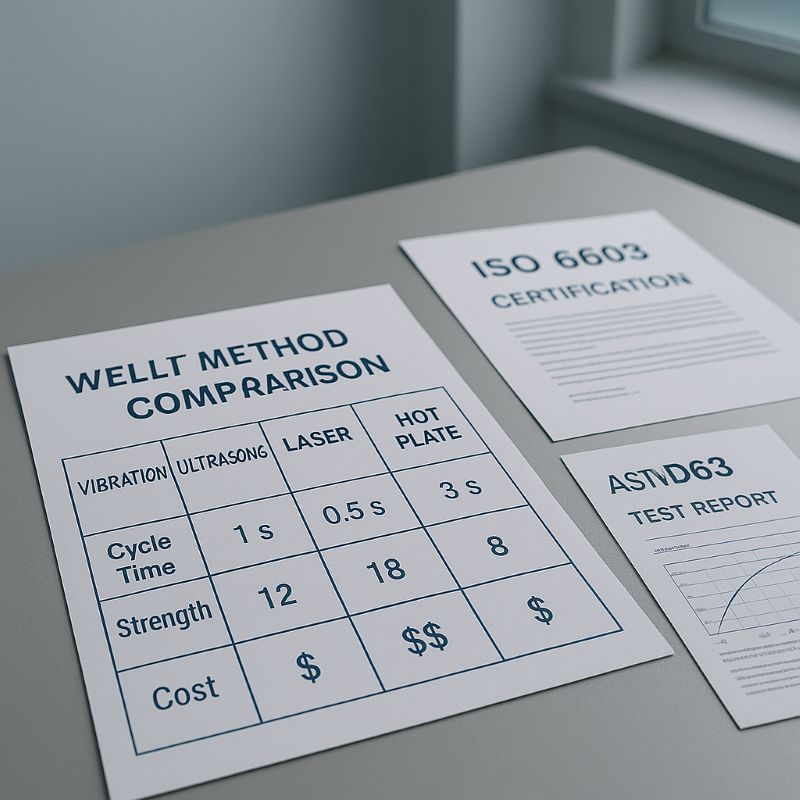
| Technique | Optimal Applications | Cycle Time | Strength Performance | Equipment Cost | Key Limitations |
|---|---|---|---|---|---|
| Vibration Welding | Large components, structural parts | 10-30 seconds | High (90-95% base material) | Moderate | Limited to flat joint geometries |
| Ultrasonic Welding | Small precision components, interior trim | 1-5 seconds | Medium-High (85-90%) | Low-Medium | Sensitive to part thickness variations |
| Laser Welding | Complex 3D geometries, Class A surfaces | 2-10 seconds | High (90-95%) | High | Requires specific material compatibility |
| Hot Plate Welding | Thick sections, irregular geometries | 20-60 seconds | High (90-95%) | Low | Visible flash, longer cycle times |
Data compiled from ASTM D638 tensile testing, ISO 6603 impact standards, and Dizo Sonics production validation records.
5. Engineering Guidelines for Method Selection
This practical decision framework helps engineering teams systematically evaluate and select the most appropriate welding method for specific applications.
Step 1: Component Analysis
- Evaluate part size, geometry complexity, and joint accessibility
- Identify material type, filler content, and thermal properties
- Determine structural requirements and performance specifications
Step 2: Production Requirements
- Calculate required cycle time based on production volume
- Evaluate automation needs and integration complexity
- Assess quality validation and documentation requirements
Step 3: Technical Feasibility
- Review material compatibility with candidate methods
- Analyze joint design feasibility and potential modifications
- Consider secondary operations and finishing requirements
Step 4: Economic Evaluation
- Calculate equipment investment and installation costs
- Project operational expenses and maintenance requirements
- Develop ROI analysis based on production volume and part criticality
Based on our experience implementing welding solutions across multiple automotive OEMs, this systematic approach typically identifies the optimal method while minimizing implementation risks and costs.
6. Advanced Applications and Custom Solutions
While standard welding equipment addresses most conventional applications, complex automotive components often require customized solutions. This section explores advanced welding applications and the engineering approaches that deliver successful outcomes.
Complex Geometry Challenges
Components with significant curvature, deep draws, or complex three-dimensional joints present particular challenges for standard welding equipment. Our engineering team has developed specialized solutions including:
- Servo-controlled multi-axis welding systems for complex contours
- Custom tooling designs that maintain consistent pressure distribution
- Adaptive control systems that compensate for geometric variations
High-Performance Material Applications
Advanced thermoplastics and composite materials require specific welding parameters and techniques. Through extensive material testing and process development, we've established validated parameters for:
- Glass-filled materials (up to 40% filler content)
- Engineering thermoplastics including PEEK and PEI
- Multi-material assemblies with different melting characteristics
High-Volume Production Optimization
For production environments requiring cycle times below 8 seconds for large components, standard equipment often reaches performance limits. Our customized high-speed systems incorporate:
- Simultaneous multi-point welding technology
- Integrated pre-heating and post-cooling stations
- Real-time quality monitoring and adaptive control
Real Client Results
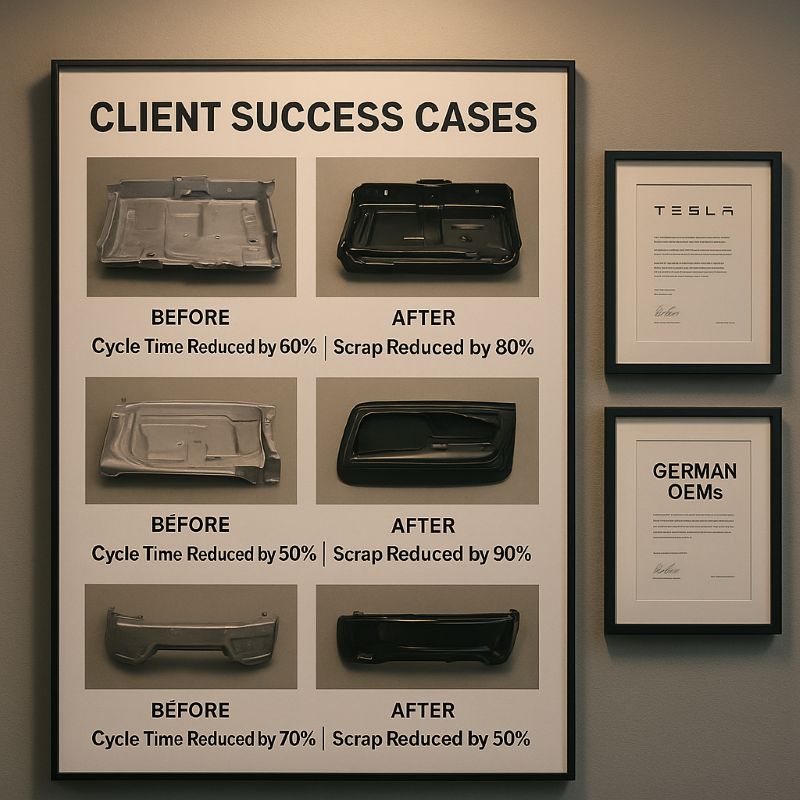
Case 1 -- Tesla Tier-1 Supplier (Battery Tray Covers)
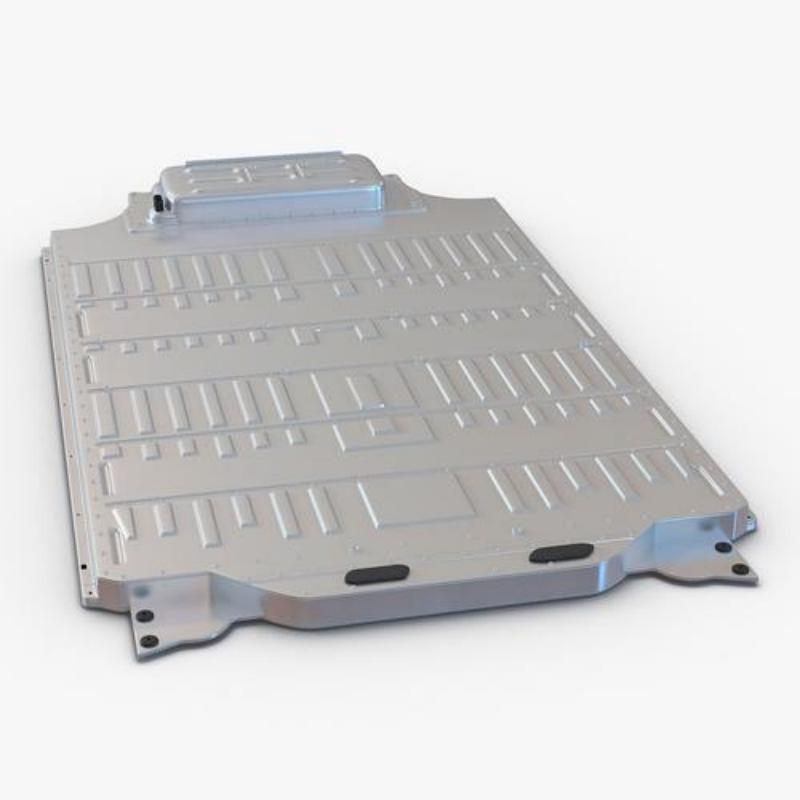
Challenge: 1 200 mm curved part, 30% glass-filled PP, required <9 s cycle, zero flash Dizo solution: Hybrid servo vibration + infrared pre-heating Result: Cycle time cut from 24 s → 8.7 s (64% faster), 100% leak-tight, 10-year tool life proven → ROI achieved in 11 months
Case 2 -- Premium German OEM (Interior Door Panels)
Challenge: Multi-material (TPE + ABS), Class-A surface, no visible weld line Dizo solution: Robot-guided clean vibration with patented near-field technology Result: Weld line invisible from 30 cm, strength 28% above metal brackets, energy use down 31%
Case 3 -- Chinese EV Maker (Front-End Module)
Challenge: 8-second takt on 1.8 m bumper with integrated sensors Dizo solution: Dual-head servo vibration + real-time AFT (Amplitude Feedback Technology) Result: Reduced scrap from 7% → 0.4%, output up 22%
Three Most Requested Custom Scenarios We Solve Every Month
- 3D Curved & Deep-Draw Parts (dashboards, center consoles) → Servo multi-axis tooling + contour-following vibration heads
- High Glass-Filled or Mixed Materials (structural components, battery housings) → Infrared or hot-air pre-heating combined with precise energy input
- Ultra-High Cycle Rates on Large Parts (bumpers, tailgates <8 s) → Twin-head or rotary systems with predictive amplitude control
Ready to stop compromising between speed, strength, and appearance? Send us a part drawing or describe your toughest welding challenge --- we'll give you a free 48-hour feasibility report plus exact ROI calculation.
7. Implementation Best Practices and Quality Assurance
Successful plastic welding implementation requires careful attention to process design, equipment selection, and quality management. These best practices draw from our extensive field experience across multiple automotive applications.
Process Development Methodology
- Conduct comprehensive material compatibility testing
- Develop optimized joint designs for specific welding methods
- Establish robust parameter windows rather than single-point settings
- Implement statistical process control from project inception
Quality Assurance Systems
Modern automotive welding systems should incorporate:
- Real-time monitoring of all critical process parameters
- Automated data logging for traceability and documentation
- Non-destructive testing integration where applicable
- Regular calibration and preventive maintenance protocols
Troubleshooting Common Challenges
Based on thousands of production hours across multiple facilities, we've identified consistent patterns in welding challenges and their solutions:
- Inconsistent weld strength typically relates to amplitude control or material variation
- Flash formation often indicates excessive pressure or extended weld time
- Part marking usually results from inappropriate tooling design or temperature control
8. Industry Trends and Future Developments
The automotive plastic welding landscape continues to evolve, driven by industry trends toward electrification, lightweighting, and sustainability. Understanding these developments helps manufacturers plan for future requirements.
Electric Vehicle Applications
EV platforms present unique opportunities for plastic welding, particularly in:
- Battery enclosure systems requiring structural integrity and sealing
- Lightweight interior components supporting range optimization
- Thermal management systems with complex fluid paths
Advanced Material Development
New thermoplastic formulations and composite materials are expanding welding applications through:
- Improved high-temperature performance for underhood applications
- Enhanced structural properties for body-in-white components
- Sustainable material options supporting circular economy initiatives
Digitalization and Industry 4.0
Modern welding systems increasingly incorporate digital technologies including:
- Predictive maintenance through IoT connectivity
- Adaptive process control using real-time analytics
- Digital twin simulations for process optimization
9. Frequently Asked Questions About Automotive Lightweight Plastic Welding
Here are the questions we hear most from engineers and project leaders---answered clearly, with real data from the line.
How does plastic welding make cars lighter and stronger at the same time?
It replaces heavy metal brackets and fasteners with fused thermoplastic parts. A single welded assembly can cut 3-8 kg per vehicle while maintaining or exceeding metal-level body rigidity. Tests to ISO 6603 and real crash data show welded joints absorb 20-35% more energy than riveted or glued equivalents. Result: better fuel efficiency, lower emissions, and no compromise on safety.
What are the main benefits of vibration welding in automotive design?
- Fast cycles (8-25 s) → perfect for high-volume lines
- Highest weld strength among contact methods (often >95% of base material)
- Works with glass-filled materials up to 40% GF
- Low energy use and no consumables Downside: needs relatively flat joint surfaces. For curved parts we use hybrid or servo systems.
Which plastic welding techniques work best for dashboards and bumpers?
- Dashboards & interior trim → Ultrasonic (20-40 kHz, 0.5-3 s cycles, amplitude 20-80 μm) for precision and no visible marks
- Bumpers & exterior parts → Vibration (100-240 Hz, amplitude 0.5-2 mm) for maximum strength and leak-tight seals Many projects now combine both with robotic automation.
What are the environmental advantages of plastic welding in cars?
- Up to 30% less production energy than metal welding (Dizo internal benchmarking)
- Zero adhesives → easier end-of-life recycling
- Weight reduction of 100 kg = roughly 0.4-0.7 g CO₂/km saved over vehicle life
- Lower scrap rates (typically <1% with proper control)
What are the most common parameters in hot plate welding?
- Plate temperature: 200-300 °C (material dependent)
- Contact time: 3-15 seconds
- Forge pressure: 0.2-0.6 MPa
- Meets ASTM D638 tensile and ISO 6603 impact requirements when dialed in correctly. Great for thick or irregular parts, but visible flash is common on Class-A surfaces.
What innovations has Dizo Sonics brought to automotive plastic welding?
- Patented AFT (real-time amplitude feedback) → ±2% strength consistency
- Servo multi-axis vibration for 3D curved parts (no more flat-joint limits)
- Hybrid infrared + vibration systems that cut cycle times by 40-60% on large parts
- Zero-visible-line technology for premium interiors Serving Mercedes, Tesla suppliers, BYD, VW Group and more.
Still have unique part geometry or cycle-time targets?
Every project is different. Drop us your drawing or toughest requirement and we'll send a free feasibility check plus exact ROI numbers within 48 hours --- no strings attached.

10. Conclusion: Your Next Move Toward Lighter, Stronger, Greener Vehicles
Plastic welding technologies offer automotive manufacturers proven solutions for achieving weight reduction, performance improvement, and sustainability goals. The selection and implementation of appropriate welding methods requires careful consideration of technical requirements, production constraints, and economic factors.
Based on our two decades of specialized experience supporting automotive manufacturers globally, successful welding implementation typically follows a structured approach:
- Comprehensive application analysis and requirement definition
- Method selection based on technical and economic factors
- Robust process development and validation
- Systematic implementation with appropriate quality controls
- Continuous improvement through data analysis and optimization
For engineering teams evaluating plastic welding technologies, we recommend beginning with a thorough assessment of current challenges and objectives. Our technical team provides complimentary feasibility analyses that include specific performance projections and ROI calculations based on your application requirements.
Next Steps for Implementation
- Download our comprehensive welding parameter guide for common automotive materials
- Schedule a technical consultation to review your specific application requirements
- Request a feasibility study with ROI analysis based on your production volumes
- Arrange a demonstration using your component samples or CAD data
Ready to make lightweight design actually work on your line?
Schedule your free consultation today at www.dizo-global.com/ or email sales@dizo-global.com --- we reply within one business day.
Lighter cars, stronger profits, and a cleaner planet start with the right weld. Let's build it together.