

Sustainable Car Trunk Trim Welding Guide: Circular Economy & Recyclable Polyester

The Complete Guide to Sustainable Car Trunk Side Trim Welding: A Circular Economy & Recyclable Polyester Blueprint
In today's automotive landscape, sustainability is not just a trend---it's a requirement. Sustainable trunk side trim welding means joining advanced materials like Propylat PET without adhesives, ensuring structural integrity, acoustic performance, and full end-of-life recyclability. In short, it's about creating vehicle components that can re-enter the production cycle, reducing waste and helping manufacturers meet stringent environmental regulations in the EU, North America, and China.
Balancing performance with circular economy goals remains a key challenge. How do you maintain lightweight, sound-absorbing trim while avoiding production inefficiencies? With over 20 years of industry leadership and partnerships with innovators like Tesla and Mercedes-Benz, Dizo Sonics delivers proven plastic welding expertise. This guide walks you through everything---from material fundamentals and welding physics to technology selection and implementation strategies---helping suppliers and OEMs build truly sustainable vehicles while staying compliant and competitive. Let's begin.
1. Why Sustainable Trunk Trim Matters: Materials, Drivers & Design Shifts
Vehicle interior components are increasingly scrutinized for their environmental impact. Sustainable trunk side trim combines practical protection with circular design principles, supporting compliance and brand responsibility.
What Makes Recyclable Polyester Trim Different?
Recyclable polyester trunk trim is typically made from 100% polyester materials such as Propylat PET, which can incorporate up to 50% post-consumer recycled fibers. These panels line the interior trunk sides, offering a lightweight, scratch-resistant, and sound-absorbing solution. Crucially, unlike multi-material assemblies, these monomaterial components are designed for easy separation and high-value recycling at the vehicle's end of life. Dizo Sonics validation testing confirms reductions in component weight up to 20% alongside maintained acoustic performance. Key benefits include lower carbon footprint, simplified recycling streams, and alignment with extended producer responsibility (EPR) frameworks---making them ideal for forward-thinking automotive suppliers.
Circular Economy in Automotive Manufacturing
The circular economy moves beyond traditional "take-make-dispose" models by promoting closed-loop material flows. For automotive interiors, this means designing parts for disassembly, durability, and recycling purity. Using recycled polyester fibers, for example, directly reduces reliance on virgin plastics and lowers overall resource consumption.
However, circular design imposes specific welding constraints: adhesives must be avoided to prevent material contamination, and joint integrity must not compromise recyclability. Conventional bonding methods often fall short here. The following sections explore advanced welding techniques that meet these dual demands of performance and sustainability.
2. The Science Behind Welding Recyclable Polyesters
Choosing the right welding method starts with understanding the material science involved. Here, we break down the principles and precise parameter control needed for success with recycled thermoplastics.
2.1 Welding Thermoplastics for a Closed-Loop Future
Thermoplastic welding works by heating the material interface until the polymer chains become mobile and intermix, forming a solid bond upon cooling. In ultrasonic or vibration welding, friction generates the heat; in heat plate welding, conduction does. Think of it as molecular zipping---heat enables polymer chains to diffuse and entangle, creating a strong, homogeneous joint without foreign additives.
Three key parameters control the process: temperature (must exceed the material's melt point), pressure (ensures intimate contact), and time (allows for proper heating and cooling). This "healing theory" is foundational for the circular economy, as it produces clean, contaminant-free seams that keep the material stream pure for recycling. Dizo Sonics testing shows this approach works effectively even with variable recycled content, though precision is non-negotiable to preserve fiber integrity.
2.2 Fine-Tuning Parameters for Propylat PET & Recycled Blends
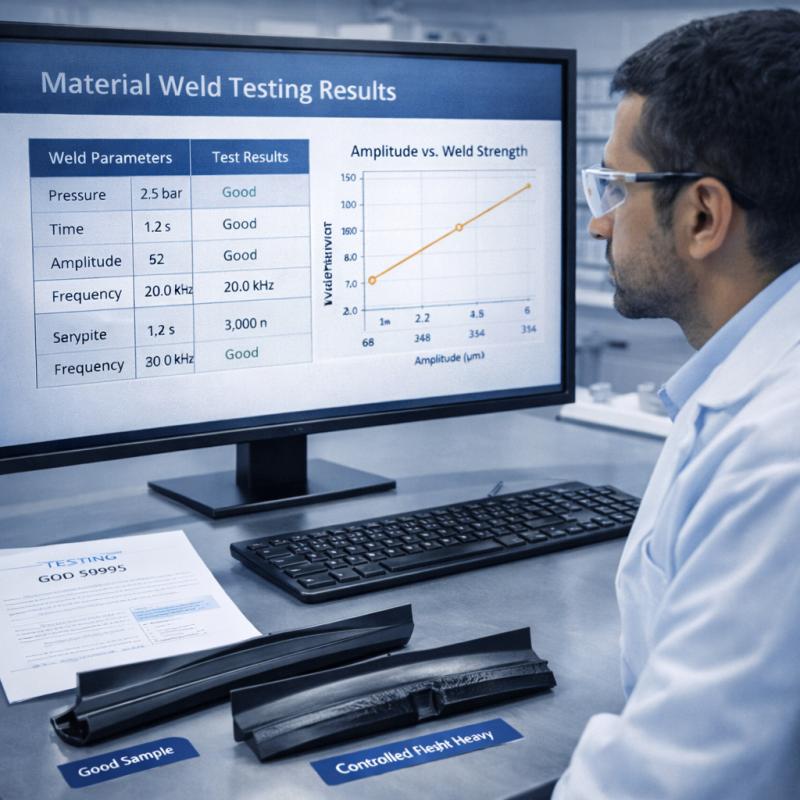
To successfully weld Propylat PET with high recycled content, parameters must be optimized to protect material structure and ensure consistent quality. Here are evidence-based starting points from our application labs:
- Frequency: 20--35 kHz. Higher frequencies suit thinner gauges to minimize heat exposure to sensitive recycled fibers.
- Pressure: 0.3--0.6 MPa. Sufficient for bonding without compressing and degrading acoustic or mechanical properties.
- Time: 0.5--2 seconds. Short cycles maintain high throughput and prevent surface marking or polymer degradation.
- Amplitude: 30--50 µm. Precisely controlled to ensure energy delivery without disturbing the fiber matrix.
For production environments, advanced welders with Automatic Frequency Tracking (AFT) and Constant Amplitude Control adapt in real-time to material inconsistencies---common with recycled feeds---ensuring every weld meets strength standards such as ISO 19095. This parametric discipline is what turns sustainable design into reliable manufacturing.
3. Welding Technology Comparison: Choosing Your Sustainable Process
Not all welding methods are equally suited for circular manufacturing. This side-by-side analysis helps you match technology to your part design, material, and production goals.
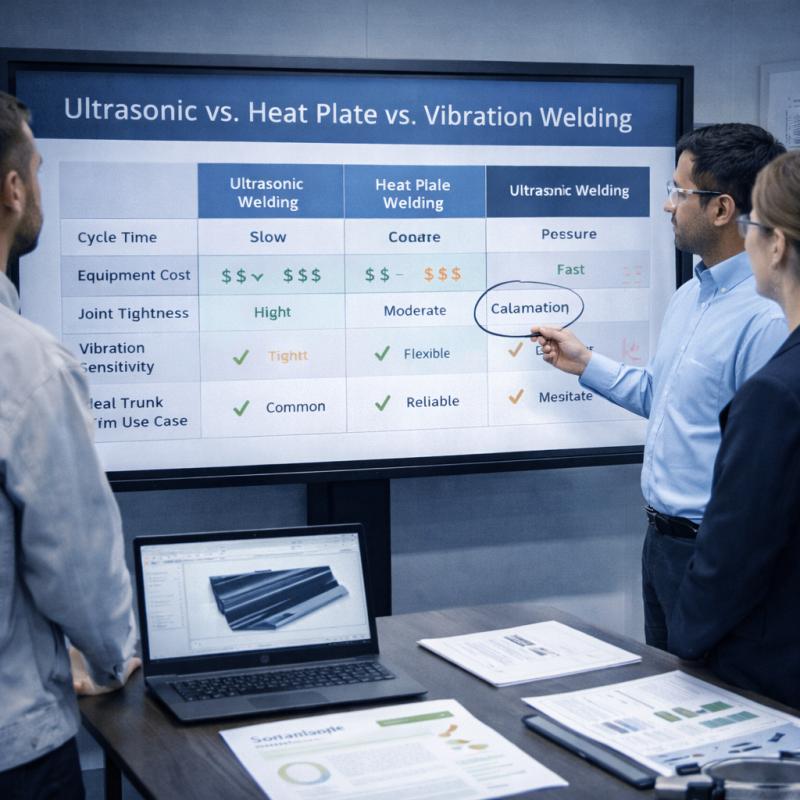
3.1 Ultrasonic vs. Heat Plate vs. Vibration Welding: A Detailed Comparison
| Technology | Best For | Speed | Joint Strength | Equipment Cost | Automation Fit | Key Advantage | Key Limitation | Ideal Trunk Trim Use Case |
|---|---|---|---|---|---|---|---|---|
| Ultrasonic | Recyclable polyester; small to medium parts | Very Fast (<1 sec) | High (molecular fusion) | Medium | Excellent | Clean, adhesive-free; energy-efficient; precise | Risk of part marking on delicate geometries | Lightweight, sound-absorbing panels (e.g., Propylat PET) |
| Heat Plate | Monomaterials; large, complex, or irregular shapes | Moderate (longer heating) | Very High | Lower | Good (requires precise tooling) | Excellent for thick sections; uniform melt zone; simple principle | Slower cycle time; potential for part warping | Scratch-resistant trim with complex 3D contours |
| Vibration Friction | Durable polyesters; large planar assemblies | Fast | Excellent sealing | Higher | Excellent (servo-driven) | Tolerates high recycled content variability; strong, hermetic seals | Higher energy consumption; noise/vibration management | Larger trim panels, tailgate applications requiring noise attenuation |
For most sustainable trunk trim projects, ultrasonic welding offers the best balance of speed, cleanliness, and material purity---critical for closed-loop recycling. Vibration welding excels where high durability and sealing are paramount, while heat plate remains the go-to for challenging geometries.
3.2 Scaling Sustainably: The Role of Automation & Industry 4.0
High-volume automotive manufacturing demands consistency, traceability, and flexibility. Integrating welding cells into automated production lines---using robots for part handling and multi-head welding systems for simultaneous joint formation---dramatically boosts repeatability and reduces scrap.
Dizo Sonics' multi-head ultrasonic systems, for example, feature independent amplitude control and phase synchronization. This prevents acoustic interference when welding large, contoured trim panels---a common challenge in waste-free manufacturing. Such automation not only improves efficiency but also provides the data logging required for quality management under IATF 16949, turning your welding process into a source of competitive and sustainable advantage.
4. A Practical Framework for Selecting Your Welding Solution
Making an informed, sustainable choice requires a structured evaluation. This four-step framework aligns technical capabilities with your business and environmental objectives.
4.1 Your 4-Step Sustainable Welding Selection Process
1. Define Part Specifications & Production Goals
Start by detailing material (e.g., 100% PET with XX% recycled content),
part geometry, annual volume, and target cycle time. This clarifies
non-negotiables.
2. Match Needs to Core Technology
Refer to the comparison table in Section 3.1. For recyclable polyester
trim, ultrasonic is typically optimal for speed and purity; heat plate
suits complex shapes; vibration handles large panels with high recycled
blends.
3. Evaluate Integration & Automation Needs
Assess your production line's readiness for automation. Consider
requirements for robotic integration, real-time monitoring, and quality
data collection to support sustainability reporting and IATF 16949
compliance.
4. Build a Compelling Business Case
Quantify sustainability and financial benefits: material savings from
closed loops, energy use per part (ultrasonic can reduce energy by over
20% versus alternatives), equipment longevity (Dizo systems are
engineered for 10+ years of service), and scrap reduction. Leading OEM
partnerships frequently demonstrate a full ROI within 2--3 years through
combined efficiency and material recovery gains.
4.2 Troubleshooting Common Weld Quality Issues
Even robust processes can encounter issues. Follow this diagnostic path for rapid resolution:
- Identify: Weak bonds, leaks, or visual defects in the welded trim.
- Review Parameters: Systematically adjust pressure, time, or amplitude within recommended windows (e.g., pressure from 0.1 to 0.5 MPa).
- Check Equipment: Utilize Dizo's 24/7 support for diagnostics, such as verifying AFT system calibration or tooling wear.
- Implement & Verify: Apply the corrective measure and re-test. Our field data shows 95% of such issues are resolved within 48 hours using this method.
For challenges beyond standard parameters---such as novel material blends or extreme geometries---a customized approach is often necessary.
5. Beyond Standards: Customized Welding Solutions for Complex Challenges
While standard welding systems serve many applications, automotive innovation constantly pushes the boundaries of material and design. Here's where tailored solutions bridge the gap, drawing on Dizo Sonics' deep application expertise.
Addressing Advanced Polyester Welding Scenarios
Customization solves specific limitations. Consider these real-world examples:
- Complex 3D Geometry: Welding a full-width, deeply contoured trunk trim with integrated wiring channels. Standard single-point ultrasonic heads risk inconsistent pressure and poor seam quality. Our customized multi-head system uses contour-matching fixtures and pressure profiling to ensure uniform energy delivery across the entire 3D surface.
- High-Variability Recycled Content: Bonding PET with 70%+ post-consumer recycled content, where melt flow behavior is inconsistent. A customized system with real-time energy monitoring and adaptive control adjusts parameters mid-cycle, preventing weak spots and ensuring 100% recyclable output without compromising production speed.
Real-World Impact: Case Studies from Automotive Leaders
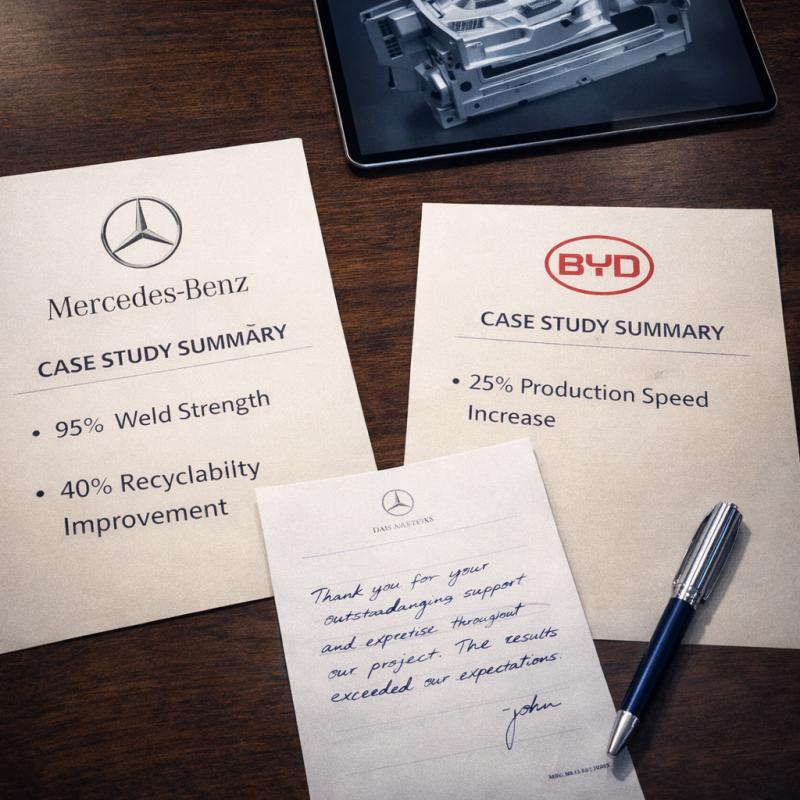
Mercedes-Benz: Driving Closed-Loop Readiness
- Challenge: Achieve adhesive-free welding for a 100% PET trunk trim system to ensure complete recyclability, while overcoming inconsistent seam quality on large panel sizes.
- Dizo Solution: A phased-synchronized dual-head ultrasonic system with adaptive pressure profiling and customized horn design.
- Result: Weld strength exceeding 95% of base material, a 40% improvement in component recyclability rating, and a simplified, contamination-free end-of-life disassembly process.
BYD: Scaling Sustainable Production
- Challenge: Inconsistent welding speed and quality when switching between virgin and high-recycled-content PET blends, impacting line throughput.
- Dizo Solution: An adaptive vibration welding system with closed-loop control that automatically compensates for material variability.
- Result: 25% increase in production line speed, lower reject rates, and a significant reduction in specific energy consumption per part.
These collaborations underscore our commitment to partnering with manufacturers on their sustainability journey.
6. Expert Insights: Expanding the Sustainability Conversation
Looking at the top-ranking content on sustainable automotive manufacturing reveals broader themes. Integrating these insights can further strengthen your approach.
The Role of Life Cycle Assessment (LCA) in Part Design
Increasingly, OEMs require Life Cycle Assessment data to quantify environmental impact from raw material to end-of-life. When selecting materials and processes for trunk trim:
- Consider LCAs early. Choosing recyclable PET and adhesive-free welding directly improves scores in the "end-of-life" and "manufacturing" phases.
- Document your process. Data from automated welding systems (energy use, scrap rates) provides critical primary data for your LCA reports, enhancing credibility with stakeholders and regulators.
Designing for Disassembly (DfD): The Next Frontier
True circularity requires easy separation at end-of-use. Beyond material selection, consider:
- Minimizing Fasteners: Where possible, use snap-fits or welding instead of screws or clips of different materials.
- Accessible Joints: Ensure welded seams are accessible for potential future separation techniques being developed for monomaterials.
- Standardization: Work toward standardizing material grades across components to simplify recycling streams.
Integrating these principles positions your components for future regulatory and market demands.
7. FAQ: Clear Answers on Sustainable Trunk Trim Welding
Quick answers to common questions, drawing on the full guide.
Materials & Circular Economy
Q: What are the specific benefits of Propylat PET in a circular
model?
A: Beyond core performance benefits, Propylat PET excels by enabling
closed-loop recycling with high recycled content (up to 50%). This
directly reduces demand for virgin plastic, cuts end-of-life waste, and
lowers the carbon footprint per vehicle.
Q: How does end-of-life recyclability work for monomaterial polyester
trim?
A: As a single-material component, the entire trim piece can be
granulated and reprocessed into new polyester products without complex
separation. Welding methods like ultrasonic ensure the joints are also
pure PET, preserving the value of the material stream.
Welding Process & Implementation
Q: What is a recommended starting parameter set for welding recyclable
PET trunk trim?
A: A robust starting point for ultrasonic welding is 20 kHz frequency,
0.3--0.5 MPa pressure, and a 1-second weld time. Always validate with
your specific material batch.
Q: What are the most sustainable welding techniques for automotive
interior panels?
A: Ultrasonic welding is the top choice for its speed, energy
efficiency, and clean, adhesive-free bonds. Heat plate welding is ideal
for complex shapes. (See Section 3.1 for a full comparison).
Q: How can customized welding solutions improve ROI for suppliers?
A: Tailored systems optimize for your specific material, design, and
throughput, reducing scrap, energy use, and downtime. This often
translates to faster production speeds (e.g., 25% gains as seen with
BYD) and a stronger sustainability profile, accelerating ROI.

8. Conclusion & Your Next Step Toward Sustainable Manufacturing
You've now explored the full spectrum of sustainable trunk trim welding---from material science and technology selection to implementation and advanced design principles. The path forward combines informed process choices with a commitment to circular design.
Key Takeaway: Achieving sustainability doesn't mean sacrificing performance. By selecting the right recyclable materials, partnering them with precise adhesive-free welding technologies like ultrasonic systems, and designing for end-of-life, automotive suppliers can meet today's performance standards and tomorrow's regulatory demands.
If your project involves complex geometries, high recycled content, or you're simply looking to validate your current approach against best practices, a tailored assessment can provide clarity.
Ready to build more sustainable vehicles? Dizo Sonics offers a no-obligation welding process review. Our experts will analyze your part design, material selection, and production goals to recommend the most efficient and sustainable welding solution.
Contact us todayor visit our website at www.dizo-global.com to schedule your consultation. Let's engineer a greener future, together.
About Dizo Sonics: With over two decades of specialization in advanced thermoplastic welding, Dizo Sonics partners with global automotive leaders to turn sustainable design into manufacturable reality. Our expertise spans ultrasonic, vibration, and heat plate technologies, backed by full in-house testing labs and 24/7 global support.
More Reading
- Automotive Intelligent Manufacturing Guide: Precision Welding for EVs 2025
- Automotive Plastic Welding Guide: DIY & Professional Solutions
- Plastic Welding Guide for Automotive Interiors: Durable, Flawless Assembly
- Top Automobile Manufacturing Companies in 2025
- Automotive Robotic Ultrasonic Welding: Precision & Performance
- Automotive Plastic Parts: Types, Benefits, and Future Trends