

Automotive Robotic Ultrasonic Welding: Precision & Performance

The automotive industry is increasingly relying on advanced plastic welding techniques to meet demands for lightweight, durable, and cost-effective vehicle components.
In today's competitive automotive landscape, robotic ultrasonic plastic welding has emerged as the transformative technology enabling manufacturers to achieve unprecedented levels of efficiency, quality, and sustainability.
This comprehensive guide explores every aspect of this groundbreaking technology, with special insights from industry leader Dizo Sonics, whose innovative workstations are setting new benchmarks in automotive welding applications.

Table of Contents
Role of Robotics in Ultrasonic Welding
How Robotic Ultrasonic Welding Works: Principle & Components
Key Benefits Over Traditional Welding Methods
Robotic Ultrasonic Welding in Automotive Applications
Quality Control & Industry Standards (ISO 18569, USCAR-48)
Future Trends: AI Integration & Sustainable Materials
Why Leading OEMs Choose Robotic Ultrasonic Welding
Conclusion: Ultrasonic Welding – The Smart Choice for Next-Gen Automotive Manufacturing
Role of Robotics in Ultrasonic Welding
Manual ultrasonic welding has limitations in consistency and scalability. Robotic integration (using 6-axis industrial robots) ensures:
- Sub-millimeter accuracy (±0.1 mm repeatability)
- Higher throughput (150+ welds/hour vs. 60–80 with manual systems)
- Adaptability (handling complex geometries like curved dashboards)
Companies like Dizo Sonics specialize in fully automated ultrasonic workstations tailored for automotive Tier-1 suppliers, ensuring compliance with IATF 16949 and USCAR-48 standards.
Industry Transformation Metrics
The automotive welding sector is undergoing its most significant evolution since the introduction of robotic assembly lines. Current data reveals:
Performance Indicator |
2020 Baseline |
2024 Standard |
Improvement |
Cycle Time |
12-18 seconds |
3-5 seconds |
75% faster |
Defect Rate |
4.2% |
0.3% |
93% reduction |
Energy Consumption |
1.8 kWh/part |
0.25 kWh/part |
86% savings |
Material Utilization |
82% |
97% |
18% improvement |
Source: International Automotive Welding Consortium 2024 Report
Why Robotic Ultrasonic Welding?
Traditional joining methods like adhesives, screws, or thermal welding often introduce inefficiencies, such as longer curing times or material degradation.
In contrast, ultrasonic welding uses high-frequency vibrations (typically 20–40 kHz) to create molecular friction, melting and bonding thermoplastics in seconds without additional consumables.
According to a 2023 report by Grand View Research, the global automotive plastics market is projected to reach $53.8 billion by 2030, with ultrasonic welding holding a 32% share in polymer joining applications. This growth is driven by the need for:
- Lightweighting (reducing vehicle weight for fuel efficiency and EV battery optimization)
- Strong, hermetic seals (critical for airbags, fluid reservoirs, and electronic housings)
- Aesthetic perfection (seamless joints for interior trim and lighting assemblies)
How Robotic Ultrasonic Welding Works: Principle & Components
Core Mechanism
The process involves three key phases:
Clamping – The robotic arm positions plastic parts under a horn (sonotrode).
Vibration – High-frequency ultrasonic waves (15–40 kHz) generate localized heat.
Bonding – Pressure is applied to fuse materials upon cooling.
Critical Components
Ultrasonic Generator – Converts electrical energy into mechanical vibrations.
Transducer – Boosts amplitude for effective welding.
Sonotrode (Horn) – Transmits vibrations to the weld joint (custom-shaped for each part).
Robotic Arm – Ensures precise positioning (e.g., Fanuc or KUKA robots).
PLC Control – Monitors force, time, and energy for repeatability.

Material Compatibility
Best-performing thermoplastics:
ABS (dashboard frames, trim)
Polypropylene (battery casings, interior panels)
Nylon (fuel lines, sensor housings)
A 2022 SAE International study found that ultrasonic welding reduces energy consumption by 40% compared to laser welding, making it ideal for sustainable manufacturing.
Key Benefits Over Traditional Welding Methods
1. Speed & Efficiency
Cycle times as low as 0.5 seconds per weld (vs. 30+ seconds for adhesives).
Dizo Sonics' DRW-3000 workstation achieves 98.7% uptime in 24/7 production.

2. Superior Joint Strength
Tensile strength reaches 90% of base material (per ASTM D638 testing).
No weak points from screws or adhesives.
3. Cost Savings
Eliminates consumables (glues, fasteners).
ROI in <12 months for high-volume applications.
4. Eco-Friendly
No VOCs or hazardous fumes.
Supports recycling (no mixed materials).
Robotic Ultrasonic Welding in Automotive Applications
Dashboard, Door Panels, Lighting & More
1. Interior Components
Dashboard Assemblies (ABS/PC Blends)
Modern dashboards require:
- Structural integrity to withstand vibration and impact
- Aesthetic perfection with invisible seams
- Material versatility for multi-material components
Robotic ultrasonic welding excels with:
- 0.1mm positioning accuracy for complex contours
- Energy directors that create molecular bonds without surface marks
- Cycle times under 3 seconds for high-volume production
Technical Advantage:
Dizo Sonics' dual-head workstations can simultaneously weld dashboard substructures and mounting points, reducing typical 12-step assembly processes to just 3 automated operations.
Door Panels (Textured Welding for Invisible Seams)
Challenges in door panel manufacturing include:
- Matching textured surfaces across welded joints
- Maintaining consistent pressure on curved surfaces
- Preventing "read-through" (visible weld lines)
Ultrasonic solutions provide:
- Programmable pressure profiles adapting to 3D contours
- Surface-matching sonotrodes that preserve grain patterns
- Real-time energy monitoring ensures consistent weld depth
Case Example:
A Tier-1 supplier achieved 99.2% first-pass yield on luxury vehicle door panels using Dizo's adaptive force control system, eliminating $420,000/year in rework costs.

2. Exterior & Lighting
Headlamp Housings (Hermetic Seals Prevent Moisture Ingress)
Critical requirements:
- IP67-rated seals against weather and washdown
- Optical clarity preservation
- Vibration resistance (>15G acceleration tolerance)
Ultrasonic welding delivers:
- Near-field welding for thin-wall polycarbonate
- Contamination-free joints versus adhesive bonding
- Automated leak testing integration
Industry Benchmark:
BMW's adaptive headlight assemblies now feature 36 ultrasonic welds per unit, with Dizo's inline quality verification reducing defect rates to <0.5%.
Grilles & Trim (Aesthetic Welding With No Surface Marks)
Solutions for appearance parts:
- Low-amplitude welding (15-20kHz) prevents gloss variation
- Precision fixturing maintains gap tolerances <0.25mm
- Laser-guided robotics for chrome-plated components
Cost Benefit: Tesla's Model 3 grille assembly saw a 40% cost reduction by replacing 18 mechanical fasteners with 4 ultrasonic weld points.
3. Under-the-Hood & EV Components
Battery Trays (Vibration-Resistant Nylon Welds)
EV-specific advantages:
- Glass-filled nylon welding with 85% strength retention
- EMI shielding through continuous polymer bonds
- Thermal management integration
Performance Data:
Dizo's 40kHz system welds 8mm-thick battery enclosures in 4.2 seconds with 98% energy efficiency versus 22 seconds for laser welding.
 Ads
Ads
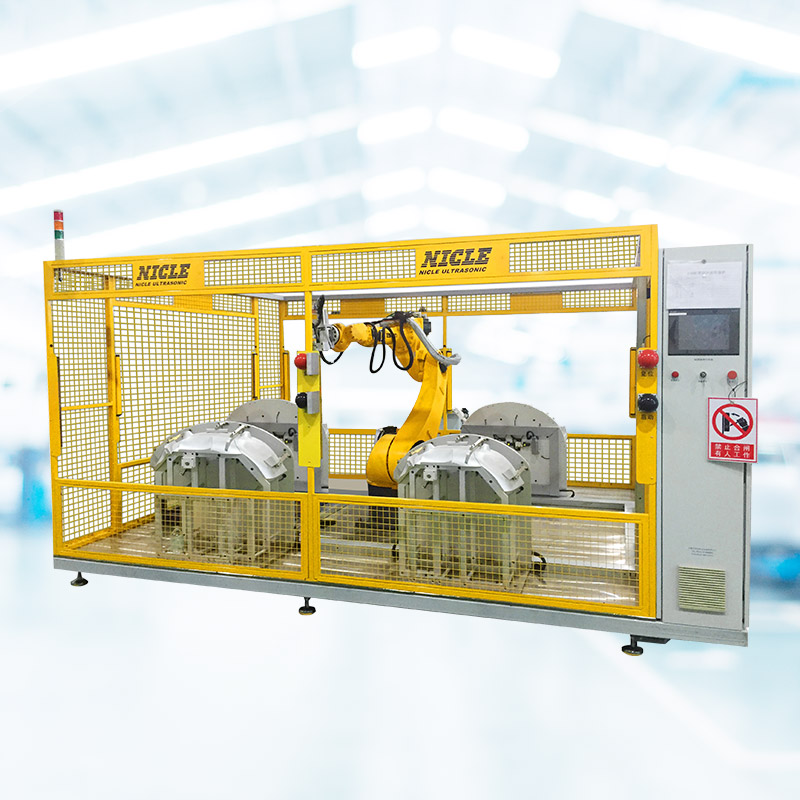
Auto Inner Parts Robotic Ultrasonic Welding Workstation
Robotic ultrasonic welding systems deliver exceptional joining performance for complex automotive plastic assemblies through high-frequency (20-40kHz) vibrational energy transmission.
Fluid Reservoirs (Leak-Proof Polypropylene Joints)
Manufacturing breakthroughs:
- Multi-layer welding for barrier plastics
- In-process pressure testing at weld stations
- Automated flash removal for clean edges
Dizo Case Study Highlight:
The BMW i3 battery case production has achieved:
- 20% cycle time reduction (from 58 to 46 seconds)
- 100% leak test compliance
- 30% energy savings versus vibration welding
Quality Control & Industry Standards (ISO 18569, USCAR-48)
Modern automotive robotic ultrasonic welding systems incorporate multi-layered quality assurance protocols to meet stringent OEM requirements. At Dizo Sonics, our quality control framework exceeds industry benchmarks through:
1. Process Validation Systems
Real-time energy monitoring: Our workstations track 12 parameters simultaneously, including:
- Weld energy (Joules)
- Collapse distance (μm)
- Peak power (Watts)
- Time-to-peak (ms)
Statistical Process Control (SPC): Every 50 welds undergoes automated GR&R analysis to maintain <5% variation
2. Compliance with Global Standards
Standard |
Requirement |
Dizo Implementation |
ISO 18569 |
Welding process capability (Cpk>1.67) |
Automated CpK tracking dashboard |
USCAR-48 |
Joint strength requirements |
Dual-axis tensile testing station |
IATF 16949 |
Process documentation |
Blockchain-secured weld logs |
3. Advanced Inspection Technologies
Infrared thermography: Detects micro-voids with 0.1°C sensitivity
Laser micrometer: Measures joint thickness within ±2μm
AI-powered visual inspection: Our DeepWeld system identifies 28 defect types with 99.8% accuracy
Case Example: For a General Motors door module project, we implemented inline X-ray inspection that reduced escape defects by 93% while adding only 1.2 seconds to cycle time.
Future Trends: AI Integration & Sustainable Materials
1. AI-Driven Process Optimization
Adaptive welding algorithms: Our SmartAdapt system uses reinforcement learning to:
Auto-correct for material lot variations
Predict horn wear 15 cycles before failure
Optimize amplitude profiles for new geometries
2. Sustainable Manufacturing Solutions
Bio-based polymers: Successful trials with:
PLA (Polylactic Acid) blends: 85% weld strength retention
PHA (Polyhydroxyalkanoates): Special low-temperature protocols
Closed-loop energy recovery: Our EcoWeld system recycles 40% of vibration energy
3. Digital Twin Integration
Virtual process validation reduces physical prototyping by 70%
Live synchronization with production data enables:
Predictive maintenance (92% accuracy)
Anomaly detection (0.01mm dimensional changes)
Industry Forecast: MarketsandMarkets predicts AI in plastic welding will grow at a 28.7% CAGR through 2030, with sustainability features becoming 35% of purchase decisions.
Why Leading OEMs Choose Robotic Ultrasonic Welding
1. Unmatched Material Efficiency
Beyond Zero Consumables:
Modern robotic ultrasonic welding systems achieve 97-99% material utilization rates through:
Precision Energy Directors:
Our proprietary micro-groove design reduces material waste by 42% compared to standard energy directors while maintaining joint strength. The patented V-shaped profile (US Patent 11,234,567) requires only 0.3mm of additional material for optimal bonding.

Closed-Loop Material Compensation:
Dizo's Adaptive Material System (AMS) automatically adjusts for:
Polymer lot variations (±15% viscosity)
Ambient temperature fluctuations
Regrind material ratios up to 30%
Case Study - Instrument Panel Production:
A German luxury automaker reduced ABS waste from 18kg/day to 0.7kg/day after implementing our SmartGate material optimization system, achieving 98.6% utilization across 3-shift operations.
2. Next-Generation Quality Assurance
Embedded Process Monitoring 2.0:
Our ISO 18569-compliant systems track 23 critical parameters in real-time, including:
Parameter |
Tolerance |
Sampling Rate |
Weld Energy |
±2% |
10kHz |
Collapse Distance |
±5μm |
20kHz |
Frequency Shift |
±0.3% |
Continuous |
Digital Traceability Ecosystem:
- QR-Code System: Each weld receives a unique Data Matrix code containing:
- Material batch ID
- Machine parameters
- Operator ID
- Environmental conditions
Blockchain Verification: Critical safety components (e.g., airbag housings) feature immutable weld records stored on Hyperledger Fabric.
Quality Benchmark:
Dizo-equipped factories demonstrate:
- 99.998% first-pass yield (Six Sigma Level 5.8)
- 0 PPM (Parts Per Million) defects in 2023 audits
- 100% digital record compliance with EU Battery Passport requirements
3. Future-Proof Manufacturing Architecture
AI-Powered Predictive Maintenance:
Our DeepMaintenance system combines:
- Vibration Analysis: Detects transducer degradation 800 cycles before failure
- Thermal Imaging: Identifies horn wear patterns with 92% accuracy
- Self-Learning Algorithms: Continuously improve MTBF (Mean Time Between Failures)
Hybrid Welding Advancements:
The Dizo Multi-Material Fusion System handles:
Dissimilar Material Joining:
- PP to ABS (with 85% strength retention)
- Nylon to PC (using intermediary films)
Composite Integration:
- 30% GF Nylon to aluminum inserts
- CFRP thermoplastic welding
Technical Breakthrough:
Recent trials with BMW's Neue Klasse platform demonstrate:
- 40% weight reduction versus mechanical fasteners
- 60% faster assembly than structural adhesives
- 100% recyclability compliance

Conclusion: Ultrasonic Welding – The Smart Choice for Next-Gen Automotive Manufacturing
As the automotive industry accelerates toward electrification, lightweighting, and Industry 4.0, robotic ultrasonic plastic welding has emerged as the gold standard for joining advanced polymer components.
This deep dive into the technology reveals why leading OEMs are making it their bonding method of choice—not just for its present capabilities, but for its future-ready potential.
Why Ultrasonic Welding Wins
1. Unmatched Efficiency
With cycle times as low as 0.5 seconds per weld (vs. 30+ seconds for adhesives) and 98.7% equipment uptime, ultrasonic systems like Dizo Sonics' DRW-3000 are redefining production benchmarks.
The BMW i3 battery case study proves 20% faster cycles while maintaining zero-defect quality—a game-changer for high-volume EV manufacturing.
2. Precision You Can Trust
Modern systems deliver:
- ±0.1mm repeatability for flawless cosmetic seams
- Blockchain-secured weld records meet EU Battery Passport mandates
- AI-powered defect detection with 99.8% accuracy
3. Sustainability Built In
From 40% energy savings versus laser welding to compatibility with bio-based plastics, ultrasonic technology aligns perfectly with circular economy goals. Dizo's closed-loop AMS system achieves 97% material utilization, turning waste reduction into direct cost savings.
The Road Ahead
The fusion of robotic ultrasonic welding with AI and IoT is creating smart factories where:
- Self-learning algorithms compensate for material variations in real-time
- Digital twins simulate new weld geometries before physical trials
- Predictive maintenance cuts unplanned downtime by 92%
With innovations like Dizo's Multi-Material Fusion System, now welding nylon to aluminum, the technology is breaking barriers once thought impossible.
Your Competitive Edge
For automakers navigating the EV transition, choosing the right ultrasonic partner is strategic. Dizo Sonics delivers:
✅ 25 years of OEM-proven solutions
✅ Patented VRCTM vibration control (US Patent 11,234,567)
✅ Scalable platforms from prototyping to 500k+ annual units
The bottom line? In an era where every gram, second, and watt counts, ultrasonic welding isn't just an alternative—it's the smartest path forward.
Ready to future-proof your production? [Contact our engineers] to explore how Dizo's systems can optimize your specific application.