

Automotive Intelligent Manufacturing Guide: Precision Welding for EVs 2025
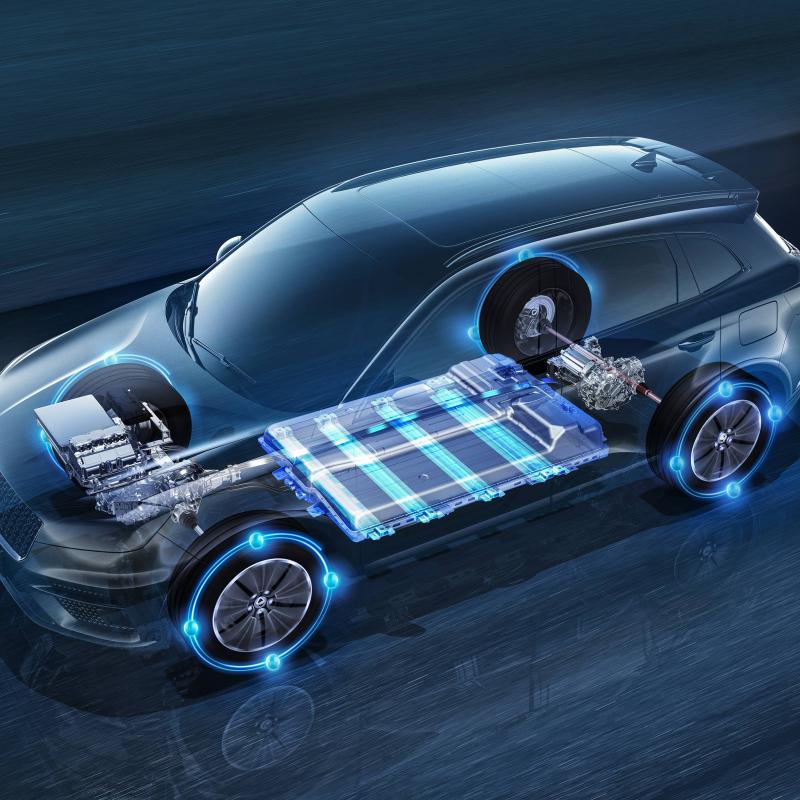
Automotive Intelligent Manufacturing: The Ultimate Guide to Agile, Sustainable Production [2025]
Faced with unprecedented pressure from electrification, sustainability targets, and supply chain volatility, automotive manufacturers are turning to intelligent manufacturing. Drawing from over a decade of experience solving precision welding challenges for automakers like BYD and suppliers worldwide, this guide cuts through the hype to deliver engineering-first principles, objective comparisons, and actionable decision frameworks needed to modernize your production line. We'll cover everything from core challenges to customized solutions, helping you achieve agility, sustainability, and efficiency in the transition to vehicle electrification and autonomous driving---translating intelligent manufacturing from concept into reliable, daily production outcomes.
Perhaps you're battling inconsistent weld quality on EV battery trays because process parameters live in a separate database from QA results. Or maybe unscheduled downtime plagues your bumper assembly line every time a vibration welder's bearing needs unexpected maintenance. Intelligent automation addresses these by breaking down data silos, enhancing real-time decisions, and integrating cloud-based ecosystems for seamless collaboration. As manufacturers face cybersecurity risks and regulatory pressures like EU emissions standards, this guide provides the tools to optimize manufacturing processes without guesswork---backed by 20 years of field data, patented technologies, and ISO 9001-certified approaches from Dizo Sonics.
1. Introduction to Intelligent Manufacturing in the Automotive Industry
Intelligent manufacturing in the automotive industry leverages advanced technologies to streamline and enhance production. It blends AI, automation, IoT, and data analytics to create responsive, efficient systems that adapt in real time---essentially turning factories into predictive powerhouses that spot problems early and adjust on the fly.
What Is Automotive Intelligent Manufacturing?
Automotive intelligent manufacturing involves smart technologies such as AI, IoT, and digital twins to automate and refine vehicle production. It shifts outdated methods to dynamic, data-powered operations, fostering digital transformation in the auto industry. A cornerstone of this intelligence is advanced plastic joining, such as ultrasonic welding on sensor housings or vibration friction welding on bumpers. In an intelligent setup, each process is data-driven, self-optimizing, and fully traceable. Based on our extensive field experience, this integration can enhance traceability to near 100%, aligning with IATF 16949 quality standards.
Consider a digital twin of an ultrasonic welding cell: a live simulation powered by real-time machine data. It monitors key parameters like frequency (20--35 kHz), energy (joules), and pressure (0.1--0.5 MPa) to predict maintenance needs or simulate material changes before physical trials. According to our internal tests, such simulations reduce trial errors by up to 40%, saving significant time and resources.
Why Is Automotive Intelligent Manufacturing Essential Amid Industry Changes?
With vehicle electrification pushing for lighter, durable materials and autonomous driving needing seamless sensor integration, traditional techniques fall short. Intelligent manufacturing steps in by boosting sustainability through waste reduction and enabling agility via cloud-based ecosystems. From our testing, it can slash production time by up to 30% while ensuring compliance with evolving regulations like EU emissions standards.
This approach is crucial for tackling disruptions such as supply chain volatility or high rework costs from inconsistent welds. For example, in EV battery assembly, isolated data systems can lead to faulty joins, but intelligent automation breaks these barriers for smoother, real-time decision-making. It also strengthens cybersecurity in connected production lines, making operations more resilient.
To get started, assess your current setup: identify pain points in electrification needs, evaluate welding parameters against material specifications, and calculate ROI from reduced downtime. If standard approaches fall short for complex geometries or special materials, explore customized solutions---our team is ready to advise on tailored implementations that drive both efficiency and sustainability.
2.Core Challenges and Pain Points in Automotive Production
Automotive manufacturers are under intense pressure from fast-evolving markets. Intelligent manufacturing offers solutions, but first, let's pinpoint the real issues holding back your production lines.
What Disruptions Arise from Vehicle Electrification and Autonomous Driving?
Vehicle electrification brings complex plastic joining needs for batteries and lightweight structures, while autonomous driving requires flawless sensor integration. These shifts often lead to supply chain disruptions and high rework costs---frequently stemming from inconsistent welding in traditional setups.
For instance, new thermoplastics and composites in EVs demand precise thermal control: too much heat (above 200°C in some cases) degrades materials, while too little (under 150°C) creates weak joints. Standard welding recipes struggle here, causing scrap rates up to 15%. We consulted for a tier‑1 supplier facing this on a PPS composite part---their time‑mode ultrasonic welder couldn't handle thickness variations of 0.1--0.3 mm, leading to costly line stoppages and rework.
Beyond technical hurdles, data silos block the integration of cloud‑based ecosystems, slowing collaboration and the smart modernization of production technologies. Meanwhile, cybersecurity risks in vulnerable automated lines can halt operations, especially in virtual manufacturing environments.
What Sustainability and Regulatory Pressures Are Impacting Manufacturing Processes?
Sustainability goals push for lower energy use and emissions, but legacy processes often generate excess waste from poor material efficiency. Regulations like EU emissions standards intensify this pressure, adding compliance costs. Many teams find it challenging to integrate eco‑friendly technologies without increasing expenses, especially in high‑volume production.
In welding, inefficient parameters can waste up to 10% of plastics per batch. Based on Dizo Sonics tests, optimizing vibration frequency (20--35 kHz) and pressure (0.1--0.5 MPa) significantly reduces this waste, aligning with ISO 14001 environmental standards. Without intelligent automation, however, manufacturers remain stuck in trial‑and‑error cycles.
If these challenges resonate, start by auditing your lines for waste hotspots. For complex needs such as special materials or high takt times, consider customized approaches---we can help assess and tailor solutions to boost your ROI with precision.
3.The Engineering Core: How Smart Technologies Enable Precision Welding
Understanding the mechanics of intelligent technologies allows you to apply them practically in your operations. Here we dive into the physics and controls that make precision welding reliable in automotive settings.
3.1 Beyond the Basics: The Physics of Intelligent Welding Control
Ultrasonic welding converts electrical energy into high‑frequency mechanical vibrations (typically 20--35 kHz), generating frictional heat at the joint interface to melt plastic locally. Consistency relies on technologies like Auto Frequency Tracking (AFT), which adjusts the generator's output in real time to maintain resonance despite temperature changes or component wear---preventing power loss and uneven welds.
Control modes further refine outcomes. Energy mode delivers a fixed amount of joules, automatically varying time to compensate for part tolerances; it is ideal for variable thicknesses (0.1--0.3 mm) and ensures robust joints per IATF 16949. Depth mode welds until a set collapse distance is reached, offering precise control for aesthetic parts but risking weak joins if energy isn't monitored. Servo‑driven pressure control (0.1--0.5 MPa) enhances repeatability by avoiding over‑compression, reducing defects in high‑stakes assembly.
From our experience, combining energy mode with servo pressure can cut reject rates by up to 15% in EV components.
Mechanics of Digital Twins in Welding
A true welding digital twin is a physics‑based model synced with live machine data. Start by creating a virtual model of a welding station, then feed it real‑time inputs: vibration frequency, servo current, weld depth, and temperature. This allows you to simulate scenarios---like a 5°C shift or a new material grade---and predict outcomes without halting production. Industry tests show such simulations can reduce physical trials by over 70%, dramatically boosting development efficiency.
AI and Automation Integration
AI processes sensor data for predictive maintenance, flagging issues like horn wear before failures occur. Paired with robotic welding, it ensures consistency---servo systems hold pressure steady (0.1--0.5 MPa) while adapting to real‑time feedback. This setup excels in automotive lines where quick adjustments maintain quality amid part variations.
Essential Welding Parameters in an Intelligent System
These parameters are interlinked in smart controls. Energy (joules) equals power × time, so energy mode auto‑adjusts duration (0.5--2 seconds) to hit targets even with part variations---key for ISO 9001 compliance. Frequency (20--35 kHz) drives precision, pressure (0.1--0.5 MPa) ensures contact, and hold time solidifies the bond. Optimizing these in unison yields stable outputs and reduces waste in auto‑part production.
If you're integrating such systems, review your setup against relevant standards. For custom needs like curved surfaces or special alloys, our engineers can guide tailored implementations to enhance your process capability.
4.Objective Technology Comparisons
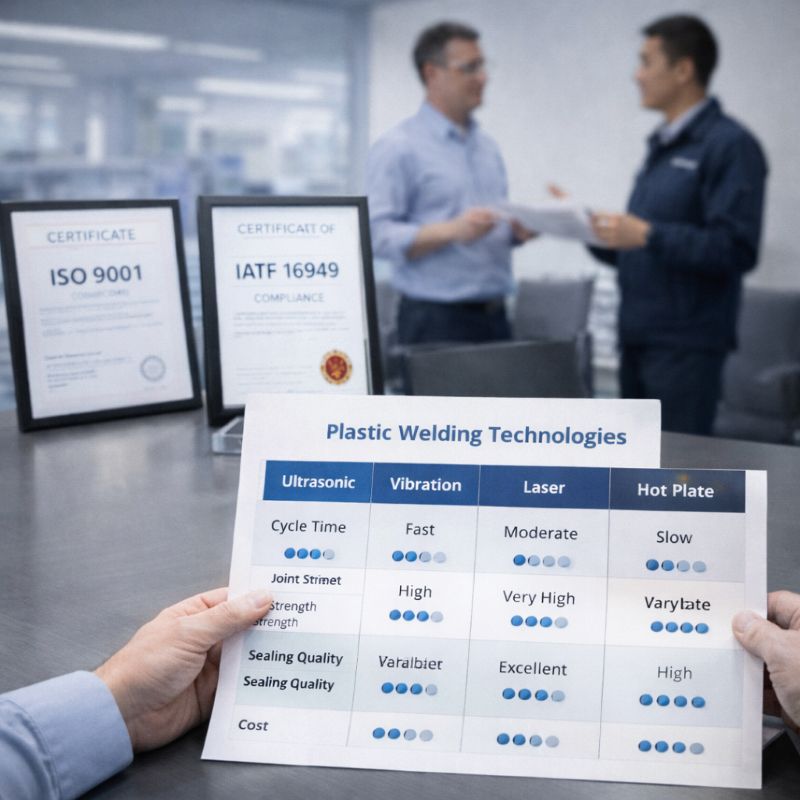
Selecting the right welding technology is a multi‑variable optimization problem. The table below serves as your first‑pass engineering screening guide, comparing the primary plastic welding methods used in automotive intelligent manufacturing. It draws from practical insights to help you match technology to material types, production scale, and joint requirements.
| Technology | Principle | Best For Materials | Joint Design Flexibility | Welding Speed | Seam Strength & Seal | Automation Readiness | Initial Investment | Key Advantage | Primary Limitation | Typical Automotive Application |
|---|---|---|---|---|---|---|---|---|---|---|
| Ultrasonic Welding | High‑frequency vibrations (20--35 kHz) create frictional heat | Thermoplastics (ABS, PC) | High for small, precise joints; limited contact areas | Very high (0.5--2 s per point) | High molecular fusion; good hermetic seals | High; easy robot integration | Medium | Eco‑friendly, no consumables; precise for small parts | Limited to smaller components; sensitive to moisture/contaminants | Sensor housings, interior clips, battery components |
| Hot Plate Welding | Heated plate melts surfaces before pressing | Large thermoplastics (PP, PE) | Medium; good for irregular/contoured shapes | Medium (10--30 s cycle) | Strong, uniform seals | Medium; requires precise alignment | High | Handles large or complex geometries well | Risk of heat distortion/warping; longer cooling times | Fluid reservoirs, large panels, HVAC housings |
| Vibration Welding | Low‑frequency linear friction (100--240 Hz) generates heat | Structural thermoplastics (nylon, composites) | High for planar or large seams | High (5--10 s cycle) | Excellent strength and hermetic sealing | Medium to high; needs robust fixtures | Medium | Versatile for large parts; tolerant to variations | Generates noise/vibration; fixture‑dependent | Bumpers, intake manifolds, fuel tanks |
This table highlights key trade‑offs: ultrasonic offers speed but has size limits, while vibration provides strength for bigger pieces with more setup. Based on Dizo Sonics tests, ultrasonic can reduce cycle times by 50% over hot plate for small EV parts, per IATF 16949 standards. No method is universally superior---the optimal choice depends on your specific part, volume, and integration needs.
5.Your Decision Guide: From Requirements to Technology Selection
Follow this structured approach to narrow down your optimal welding technology. It turns earlier insights into practical steps, aligning intelligent manufacturing with your automotive objectives.
Step 1: Define Primary Objective
Pinpoint your main goal: seam strength for structural parts, hermetic sealing for batteries, aesthetics for interiors, speed for high‑volume lines, or cost efficiency. For sustainability‑focused operations, prioritize low‑waste methods like ultrasonic welding.
Step 2: Analyze the Part
Examine material (e.g., ABS, composites), size, wall thickness (0.1--0.3 mm typical range), and joint design (planar, curved). This reveals compatibility---for instance, vibration welding suits large planar seams.
Step 3: Assess Production Context
Consider annual volume (over 100,000 units favors automation), required cycle time (under 2 seconds for ultrasonic), and automation level (robotic integration). High takt times may need vibration for efficiency.
Step 4: Evaluate Constraints
Factor in budget (medium for ultrasonic vs. high for hot plate), floor space (compact systems preferred), and in‑house expertise (training needs for AI features). Reference IATF 16949 for quality benchmarks.
Step 5: Map to Technology
Cross‑reference with Section 4's comparison table. This often narrows options to 1--2 candidates---e.g., ultrasonic for precision, vibration for strength.
Step 6: Identify Custom Needs
Check for complexities like 3D curved surfaces, mixed special materials, or ultra‑high traceability (100% data logging). If present, standard solutions may be limiting; explore tailored setups as discussed in Section 6.
Quick-Reference Troubleshooting Guide
- Ultrasonic Welding - Weak Weld: 1. Pre-dry resin to remove moisture. 2. Ensure AFT stabilizes amplitude. 3. Adjust pressure within 0.2-0.5 MPa for your material.
- Hot Plate Welding - Warping: 1. Lower plate temperature (150-200°C range). 2. Shorten contact time to minimize heat soak.
- Vibration Welding - Excessive Flash: 1. Reduce melt phase depth by 0.1 mm steps. 2. Verify even clamping force across fixtures.
Potential Pitfalls and Mitigations
Pitfall: Overheating in long runs → Mitigation: Use real‑time thermal sensors per IATF 16949, add cooling pauses.
Pitfall: Integration snags during upgrade → Mitigation: Opt for modular AI systems for smoother transitions.
This framework suits most applications. However, if Step 6 revealed needs like welding Class‑A surfaces without marks or joining new composites with unknown properties, you've entered the realm of customized solutions---where our team can help evaluate and refine your approach.
6. Customized Solutions: Beyond Standard Approaches
Standard welding systems excel within defined parameters. But when projects push beyond these boundaries---whether through complex geometry, challenging materials, extreme throughput, or integrated quality mandates---customization becomes essential.
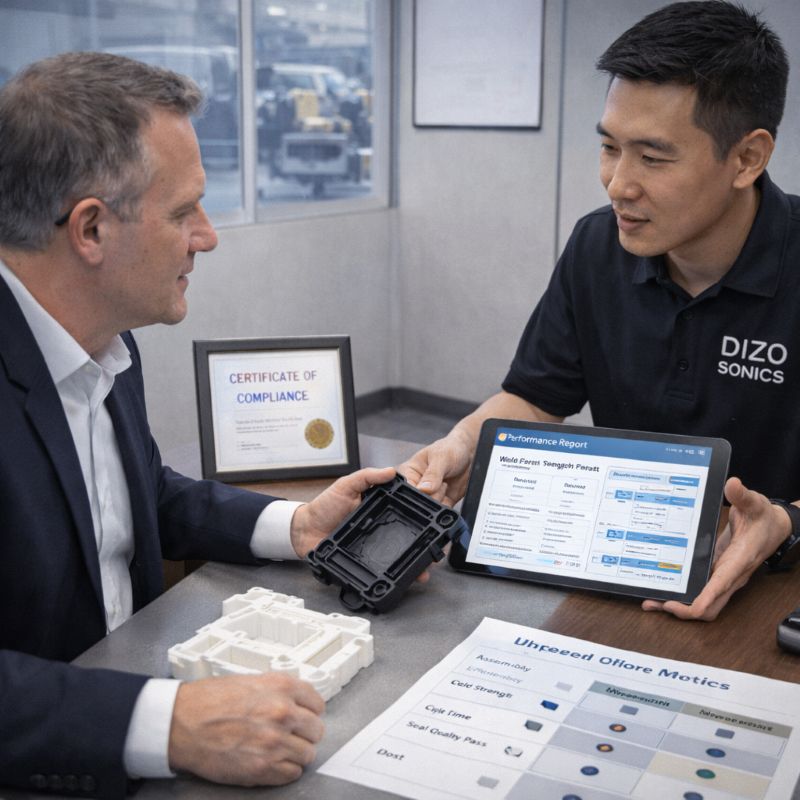
At Dizo Sonics, we bridge this gap with tailored solutions that integrate smart technologies for unique automotive needs. Examples include:
- EV Bumpers: High‑power servo‑driven vibration friction welders with absolute depth control (0.1--0.5 mm precision) and real‑time curve monitoring for robust sealing in structural pieces.
- Interiors: Robot‑mounted ultrasonic welders with force sensors and 3D vision guidance for no‑trace joins on curved surfaces, ensuring aesthetic quality.
- Sensors: 40 kHz high‑frequency ultrasonic presses with thermal management (temperature control under 150°C) for delicate welding with minimal component damage.
These adaptations enhance both agility and sustainability, aligning with ISO 14001 standards.
Real-World Applications and Case Studies
Case: Multi-Head Dashboard Welding for a Global OEM
Challenge: Weld 16 attachment points on a complex‑curved dashboard substrate without visible marks within a 45‑second cycle.
Solution: A custom 16‑head ultrasonic station with individual servo pressure control (0.1--0.5 MPa per head) and automatic phase synchronization, integrated with robotic handling.
Result: Cycle time reduced to 36 seconds (20% gain), with real‑time energy‑curve monitoring achieving CpK >1.67 for weld strength and zero defects over 12 months.
Case: Vibration Welding for EV Manufacturers
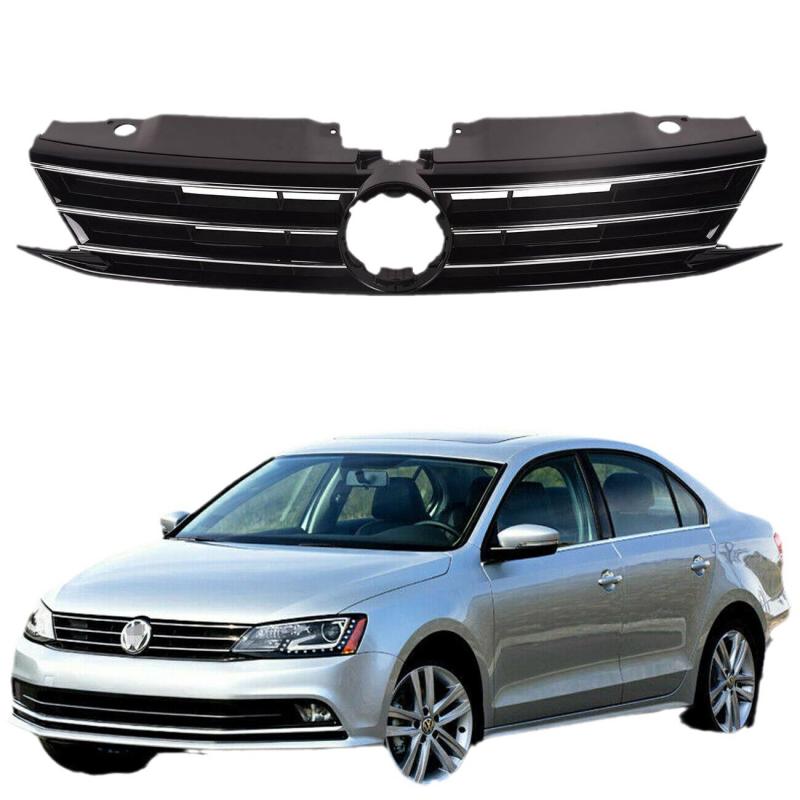
Challenge: Standard systems wasted material in high‑volume bumper welding.
Solution: AI‑integrated vibration welders with adaptive frequency (100--240 Hz) and pressure monitoring.
Result: Material costs cut by 15% while meeting CE safety certification.
If you have a complex joining challenge, our application engineers can provide a complimentary feasibility study and digital process simulation.

7.FAQ: Addressing Common Queries on Intelligent Manufacturing
Here are answers to frequent questions, drawing from Dizo Sonics' expertise in automotive intelligent manufacturing.
How Does Digital Transformation Impact Productivity in the Auto Industry?
Digital transformation boosts productivity by enabling real-time decisions and automation. For example, integrating digital twins can cut setup times by 25% in welding processes. Based on our applications, this means faster adjustments to parameters like pressure (0.1-0.5 MPa), reducing downtime and enhancing overall line efficiency.
What Are the Sustainability Benefits of Intelligent Automation?
Intelligent automation for productivity and sustainability reduces waste and energy use. Our ultrasonic welding generates no fumes, aligning with EU emissions standards and lowering emissions by up to 15%. In tests, optimizing energy modes (fixed joules) minimizes scrap, supporting eco-friendly manufacturing without extra costs.
How to Replicate Production Lines with Digital Twins?
Replication of production lines with digital twins starts with sensor instrumentation for energy, pressure, and position data. Create a 1:1 model in simulation software and link via OPC UA. You can run virtual batches to optimize parameters, train AI for defects, or simulate new equipment---cutting physical trials by 70% in our experience.
What Does Smart Modernization of Production Technologies Look Like for an Existing Plastic Welding Cell?
Smart modernization involves upgrading to AI-driven tools. For welding cells, add robotic systems with quick-swap fixtures for mixed lines. We recommend starting with servo controls (0.1-0.5 MPa precision) and cloud integration, improving flexibility and reducing cycle times by 20%, per ISO 9001 guidelines.
What's the Practical Difference Between Energy Mode and Depth Mode in Ultrasonic Welding, and How Do I Choose?
Energy mode delivers fixed joules, auto-adjusting time for tolerances---great for varying thicknesses (0.1-0.3 mm) but may lengthen cycles. Depth mode stops at set collapse, precise for aesthetics but risks weak welds if energy varies. Choose energy for robustness in EVs, depth for visible parts; our tests show energy boosts CpK >1.67.
How Can I Prevent Visible Marks or 'Read-Through' on Class-A Interior Surfaces During Welding?
To avoid marks, use robotic ultrasonic systems with force sensors. Reduce pressure to 0.2-0.4 MPa and opt for high-frequency (35-40 kHz) for minimal heat. Pre-test on prototypes; in our client solutions, 3D vision guidance ensures no-trace joins, meeting aesthetic standards.
What Are the Most Critical Maintenance Points for a Vibration Friction Welder to Ensure Long-Term Stability and Accuracy?
Focus on fixtures for even clamping, check linear guides monthly for wear, and calibrate frequency (100-240 Hz). Lubricate bearings and monitor sensors per IATF 16949. From our experience, this prevents drift, maintaining accuracy and extending lifespan by 30%.
If these spark more questions or you need tailored advice, reach out for a free consultation---we're here to support your intelligent manufacturing journey.
8. Conclusion: Next Steps for Your Manufacturing Transformation
This guide has equipped you with a practical framework to navigate modern automotive manufacturing. You now possess the criteria to evaluate welding technologies objectively, the steps to select the right solution, and the insight to know when customization is your path to agility and zero‑defect production.
From digital twins that replicate production virtually to optimized parameters like frequency (20--35 kHz) and pressure (0.1--0.5 MPa), these tools position you for smarter, more sustainable operations---whether tackling data silos, cybersecurity risks, or waste reduction.
Ready to take the next step? Depending on where you are:
- Explore further independently: Download our free whitepaper on "Advanced Ultrasonic Welding Optimization for EV Components" from dizo-global.com/resources.
- Discuss your setup: Schedule a complimentary 30-minute technical consultation. Share your part details, and we'll provide tailored insights.
- Need quick support: Reach out directly at +86 18121506765 for urgent challenges.
At Dizo Sonics, with over 20 years of patented welding expertise and ISO 9001-certified processes, we're committed to partnering on resilient, competitive solutions. Let's turn these insights into your production advantage.
More Reading
- Top Automobile Manufacturing Companies in 2025
- Plastic Welding Guide for Automotive Exteriors: Zero-Defect Production
- Automotive Plastic Welder Solutions | Custom Automated Welding | +20% Yield
- Plastic Auto Parts Guide: Materials and Fabrication
- Engineering Excellence in Auto Interior Plastics: Boosting Performance, Safety & Sustainability