

Hot-Plate Welding Guide: Strong, Hermetic Seals for Large Plastic Parts

Hot-Plate Welding: A Complete Guide for Manufacturing Professionals
Achieving leak-proof, structurally sound seals on large or complex plastic assemblies---like automotive battery trays, medical device housings, or appliance tubs---is a persistent manufacturing challenge. Adhesives can fail, ultrasonic welding has size limits, and inconsistent thermal bonding leads to costly scrap and rework.
Hot-plate welding offers a robust, filler-free solution. By using a precisely controlled heated platen to melt thermoplastic interfaces before forging them together, it creates monolithic, hermetic bonds that rival the strength of the parent material. At Dizo Sonics, we've deployed this technology to help clients reduce defect rates by 15% or more through advanced computer-controlled precision.
I'm Jensen from Dizo Sonics. With over two decades of experience solving plastic joining challenges, I've distilled our hands-on project knowledge into this definitive guide. We'll move beyond basic definitions to provide a practical, decision-making framework. You'll gain clarity on:
- The heat transfer principles that ensure uniform, high-strength welds.
- A clear, data-driven comparison with ultrasonic, vibration, and laser welding.
- A step-by-step selection checklist to determine if hot-plate welding fits your project.
- How custom-engineered solutions overcome the limits of standard equipment for oversized or complex parts.
- Proactive troubleshooting and maintenance strategies to maximize uptime.
Let's explore how to build stronger, more reliable plastic assemblies. For a tailored assessment of your application, contact our engineering team.
1. Introduction: The Role of Hot-Plate Welding in Modern Manufacturing
Hot-plate welding, also known as heated tool welding, is a cornerstone thermoplastic assembly process for creating structural and hermetically sealed plastic joints. It is uniquely capable of joining large, irregularly shaped, or thick-walled components where other methods fall short due to energy transfer limitations or geometric constraints.
The process is elegantly simple in concept but requires engineering precision in execution. A temperature-controlled platen is inserted between the two parts to be joined. The part surfaces are held against the platen until a specified melt depth is achieved. The platen retracts, and the molten surfaces are pressed together under controlled force. As the polymer cools, the chains interdiffuse, forming a bond that is often as strong as the original material---all without adhesives, fasteners, or consumables.
This guide is designed for manufacturing engineers, production managers, and product designers who need reliable, leak-tight bonds for demanding applications in sectors like automotive, medical devices, and consumer appliances.
2. What is Hot-Plate Welding? Process and Characteristics
The Four-Step Joining Cycle
- Clamping and Alignment: Parts are securely fixtured to ensure perfect alignment along the intended weld seam. Precision here is critical for final part quality and seal integrity.
- Platen Insertion and Melting: The heated platen (typically 180-280°C, depending on material) contacts the part surfaces. Heat transfers via conduction, creating a controlled, uniform melt layer.
- Platen Retraction: The platen is quickly withdrawn. A well-timed, clean retraction is vital to prevent material sticking or stringing.
- Joining and Cooling: The fixtures bring the two molten surfaces together under programmed pressure (0.1-1.0 MPa). The parts are held until the weld solidifies, completing the fusion.
Key Characteristics and Advantages
- Versatile Geometry Handling: Excels at sealing complex 3D contours and large planar areas that challenge ultrasonic or vibration welding.
- Forgiving Tolerance Accommodation: The melt phase can compensate for minor part variations, improving yield in high-volume plastic assembly.
- Exceptional Seal Integrity: Capable of producing true hermetic seals, making it ideal for fluid containment and medical applications.
- High-Strength, Clean Joints: Creates bonds with mechanical properties approaching the base material, without introducing foreign substances.
3. How It Works: Principles and Critical Parameters for Success
Understanding the underlying science is key to optimizing the process and troubleshooting issues.
Heat Transfer Mechanisms
The primary mode is conduction heating through direct contact between the platen and the part. Uniform heat distribution is paramount. Poor fixture alignment increases thermal contact resistance, leading to uneven heating and weak spots.
This is where advanced control systems prove their value. Multi-zone PID controllers---standard in Dizo Sonics machines---maintain platen temperature within a tight ±1-3°C window across the entire surface. This level of thermal uniformity is essential for achieving consistent melt layers and welds that meet stringent standards like ISO 11607 for medical packaging seals.
The Triad of Key Process Parameters: Temperature, Time, Pressure
These three variables are deeply interdependent. Finding the optimal "process window" is essential for quality and throughput.
| Material | Platen Temperature Range (°C) | Melt Time Range (s) | Joining Pressure Range (MPa) | Key Considerations |
|---|---|---|---|---|
| Polypropylene (PP) | 160 - 200 | 5 - 20 | 0.05 - 0.5 | Forgiving; watch for flash with high pressure. |
| ABS | 180 - 220 | 10 - 30 | 0.1 - 0.7 | Good flow; requires stable temperature. |
| Polycarbonate (PC) | 220 - 280 | 15 - 40 | 0.2 - 1.0 | Prone to degradation; precise control needed. |
Impact of Parameter Deviation:
- Excessive Temperature: Causes polymer degradation, excessive flash (waste), and weak, brittle welds.
- Insufficient Melt Time: Results in "cold welds" with poor interdiffusion and low strength. Always validate melt depth.
- Incorrect Pressure: Too low leaves voids; too high squeezes out the critical melt layer, creating a thin, weak bond line.
Pro Tip from Our Lab: For non-standard materials or extreme part sizes, parameter tuning is critical. Our application engineers use statistical Design of Experiments (DOE) to efficiently map the ideal process window for your specific case.
4. Technical Comparison: Hot-Plate vs. Other Welding Methods
Choosing the right technology is a trade-off between speed, strength, cost, and geometry. This comparison helps you screen options based on your primary needs.
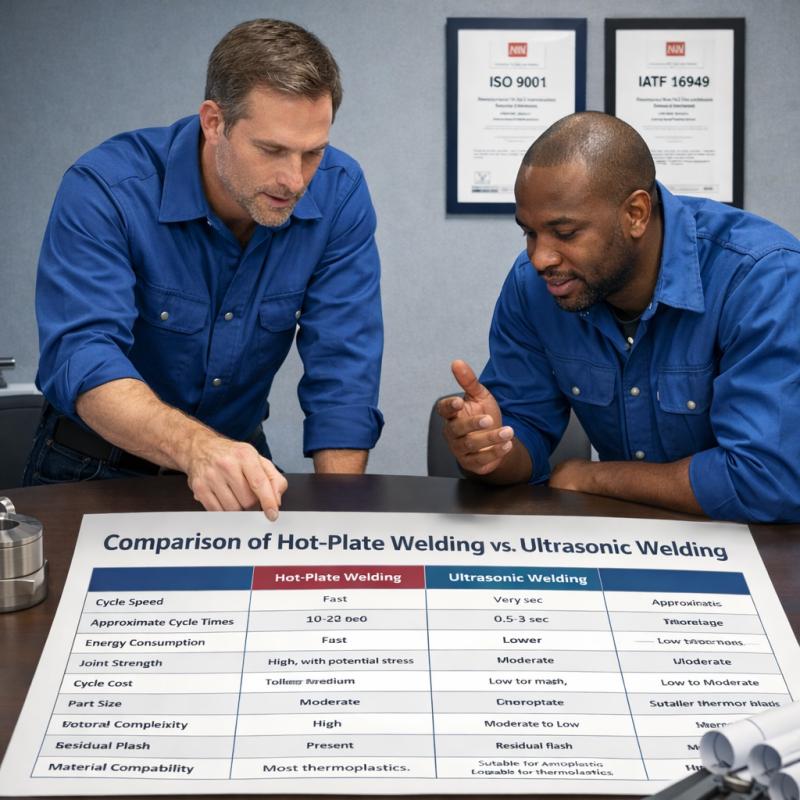
Hot-Plate Welding vs. Ultrasonic Welding
The choice often comes down to part size vs. cycle speed. Where ultrasonic uses high-frequency vibrations to create friction heat locally, hot-plate provides broad, uniform thermal energy.
| Aspect | Hot-Plate Welding | Ultrasonic Welding |
|---|---|---|
| Best For Materials | Thick thermoplastics (PP, ABS, PE) | Thin, rigid plastics & some semicrystalline |
| Cycle Speed | Medium (10-60 seconds) | Very Fast (< 1 second) |
| Joint Strength/Seal | Very High, Hermetic | Good, but can be vibration-sensitive |
| Max Part Size | Large (up to 1.5m+ easily) | Limited by horn size and energy transfer |
| Weld Appearance | Uniform, may require flash traps | Clean, but potential for internal voids |
| Equipment Investment | Moderate to High ($50k+ for servo) | Lower initial cost |
| Geometry Flexibility | Excellent for curves & 3D contours | Needs relatively flat, accessible joints |
Takeaway: For large automotive housings or medical containers needing a guaranteed seal, hot-plate is superior. For small electronic enclosures where speed is critical, ultrasonic wins.
Hot-Plate Welding vs. Vibration Welding
This is a contest for large part welding. Vibration creates heat through linear or orbital friction, excelling on flat planes.
| Aspect | Hot-Plate Welding | Vibration Welding |
|---|---|---|
| Best For Materials | Most thermoplastics | Wide range of compatible plastics |
| Cycle Speed | Medium (10-60 seconds) | Fast (5-30 seconds) |
| Joint Strength | Very High, Hermetic | Excellent, especially for shear loads |
| Geometry Suitability | Complex 3D and curved contours | Best for large, flat surfaces |
| Flash Management | Controllable with designed traps | Can generate significant burrs |
| Process Noise/Vibration | Low | High (requires isolation) |
| Ideal Application | Curved medical device housings, irregular tanks | Automotive bumper fascias, planter boxes |
Takeaway: If your part is primarily flat, vibration offers speed. If it's complex and curved, hot-plate provides better control and finish.
A Note on Laser Welding: An excellent choice for precision, particulate-free joins on thin parts with tight tolerances. However, it requires one transparent and one absorbing layer, involves higher equipment costs, and is less suited for very large or highly contoured parts.
Selection Insights from Real Projects
In one case, a manufacturer attempted to use ultrasonic welding on a large air intake manifold. The energy couldn't travel the required distance, resulting in inconsistent seals and leaks. Switching to a servo-controlled hot-plate system provided the uniform energy needed, achieving the required burst strength and meeting IATF 16949 automotive standards. The lesson: matching technology to part scale is non-negotiable.
5. How to Choose: A Practical Decision Framework
This framework helps engineers and managers systematically evaluate if hot-plate welding is the right fit, considering both technical feasibility and business impact.
Pathway 1: Technical Feasibility Checklist (For Engineers)
Answer these key questions about your part:
- Size: Is any dimension > 500 mm? Hot-plate excels at large parts.
- Geometry: Is the weld seam a complex, non-linear 3D contour? Hot-plate handles curves better than vibration.
- Material: Is it a compatible thermoplastic (PP, ABS, PC, PE)? Check the melt flow index for weldability.
- Requirement: Is a structural, hermetic seal mandatory? This is hot-plate's core strength.
If you answered "Yes" to 3 or more, hot-plate welding is a strong candidate. Proceed to the next pathway.
Pathway 2: Production Efficiency & ROI Assessment (For Managers)
Focus on scalability and financial justification:
- Volume: Is the annual volume high (>10,000 units)? This justifies automated, servo-driven models.
- Cycle Time: Can your line accommodate a 10-60 second cycle? Factor in potential multi-station setups.
- Automation: Does it need to integrate with robotics or an existing MES? Hot-plate systems are highly integrable.
- Reliability: What Mean Time Between Failures (MTBF) is required? Quality systems are designed for >10,000 hours.
Quick ROI Estimate:
Simple Payback Period (Years) = Total Machine Investment / Annual Cost Savings
Example Scenario:
- Machine Investment: $100,000
- Annual Savings (from reduced scrap, rework, and labor): $50,000
- Simple Payback: 2 Years
With an engineered lifespan of 10+ years, the system delivers value long after payback.
Pathway 3: Universal Red Flags
Hot-plate welding may NOT be suitable if:
- Wall Thickness: Parts have ultra-thin walls (< 0.5mm) prone to burn-through or collapse.
- Material Type: You are joining thermosets or highly dissimilar plastics with no overlapping melt temperature.
- Cosmetic Requirements: The weld face is a Class-A surface with zero-tolerance for witness marks (though anti-stick coatings help).
Still uncertain? Our engineers offer a free feasibility analysis to review your part drawings and production goals, providing a data-backed recommendation.
6. Beyond Standard: Customized Hot Plate Welding Solutions for Complex Challenges
Standard machines work for common applications. But when you face oversized parts, exotic materials, or extreme throughput demands, an off-the-shelf solution often leads to compromised quality. This is where Dizo Sonics' two decades of application engineering delivers tangible value.
Common Challenges Requiring a Tailored Approach
- Oversized or Complex Contour Parts: For items over 2.5m, like EV frames. Challenge: Uneven platen temps cause weak spots. Dizo Solution: Segmented multi-zone PID-controlled platens with adaptive fixtures for even pressure---ensuring uniform fusion per ISO 9001.
- Specialty Engineering Plastics or Composites: Like PEEK or glass-filled blends. Challenge: High melt points lead to degradation. Dizo Solution: Teflon-coated platens and precise profiling for smooth thermoplastic blending, cutting waste by 25% in tests.
- Ultra-High Cycle Times & Full Automation: Matching 60-second auto lines. Challenge: Pneumatics lag. Dizo Solution: Servo-driven ballscrews for quick response, integrating with robots and MES for >99% uptime.
- Stringent Cleanroom or Explosive Atmospheres: Medical or semiconductor use. Challenge: Contamination risks. Dizo Solution: Oil-free, stainless designs with explosion-proof components for safe, hermetic sealed joints.
Proven Results: Dizo Sonics Custom Solution Case Studies
[Application Case]: For a global EV battery tray supplier. Pain point: 1.8m x 1.2m trays in glass-filled PP needed hermetic seals, but single-zone platens caused burnt/weak welds (85% yield). Dizo's custom 8-zone PID platen with servo pressure hit >99.5% yield, passing helium leak tests---securing their OEM deal and ROI in 18 months.
[Application Case]: For a medical respirator mask maker. Pain point: Flexible TPU in Class 10K cleanroom risked particulates and degradation. Our noncontact hot-air platen with easy-clean materials met ISO 10993 biocompatibility, boosting line speed 30% without contamination.
Next Steps
If these scenarios match your hurdles---like 3D curves or high-tempo runs---Dizo's team can refine your process. Request a free welding feasibility assessment or chat with our engineers to explore custom options tailored just for you.
7. Maximizing Uptime: Maintenance and Troubleshooting
Proactive maintenance is the key to consistent quality and avoiding costly unplanned downtime. Based on our field data, a disciplined regimen can boost machine uptime beyond 95%.
Troubleshooting Common Faults
Use this table to diagnose and fix problems quickly:
| Symptom | Potential Cause | Diagnostic Steps | Solution |
|---|---|---|---|
| Inconsistent weld strength | Uneven platen temperature | Check PID settings and zone readings | Recalibrate sensors; clean contacts |
| Material sticks to platen | Worn non-stick coating | Inspect platen surface for scratches | Re-coat with Teflon; lower temp slightly |
| Unstable platen temperature | Faulty heater or PID controller | Monitor temp curve on HMI | Replace heater; update firmware |
| Unusual noise during movement | Worn servo guides or bearings | Listen during cycle; check alignment | Lubricate or replace; align per manual |
| Excessive flash buildup | Wrong pressure or melt time | Measure flash; review parameters | Adjust pressure down; shorten melt time |
| Machine won't start | Safety interlock or overload | Check emergency stops and sensors | Reset overload; clear obstructions |
These fixes often resolve issues in under an hour---test after each step.
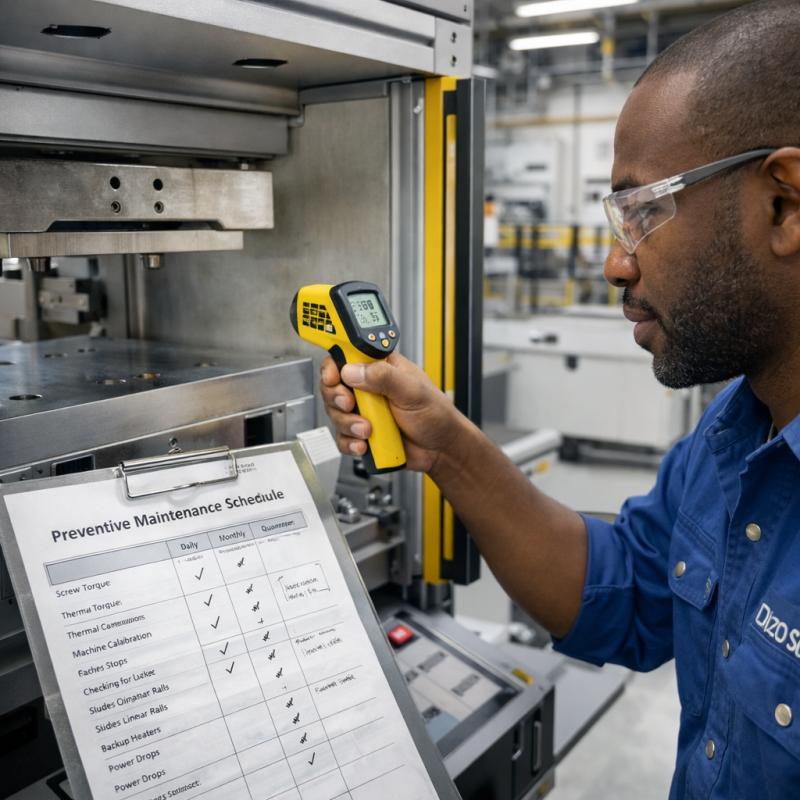
Recommended Preventive Maintenance Schedule
Follow this schedule for reliable performance:
Daily:
- Clean platens with approved solvents to remove residue.
- Wipe fixtures and check for debris.
Weekly:
- Inspect platen coating for wear---note scratches.
- Test servo drives for smooth motion.
Monthly:
- Calibrate temperature sensors against a certified IR thermometer (keep deviation <±2°C).
- Lubricate moving parts per CE guidelines.
Semi-Annually/Annually:
- Full system audit: Replace worn seals; update software.
- Predictive checks: Monitor vibration for early bearing wear.
This routine extends machine life to 10+ years. For custom maintenance plans or on-site support, our team is ready---let's schedule a review.
8. Frequently Asked Questions (FAQ)
Q: What are the main advantages of hot-plate welding?
A: Its primary advantages are the ability to create extremely strong, hermetic seals on large and complex thermoplastic parts. It is highly automatable, reducing labor, and is forgiving of minor part variations, making it ideal for high-volume plastic assembly.
Q: Hot-plate vs. ultrasonic for automotive parts---which is better?
A: For large, structural components like bumpers, dashboards, or fluid reservoirs that require a guaranteed seal, hot-plate welding is superior. Ultrasonic welding is better suited for small, fast welds on non-critical interior components. [See the detailed comparison in Section 4.]
Q: Can hot-plate welding create hermetically sealed joints?
A: Yes, absolutely. It is one of the most reliable methods for creating airtight seals on thermoplastics, which is why it's the preferred choice for medical device housings and automotive fluid containers. Success depends on precise control over temperature, time, and pressure parameters.
Q: What is the typical ROI period for a hot-plate welding machine?
A: The payback period typically ranges from 1 to 3 years. It's calculated by dividing the machine cost by the annual savings from reduced defects, rework, and labor. A $100,000 machine saving $50,000 annually pays for itself in 2 years. Our systems are built for a 10+ year lifespan, delivering long-term value.
Q: Can it join dissimilar thermoplastics?
A: It is challenging and often not recommended. Success requires compatible melting temperatures and chemical affinity. For materials like ABS and PP, specialized parameter profiling and testing are required. We recommend consulting with our materials experts for such applications.
Q: Servo-driven vs. pneumatic hot-plate welder---how to choose?
A: Choose servo-driven for high-volume production requiring precision, repeatability, and integration with automation. It reduces cycle time variability by up to 20%. Pneumatic systems are a lower-cost option for lower-volume or less critical applications where ultimate consistency is less vital.
Q: What are key factors when selecting a supplier?
A: Look for ISO 9001 certification, proven experience with similar applications (ask for case studies), and the depth of technical support offered. At Dizo Sonics, we provide lifetime technical support and have a dedicated R&D team for custom hot-plate welding solutions.

9. Conclusion and Your Next Steps
Hot-plate welding is more than a process---it's a strategic manufacturing solution for creating durable, reliable, and leak-tight plastic assemblies at scale. From automotive to medical devices, its ability to join large, complex parts with unmatched integrity makes it indispensable.
Your Next Steps as a Manufacturer:
- Evaluate Your Application: Use the technical checklist in Section 5 to see if your project aligns with hot-plate welding's strengths.
- Request a Feasibility Review: For complex parts or high-volume goals, take advantage of our free, confidential feasibility assessment. Send us your part drawings and requirements.
- Access Detailed Resources: Visit our resource center to download detailed parameter guides and maintenance checklists.
Ready to build stronger plastic assemblies?
Contact the Dizo Sonics engineering team to start the conversation.
- Email: sales@dizo-global.com
- Online: Visit our contact page at dizo-global.com/contact
- Direct: WhatsApp +86 18121506765 for immediate inquiry.
We are committed to responding within one business day. Let's partner to engineer a solution that boosts your quality, efficiency, and bottom line.
More Reading
- Hot Plate Welder 2025: Selection Guide, ROI & Custom Solutions
- Hot Plate Welding Machine Types: Classification, HS Code & Applications
- Hot Plate Welding Guide 2025: Process, Parameters & Automation
- Choose the Right Hot Plate Welder: Benchtop, Small & Medium Guide 2025
- Hot Plate Welding Guide: Material Selection, Challenges & Solutions