

Hot Plate Welding Guide: Material Selection, Challenges & Solutions

Hot Plate Welding: The Ultimate Guide to Material Selection, Overcoming Challenges & Advanced Solutions
For engineers and manufacturing managers tasked with joining large, complex plastic parts, achieving consistent, leak-proof bonds can be a persistent challenge. Are you seeing weak seams in polypropylene assemblies, or grappling with micro-voids in nylon components that fail pressure testing? The root cause often lies not in the process itself, but in the nuanced interplay between material science and welding parameters.
Hot plate welding stands out for its ability to create strong, hermetic seals in thermoplastics, especially for large or geometrically complex parts. However, its success hinges on a deep understanding of polymer behavior. This definitive guide, drawing from over 20 years of ISO 9001-certified engineering experience at Dizo Sonics, delivers a clear framework. You'll gain a practical material selection checklist, data-driven comparisons to other plastic welding methods, step-by-step procedures, and insights into when custom-engineered systems deliver the optimal return on investment for demanding applications in automotive, medical, and consumer electronics.
1. Who Is This Guide For? An Introduction to Hot Plate Welding
This guide is designed for professionals who specify, design, or manufacture plastic assemblies:
- Welding & Process Engineers seeking to optimize parameters and troubleshoot bond failures.
- Product Designers selecting materials and designing joints for manufacturability.
- Manufacturing & Operations Managers evaluating joining technologies for production lines.
- Quality Assurance Professionals responsible for validating weld integrity and consistency.
What is Hot Plate Welding?
Hot plate welding is a thermal joining process where two thermoplastic surfaces are simultaneously heated by contacting a precisely controlled heated platen. Once a sufficient melt layer forms, the platen retracts, and the parts are pressed together under force. The molten polymers interdiffuse, and as they cool under pressure, they form a solid, molecular-level bond. In essence, it's like perfectly melting the edges of two candles and pressing them together to form a single, seamless piece.
Why Choose Hot Plate Welding for Thermoplastic Assembly?
This technique offers distinct advantages that make it the preferred choice for many applications:
- Excellent for Large & Complex Parts: Accommodates substantial part sizes (often over 1.5 meters) and intricate, non-linear joint geometries better than ultrasonic or vibration welding.
- Superior Weld Strength & Hermeticity: Produces bonds that typically reach 80-90% of the base material's strength, ideal for fluid reservoirs, air ducts, or protective housings requiring a perfect seal.
- Effective with Dissimilar Materials: Can join different thermoplastics, provided their melting temperatures and rheological properties are compatible, by using independent temperature control for each platen side.
- Process Control & Consistency: Modern servo-electric systems allow precise control over temperature, pressure, and displacement, leading to highly repeatable results.
2. The Science of the Seal: How Hot Plate Welding Works
Understanding the underlying physics is key to selecting the right materials and avoiding common pitfalls. The process hinges on controlled thermal energy transfer and polymer flow.
Thermal Transfer and Melt Layer Formation
Heat is transferred from the heated platen to the part surfaces primarily through conduction. The goal is to create a uniform, viscous melt layer (typically 0.5mm to 2.0mm deep) across the entire joint interface. Think of it like heating butter in a pan---the goal is an even, liquid layer, not burnt spots or unmelted solids. Inconsistent heating leads to uneven flow and weak spots in the final weld.
Material Behavior: Semi-Crystalline vs. Amorphous Polymers
A plastic's molecular structure dictates its welding behavior:
| Polymer Type | Structure | Melting/Softening Behavior | Hot Plate Welding Consideration |
|---|---|---|---|
| Semi-Crystalline (e.g., PP, PE, Nylon) | Ordered, packed chains. | Has a sharp, definite melting point (Tm). Transforms rapidly from solid to melt. | Provides strong, clean welds but requires precise temperature control at the melting point. |
| Amorphous (e.g., ABS, PC, PMMA) | Random, tangled chains. | Softens gradually over a glass transition range (Tg), not a sharp melt. | Easier to plasticize; more forgiving on temperature but generally yields lower ultimate bond strength. |
Molecular Interdiffusion: The Source of Strength
When the molten surfaces are pressed together, polymer chains from each side diffuse across the interface. This interdiffusion, driven by time, temperature, and pressure, creates a monolithic structure. The bond's integrity can be compromised by:
- Viscosity Mismatch: If one material flows much easier, it can be displaced, causing an uneven bond line.
- Thermal Degradation: Excessive heat or time can break polymer chains, weakening the material.
- Contamination: Even minor oils or mold release agents can form a barrier to molecular diffusion.
3. Material Selection Guide: Optimal Thermoplastics for Hot Plate Welding
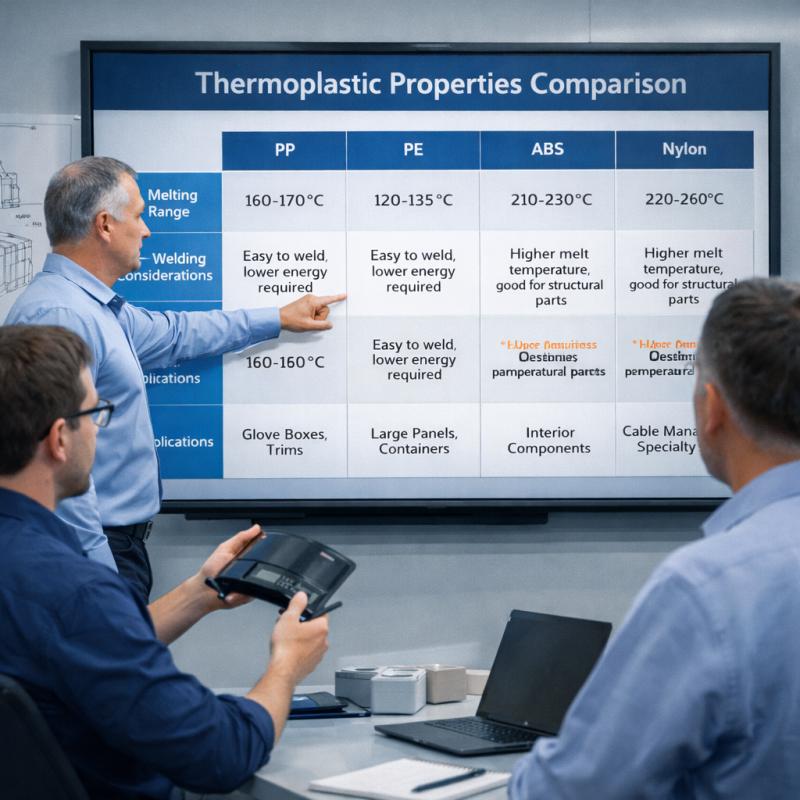
Choosing a weld-compatible material is the first critical step. The following table compares the most common and effective options.
Primary Material Choices
| Material | Key Melting Range (°C) | Notable Properties | Hot Plate Welding Considerations | Common Applications |
|---|---|---|---|---|
| Polypropylene (PP) | 160 - 170 | Low cost, excellent chemical resistance, low density. | Low melt viscosity ensures good flow. Prone to warping; requires stable fixturing. | Automotive bumpers, fluid containers, battery housings. |
| Polyethylene (PE) | 120 - 140 (LDPE) 130 - 145 (HDPE) | Flexible, tough, excellent impact resistance. | Forgiving process; ideal pressure range 0.3-1.0 MPa. Different densities (LDPE/HDPE) weld well together. | Pipes, tanks, kayaks, cosmetic cases. |
| ABS | 220 - 250 | Rigid, durable, good impact & surface finish. | Requires higher heat; ensure even platen contact to avoid cold spots. Can produce noticeable weld flash. | Electronic housings, automotive trim, instrument panels. |
| Nylon (PA 6 or 66) | 220 - 265 | High strength, wear resistance, good temperature performance. | Hygroscopic---must be dried to <0.1% moisture before welding to prevent bubble formation (see Section 5). | Under-hood automotive parts, gears, power tool housings. |
Advanced & Engineering Plastics
For specialized applications requiring high heat, chemical resistance, or optical clarity:
- PMMA (Acrylic): Valued for clarity. Requires careful control of melt flow and temperature to avoid optical haze. Common in automotive lighting lenses.
- PC (Polycarbonate): High impact strength. Prone to stress cracking if improperly dried or overheated.
- PEEK: Ultra-high performance. Requires very high platen temperatures (approx. 343°C) and controlled atmospheres to prevent oxidation.
4. Hot Plate Welding vs. Other Plastic Joining Methods
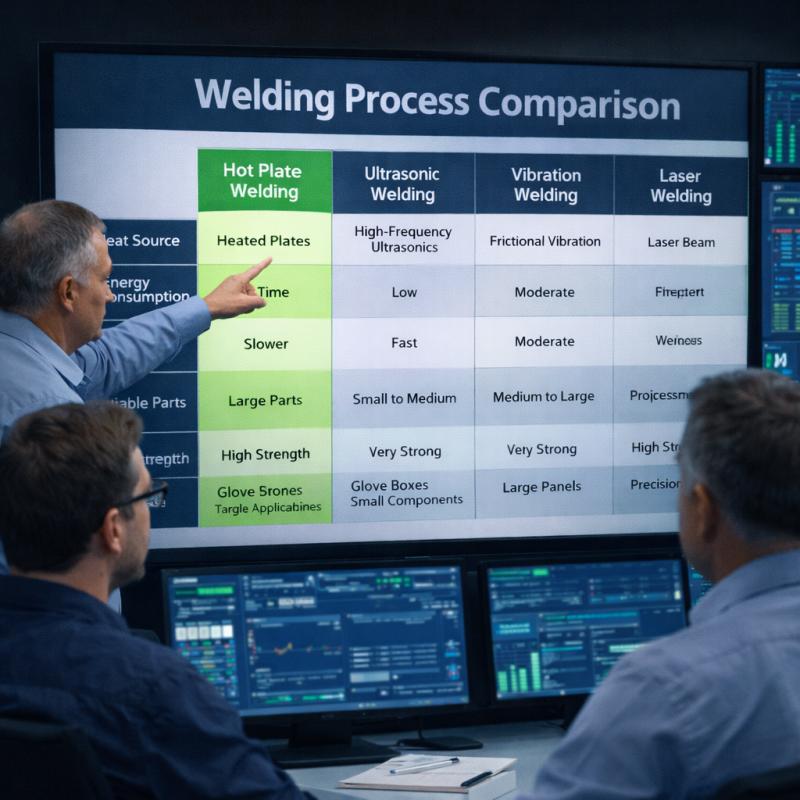
How do you know if hot plate welding is the right choice? This comparison against other prevalent plastic welding techniques provides a clear decision framework.
Technical Comparison at a Glance
| Dimension | Hot Plate Welding | Ultrasonic Welding | Vibration Welding | Laser Welding |
|---|---|---|---|---|
| Best Suited Materials | PP, PE, ABS, Nylon | ABS, PS, most amorphous plastics | PP, PE, large semi-crystalline parts | Clear/opaque thermoplastic pairs |
| Max Part Size/Geometry | Large (1.5m+), complex 3D contours | Small-to-medium, simpler geometries | Very large, primarily linear/planar joints | Small, precise, complex 2D contours |
| Cycle Time | Medium (20-60 sec) | Very Fast (1-5 sec) | Medium-Fast (10-30 sec) | Fast (<10 sec) |
| Joint Strength | High (80-90% of base) | High (for compatible materials) | Very High | Medium-High |
| Sealing Ability | Excellent (Hermetic) | Good (for small perimeters) | Excellent | Good (depends on material transparency) |
| Equipment & Tooling Cost | Medium | Low-Medium | High | Very High |
Decision Guidance: Choosing the Right Process
Use this flow to guide your selection:
- Is the part large (>0.5m) or have a complex 3D seam? → Yes: Strong candidate for Hot Plate or Vibration welding.
- Is a hermetic seal a critical requirement? → Yes: Hot Plate or Vibration are top choices.
- Are you joining semi-crystalline plastics like PP or PE? → Yes: Hot Plate or Vibration are typically best.
- Is cycle time the absolute top priority for a small part? → Yes: Consider Ultrasonic or Laser welding.
For optimal ROI on challenging projects---such as those involving advanced composites, extreme throughput demands, or zero-defect mandates---a custom-engineered hot plate welding system is often the solution that balances all requirements.
5. Troubleshooting Common Hot Plate Welding Challenges
Even with the right material and process, issues can arise. Here are solutions to the most frequent challenges, based on our field data.
| Challenge & Root Cause | Diagnostic Check | Corrective Action |
|---|---|---|
| Weak or Brittle Weld Insufficient melt depth, contamination, or material degradation. |
Check melt layer consistency. Review material certs for MFI. | Increase platen temperature or dwell time. Ensure surfaces are clean (IPA wipe). Verify material has not exceeded its heat history. |
| Bubble Formation (Especially in Nylon) Moisture absorption in hygroscopic polymers turning to steam. |
Listen for sizzle during heating. Check drying logs. | Pre-dry material to <0.1% moisture (e.g., 4-6 hrs at 80°C in a desiccant dryer). Implement a post-molding drying step. |
| Excessive Flash or Part Distortion Too much melt, excessive pressure, or poor part support. |
Measure flash dimensions. Check fixture alignment. | Reduce dwell time or temperature. Optimize pressure profile (use lower 2nd-stage pressure). Improve fixture support near the weld joint. |
| Inconsistent Weld Quality Uneven platen temperature, worn non-stick coating, or inconsistent part quality. |
Use IR thermometer to map platen surface. Audit part dimensions. | Re-calibrate or replace heater cartridges. Re-apply PTFE or ceramic non-stick coating. Tighten incoming part tolerances. |
6. A Step-by-Step Procedure & Best Practices Checklist
Translate theory into reliable production with this actionable guide.
Optimized Hot Plate Welding Procedure
- Preparation: Clean joint surfaces with isopropyl alcohol. For hygroscopic materials (Nylon, PC), ensure they are dried per supplier specifications.
- Fixturing: Securely clamp parts, ensuring proper alignment and accounting for thermal expansion.
- Heating Phase: Bring parts into contact with the heated platen. Apply light contact pressure. Maintain for the calculated dwell time to achieve target melt depth.
- Change-Over: Rapidly retract the platen to avoid drag marks.
- Joining & Forging Phase: Immediately press parts together. Apply welding pressure (typically 0.5-2.0 MPa) to displace surface oxides and promote interdiffusion.
- Cooling/Holding Phase: Maintain pressure as the weld solidifies to prevent shrinkage voids and distortion.
Material & Process Selection Checklist
Before launching production, verify these points:
- Material Compatibility: Melting points of dissimilar materials are within 20-30°C. Chemical compatibility is confirmed.
- Moisture Control: Hygroscopic materials are specified with a dryness requirement (<0.1%) and a validated drying process is in place.
- Joint Design: Weld joint is designed for hot plate welding (e.g., shear or tongue-and-groove design for alignment).
- Parameter Validation: Key parameters (Temperature, Time, Pressure) have been defined via Design of Experiments (DOE) and documented in a Control Plan.
- Quality Standard: Test method for weld strength (tensile, burst) and leak rate (pressure decay) is defined, aligned with relevant ISO or ASTM standards.
7. When Standard Machines Fall Short: Engineered Solutions for Demanding Applications
While standard hot plate welders handle many jobs, complex real-world requirements often demand a tailored approach.
Limitations of Standard Equipment
Manufacturers often encounter these barriers:
- Complex 3D Contours: Welding irregular, multi-plane seams without leaks or visual marks.
- Extreme Throughput: Achieving cycle times under 15 seconds for mass production without sacrificing quality.
- Advanced Materials: Joining high-temperature plastics (PEEK, PPS) or long-glass-fiber composites.
- Full Traceability: Meeting IATF 16949 mandates for data collection and Statistical Process Control (SPC) on every weld.
- Seamless Automation: Integrating the welder into a fully robotic cell with minimal manual intervention.
Engineered Solutions from Dizo Sonics
We develop systems to overcome these exact challenges:
- For 3D Contours: Robotic manipulators with vision-guided alignment and contoured platens ensure perfect, mark-free seams on complex parts like air intake manifolds.
- For High Speed: Servo-electric drives with optimized motion profiles and simultaneous multi-point welding drastically reduce cycle times.
- For Special Materials: Multi-zone temperature control and advanced non-stick coatings (e.g., ceramic) handle aggressive polymers.
- For Traceability: Integrated HMI with real-time SPC charts stores complete weld curves (pressure vs. displacement) for every part, ensuring IATF 16949 compliance.
- For Automation: Full robotic integration with standard industrial interfaces (PROFINET, Ethernet/IP) for plug-and-play cell integration.
Case Study: Automotive Lighting Assembly
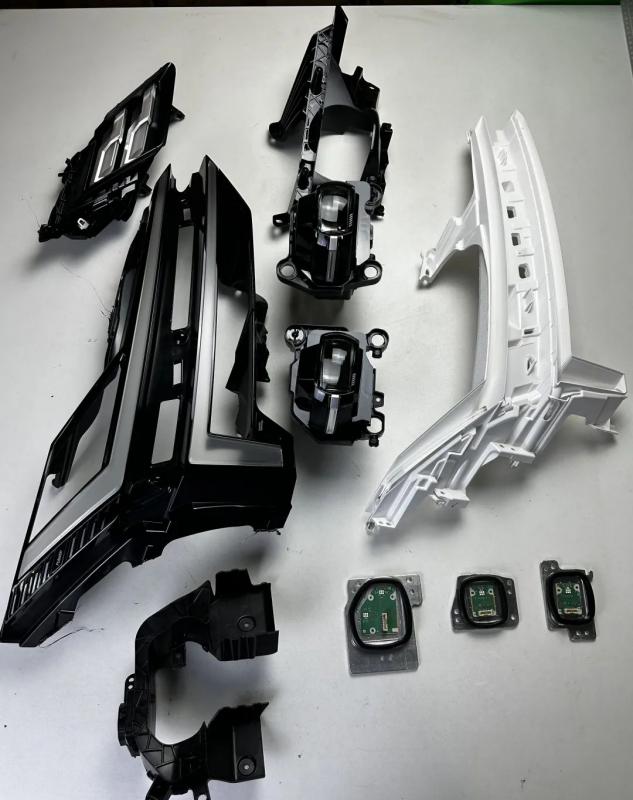
Challenge: A Tier-1 supplier faced a 12% reject rate welding clear PMMA lenses to black ABS housings for rear light clusters. Issues included stress cracks, leaks, and visible weld flash.
Dizo Sonics Solution: We supplied a custom welder with non-contact infrared pre-heating for the PMMA (to prevent marking) and a 4-stage servo pressure profile for the ABS. The system included in-situ leak testing.
Result: Reject rate fell below 2%, cycle time improved by 15%, and the project achieved ROI in under 10 months through scrap reduction and increased throughput.
8. FAQ: Common Questions on Hot Plate Welding Thermoplastics
Q: What plastics are best for hot plate welding?
A: Polypropylene (PP), Polyethylene (PE), ABS, and Nylon (with proper
drying) are top choices due to their favorable melting and flow
characteristics. For detailed properties, see the Material Selection
Guide in Section 3.
Q: How do I prevent bubbles when welding nylon?
A: Nylon is highly hygroscopic. You must pre-dry it to less than 0.1%
moisture content before welding, typically in a desiccant dryer at 80°C
for 4-8 hours. This prevents steam formation during heating. More
details in Section 5.
Q: Can I weld two different plastics together?
A: Yes, it is possible with careful parameter setting. The key is to
match the melt temperatures and viscosities. Often, using
dual-temperature platens (one side hotter than the other) facilitates a
good bond. Always conduct compatibility tests first.
Q: What's the difference between hot plate and vibration welding?
A: Both are excellent for large parts. Hot plate welding is superior for
complex 3D seams and provides excellent visual quality. Vibration
welding is generally faster for long, straight-line welds.
The comparison table in Section 4 provides a full breakdown.
Q: How strong is a hot plate weld?
A: A well-executed weld in compatible materials like PP or PE can
achieve 80-90% of the base material's tensile strength, as verified by
standard ASTM D638 testing protocols.
Q: How do I optimize my welding cycle time?
A: Focus on reducing the change-over time between heating and joining
phases, optimizing pressure profiles to minimize required cooling/hold
time, and ensuring efficient part handling automation.

9. Conclusion & Key Takeaways
Hot plate welding is a powerful, versatile process for creating strong, sealed joints in thermoplastics. Success depends on a methodical approach:
- Select weld-compatible materials (PP, PE, ABS, dried Nylon) and design the joint appropriately.
- Understand the competition---hot plate excels where part size, geometry, and seal quality are priorities over ultra-high speed.
- Master the parameters: Temperature, time, and pressure must be balanced to create a perfect melt layer and forging action.
- Anticipate challenges like moisture in nylon or material degradation, and implement the corrective actions outlined.
Is a Custom Solution Right for You?
If your project involves complex 3D geometries, extreme production volumes, advanced engineering plastics, or requires full digital traceability, a standard machine may limit your results. Custom-engineered systems are designed to turn these constraints into competitive advantages, delivering superior strength, yield, and ROI.
Ready to Engineer Your Solution?
Claim your free, no-obligation Welding Process Feasibility Review. Our senior engineers will analyze your part design, materials, and production goals to identify potential risks and outline a clear path to success.
Contact Dizo Sonics today to schedule your assessment