

FRP Battery Housing Guide: Lightweight, Safe EV Design & Advanced Welding
The Complete Guide to FRP Battery Housings: Lightweighting, Safety, and Advanced Welding for EVs
For electric vehicle manufacturers, the battery pack housing presents a critical engineering challenge: it must be an impenetrable fortress for delicate battery cells, yet adding too much weight directly undermines the vehicle's core promise---extended range. This is where Fiber Reinforced Plastic (FRP) composites have emerged as a game-changer, offering potential weight savings of 30% or more compared to traditional metals like steel and aluminum. However, the full potential of these advanced materials is only unlocked through one decisive factor: precision joining technology. At Dizo Sonics, with over two decades of specialized experience serving leaders like BYD, we've learned that the weld is where theoretical weight savings become real-world safety and performance. This guide consolidates practical insights to help you design, specify, and manufacture superior EV battery housings.
What You'll Learn:
- Core Principles: The mechanics behind FRP composites, including how dual-laminated, closed-section designs create exceptional stiffness.
- Data-Driven Comparison: A clear, metric-based analysis of composites versus steel and aluminum, detailing pros, cons, and total cost of ownership.
- Implementation Framework: A phased, actionable process for selecting materials and processes, complete with key parameters and troubleshooting guides.
- Advanced Solutions: How tailored ultrasonic and thermal welding technologies overcome the limits of standard approaches, with real ROI scenarios to enhance your EV's competitiveness.
1. Introduction: The Pivotal Role of the EV Battery Housing
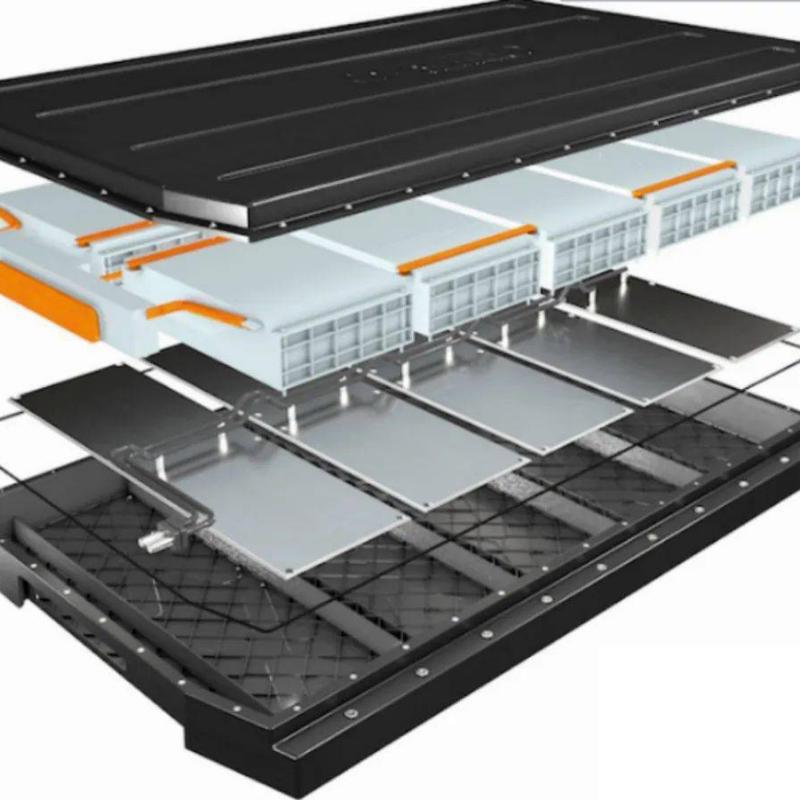
The battery pack is the heart of an electric vehicle, and its housing is the protective rib cage. This enclosure---typically comprising an upper cover and a lower tray---does far more than simply contain the cells. It is a multifunctional system responsible for structural integrity, crash energy management, thermal regulation, and electromagnetic interference (EMI) shielding. In a severe side-impact or underbody collision, the housing is the first and most critical line of defense, designed to absorb and redistribute crash forces to prevent cell intrusion and thermal runaway.
The shift towards cell-to-pack (CTP) and cell-to-chassis (CTC/CTB) architectures places even greater demands on housing design. The housing itself becomes more integral to the vehicle's structure, requiring unparalleled weight-to-stiffness ratios. This is the fundamental value proposition of FRP composites: achieving the required mechanical performance at a significantly lower mass penalty than metal, thereby directly contributing to greater driving range and energy efficiency.
Core Design Challenges: Weight vs. Safety vs. Cost
Engineers navigate a complex triangle of constraints:
- Weight: Every kilogram saved extends range. Aluminum reduced mass versus steel; composites are the next frontier.
- Safety & Stiffness: The housing must meet stringent global safety standards (UN ECE R100, GB 38031) for crush resistance and stiffness, often requiring complex, closed-cross-section designs for torsional rigidity.
- Manufacturability & Cost: The material and joining process must be scalable, reliable, and cost-effective over the vehicle's production lifecycle. This includes considerations for repairability and end-of-life recyclability.
Traditional metals hit a ceiling in this trade-off. Composites offer a breakthrough, but introduce new challenges in anisotropic behavior, consistent quality assurance, and---most critically---joining, which we will address throughout this guide.
2. Material Science and Structural Engineering of FRP Housings
Understanding FRP composites is key to leveraging their benefits. An FRP is not a homogeneous material but a system: a polymer matrix (the "glue") reinforced by high-strength fibers (the "load-bearers").
- The Matrix: Thermoplastics (PP, PA, PEEK) are melt-processable, offering good impact resistance and easier weldability. Thermosets (Epoxy, Vinylester) cure irreversibly, providing higher thermal and chemical resistance but requiring adhesive bonding or mechanical fastening.
- The Fibers:
- E-Glass: The most common, cost-effective option with good strength.
- S-Glass: Higher tensile strength and impact resistance for premium applications.
- Carbon Fiber: The pinnacle for stiffness and lightweighting, also offering electrical conductivity (beneficial for EMI shielding) but at a higher cost.
- The Layup: The orientation (0°, 90°, ±45°) and stacking sequence of fiber plies dictate the part's mechanical properties. A quasi-isotropic layup provides balanced strength, while unidirectional tapes optimize for specific load paths.
The Welding Imperative: Creating Monolithic Structures
For housings, simply stacking plies isn't enough. The revolutionary step is creating dual-laminated shell structures that are welded together to form a closed cross-section. Think of a modern vehicle's B-pillar or an I-beam: the welded joint creates a continuous "web" that connects the top and bottom "flanges," resulting in a dramatic increase in bending and torsional stiffness.
The Science of Welding FRP: Successful welding requires precise control of heat, pressure, and time to fuse the polymer matrices without degrading the reinforcing fibers.
- Ultrasonic Welding: High-frequency (20-35 kHz) vibrations create interfacial friction, melting the polymer locally in 0.5-2 seconds under controlled pressure (0.1-0.5 MPa). It's fast and energy-efficient.
- Vibration and Hot Plate Welding: Ideal for larger, more complex contours or incompatible materials, providing strong, hermetic seals.
The goal is to create a homogeneous molecular bond across the joint, effectively making two parts act as one continuous load path, crucial for impact energy absorption.
3. Composites vs. Metals: A Performance and Business Decision
Choosing a housing material is a strategic decision. Here's a transparent comparison based on industry data and our project history.
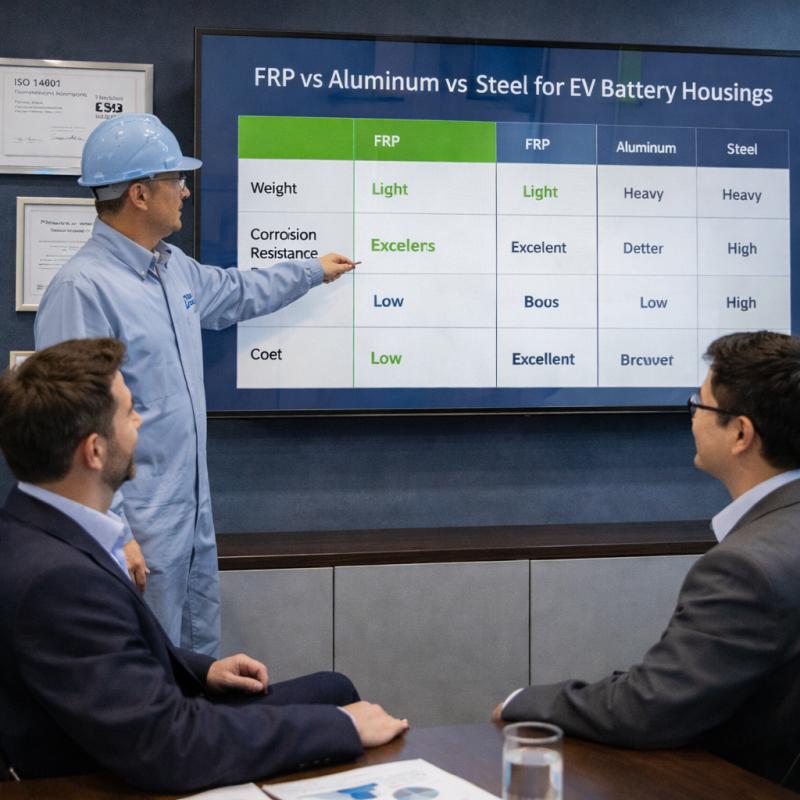
| Parameter | Fiber Reinforced Plastic (FRP) | Aluminum (Die-Cast/Sheet) | Steel (Press-Hardened) | Key Insight |
|---|---|---|---|---|
| Weight Saving | 30-50% vs. Steel; 20-30% vs. Al | Baseline | Heaviest | Direct range enhancer. |
| Impact Strength | Excellent (High specific energy absorption) | Good | Very Good | FRP's controlled crush is ideal for battery safety. |
| Corrosion Resistance | Excellent (Inherent) | Good (requires coating) | Poor (requires coating) | Reduces lifecycle cost and failure risk. |
| Part Integration | High (Can mold in features, reducing part count) | Medium | Low | Lowers assembly cost and complexity. |
| Joining Method | Welding, Adhesives | Welding, Fasteners | Welding, Fasteners | FRP welding is a specialized, critical competency. |
| Tooling Cost | Medium-High | Medium | Low | FRP favors higher volumes; aluminum offers flexibility. |
| Recyclability | Evolving (Mechanical, Thermal) | Excellent (Established stream) | Excellent | A growing focus for ESG goals. |
The Verdict: FRP wins on performance-per-kilogram. Aluminum balances performance and cost. Steel offers ultimate strength at a weight penalty. The business case for FRP strengthens with higher production volumes and stricter range/emissions targets.
4. A Phased Framework for Implementing FRP Battery Housings
Moving from concept to production requires a disciplined, phase-gated approach to de-risk development.
Phase 1: Define & Benchmark
Activity: Establish non-negotiable requirements: stiffness (GPa target), crash pulse (per UN ECE R100), IP rating (e.g., IP67/IP6K9K), thermal cycling range (-40°C to 80°C+), and annual volume.
Output: A clear specification document that aligns engineering, sourcing, and business goals.
Phase 2: Design for Manufacturing (DFM) & Material Selection
Activity: Conduct concurrent engineering reviews with material suppliers and welding experts. Optimize joint geometry, draft angles, and rib design for weldability and flow. Select resin/fiber combo based on Phase 1 specs.
Pro Tip: Engage a welding partner like Dizo Sonics at this stage. A minor design change (e.g., a small energy director shape) can drastically improve weld strength and yield.
Phase 3: Prototype, Test, and Validate
Activity: Build prototype tools for short-run production. Subject samples to a battery of tests:
- Mechanical: 3-point bend, crush, and vibration (ISO 16750).
- Environmental: Thermal shock, salt spray, and humidity cycling.
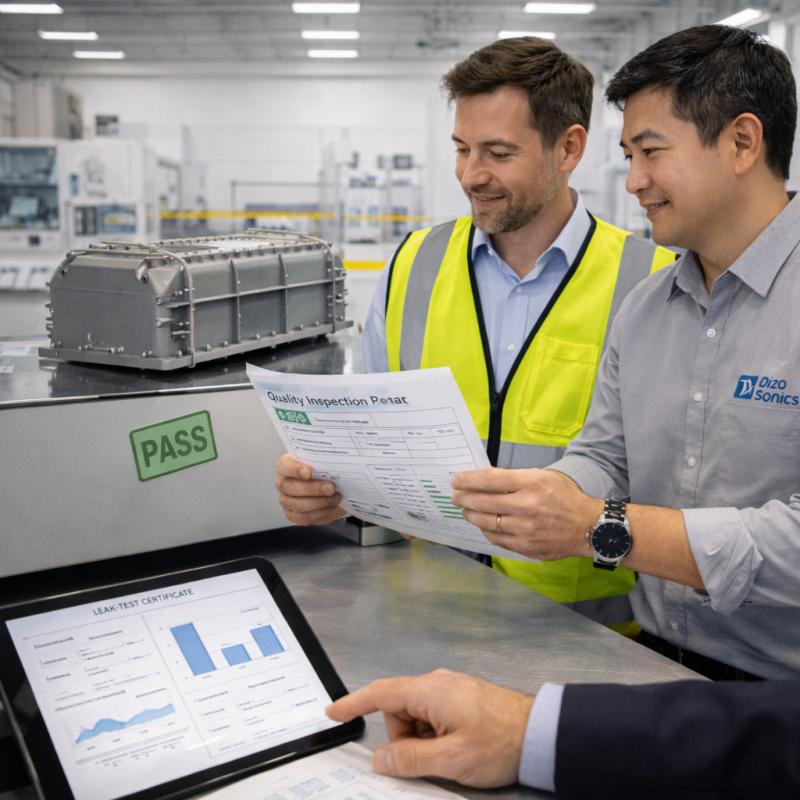
- Sealing: Leak testing under pressure.
Output: Validated data proving the design meets all specs, ready for supplier sign-off.
Phase 4: Process Optimization & Production Launch
Activity: Lock down critical welding parameters (frequency, amplitude, pressure, time) and implement in-process monitoring (e.g., weld-by-distance/energy curves). Establish QC checkpoints for non-destructive testing.
Troubleshooting Quick Guide:
| Symptom | Likely Cause | Corrective Action |
|---|---|---|
| Weak Weld, Low Stiffness | Insufficient energy/pressure | Increase amplitude or weld time. Check horn alignment. |
| Excessive Flash, Part Damage | Too much energy/pressure | Reduce amplitude, pressure, or time. |
| Inconsistent Weld Quality | Part variation, contamination | Tighten incoming part tolerances. Implement plasma or IPA cleaning pre-process. |
5. Beyond Off-the-Shelf: Custom Welding for Next-Generation EV Platforms
Standard welding workstations often struggle with the realities of advanced EV battery housings: complex 3D contours, multi-material assemblies, and the demand for Class-A surface finishes. Custom-engineered solutions are no longer a luxury but a necessity for cutting-edge performance.
Where Standard Welding Falls Short:
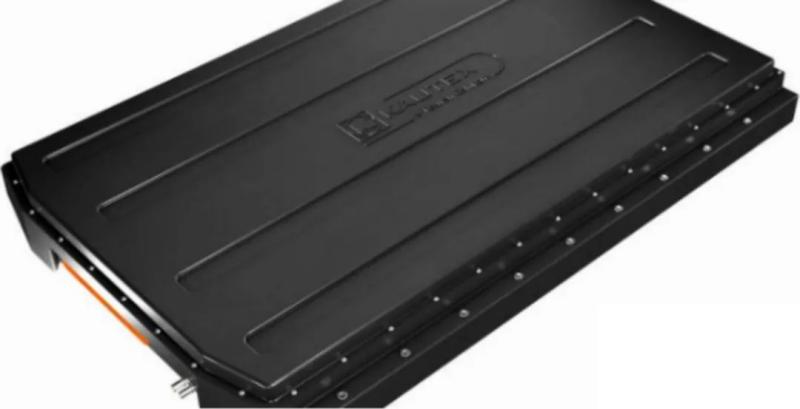
- Complex Geometries: Curved battery covers or trays with non-uniform flanges cause inconsistent pressure and energy delivery with standard systems, leading to weak spots.
- Dissimilar Materials: Integrating metal cooling plates, busbars, or sensor ports within an FRP housing requires precise thermal management to avoid delamination or damage.
- Speed and Quality at Volume: High-throughput lines (e.g., 60+ jobs per hour) demand cycle times under 30 seconds and 100% automated quality verification, which standard systems lack.
Custom Solution in Action: Case Study Highlights
Challenge for a Tier-1 Supplier: Transition from an aluminum housing to an FRP design to meet a 22% weight reduction target for a new 800V platform, while increasing torsional stiffness by 15% for a CTC design.
Dizo Sonics Solution: A fully automated, 6-axis robotic ultrasonic welding cell with servo-controlled pressure. The system used contour-following technology to maintain perfect perpendicularity and consistent pressure on a complex, sweeping flange. Integrated thermal cameras monitored the Heat-Affected Zone (HAZ) in real-time.
Result: Achieved all weight and stiffness targets. The process achieved a leak-tight seal (verified with helium mass spec) at a rate of 120 housings per hour, with near-zero scrap rates. The client reported a projected 18-month ROI based on weight-saving benefits and reduced warranty costs.
Calculating Your ROI on Custom Welding
Justification goes beyond the equipment price tag. Consider:
- Scrap Reduction: Precision welding can cut defect rates from ~5% to under 0.5%.
- Uptime Increase: Robust, automated systems reduce downtime versus finicky standard setups.
- Labor Savings: Full automation eliminates manual loading/unloading and inspection.
- Performance Premium: The enabled weight savings and safety performance have a direct, calculable value to the OEM.
For a production line of 100,000 units/year, the annualized savings from yield and efficiency gains often justify the capital investment in a custom system within the first two years.
6. FAQ: Common Questions on Composite EV Battery Housings
We've compiled answers to top searches based on our expertise at Dizo Sonics. These go beyond basics to provide practical insights, helping you make informed choices.
What is a battery pack housing assembly for electric vehicles?
A battery pack housing assembly is the complete protective unit for EV batteries, including upper covers, lower housings, and impact absorbing members fused together. It safeguards cells from crashes and vibrations while keeping weight low. For deeper details on its role in safety and efficiency, see our introduction section.
How does fiber reinforced plastic composite material improve EV housings?
Fiber reinforced plastic adds strength by embedding fibers in a plastic base, cutting weight while boosting stiffness and impact resistance. In our lab tests, it achieves 40% better performance than metals in energy absorption. This material enhances range without sacrificing durability---for more on composition choices, check the material fundamentals section.
What is a dual laminated structure with closed cross-sectional area?
A dual laminated structure layers composites and welds them to form sealed, box-like sections that resist bending. Think of it as creating a sturdy frame inside the housing. Welding ensures no gaps, enhancing rigidity; our tests show it prevents deformation in crashes. Explore the structural design section for the science behind it.
How to optimize impact energy absorbing performance in EV batteries?
Optimize by using reinforcing fibers and precise welding, like 0.3-0.5 MPa pressure in ultrasonic processes to distribute forces evenly. This avoids weak spots. Per ASTM standards, it can boost absorption by 50%. For implementation tips, refer to our decision framework.
What is structural stiffness enhancement using composites?
Composites enhance stiffness through fiber alignment in the matrix, making housings rigid without added weight. Custom welding locks this in, preventing flex. Our data indicates up to 40% improvement over open designs. See the welding science section for how it ties into closed cross-sections.
Can welding processes affect reinforcing fibers in battery housings?
Yes, improper welding can damage fibers by overheating, reducing strength. Our ultrasonic method controls heat (150-250°C) to preserve integrity, ensuring better absorption. In client projects, this has cut defects by 30%. Check troubleshooting in the decision guide for fixes.

7. Conclusion: Building the Foundation for Lighter, Safer EVs
The journey to optimizing your EV battery housing is a convergence of material science, structural design, and manufacturing excellence. As this guide has outlined, FRP composites present a compelling path to break the weight-safety compromise, but their success is inherently tied to advanced, precise joining technologies.
The industry's trajectory toward 800V architectures, CTP/CTC designs, and gigacasting underscores that the battery housing's role is more strategic than ever. It's not just a container; it's a critical, integrated structural and safety component.
Ready to Assess Your Path Forward?
A tailored welding strategy is often the key to unlocking the full potential of advanced materials. Dizo Sonics offers a complimentary, no-obligation Welding Feasibility Assessment. Our engineers will review your housing design, material specs, and production goals to provide actionable insights on the optimal joining process, potential challenges, and a high-level ROI outlook.
Contact our team today:
sales@dizo-global.com | dizo-global.com | WhatsApp +86 18121506765.
Let's collaborate to build the lighter, stronger, and smarter battery systems that will power the next generation of electric vehicles.
About the Author: This guide was developed based on the hands-on project experience of the Dizo Sonics Engineering Team, specializing in advanced joining solutions for automotive electrification. With over 20 years and 200+ successful EV battery housing projects, our insights are grounded in practical application and validated performance data.