

Plastic Welding Guide for Automotive Exteriors: Zero-Defect Production

Plastic Welding for Automotive Exteriors: The Complete Guide to Zero-Defect, High-Volume Production
Imagine shipping vehicles only to face customer complaints about foggy tail lights, cracked bumper seams, or visible weld lines on illuminated logos. These costly failures almost always trace back to an inconsistent or poorly chosen plastic welding process.
I'm Jensen from Dizo Sonics. With over 20 years of experience specializing in ultrasonic, vibration, and laser welding for automotive plastics, I've partnered with OEMs and Tier-1 suppliers globally to eliminate these exact problems. This guide will provide you with proven technologies, actionable parameters, objective comparisons, and a ready-to-use selection framework to achieve hermetic seals, flawless aesthetics, and reliable LED integration for bumpers, tail lights, and light strips---all while meeting IATF 16949 standards and your production targets.

1.Why Precision Plastic Welding is Non-Negotiable for Modern Vehicles
The shift toward electric vehicles and bold lighting design has made engineering plastics indispensable for automotive exteriors. Components like bumpers and full-width tail lights are now complex, multi-part assemblies where plastic welding---the molecular-level fusion of thermoplastics using controlled heat and pressure---is the only method that guarantees the required strength, seal, and finish.
The High Cost of Welding Failures
When welding succeeds, it enables weight reduction, part consolidation, and perfect aesthetics. When it fails, the consequences are severe:
- Warranty Claims: Moisture ingress in tail lights or light strips leads to electrical failures.
- Brand Damage: Visible weld marks on Class-A surfaces compromise premium appeal.
- Production Losses: Inconsistent strength causes crash test failures and line stoppages.
Our work with clients like Tesla, BYD, and Mercedes-Benz has shown that these issues stem not from the materials, but from selecting the wrong welding process or lacking precise parameter control.
2.The Science Behind a Perfect Weld: Principles Simplified
At its core, plastic welding is controlled melting and molecular interlocking. When two parts are heated at the joint interface, polymer chains become mobile, cross the boundary, and entangle, forming a bond that can be stronger than the base material.
Energy Delivery Methods
Different processes generate heat in distinct ways, each suited to specific applications:
- Vibration Welding: Uses linear or orbital motion (80--240 Hz) to create frictional heat. Ideal for large, structural parts like bumpers.
- Ultrasonic Welding: Employs high-frequency vibration (20--40 kHz) for near-instant heat at a focused point. Best for small, precise components.
- Laser & Hot-Plate Welding: External heat sources conduct or radiate energy. Essential for applications where zero particulates and perfect cosmetics are critical, such as clear lenses and illuminated logos.
The Four Command Parameters You Must Control
Mastering these variables is the key to repeatable, high-quality welds:
These four variables decide 95 % of your weld quality. Get them right and you'll pass IATF 16949 audits every time.
- Amplitude/Stroke: Governs heat generation aggressiveness.
- Pressure/Clamp Force: Ensures material merging and void elimination.
- Frequency (Ultrasonic): Higher frequencies (35-40 kHz) allow gentler, mark-free welding on thin-walled parts.
- Time/Collapse Distance: Controlling by precise melt depth ("collapse") is more repeatable than time alone for automotive production.
Optimizing these parameters, as we do daily in our application lab, is fundamental to passing stringent IATF 16949 quality audits.
3. Technology Comparison: Vibration vs. Ultrasonic vs. Laser Welding
Selecting the right technology requires a clear comparison. Here's how the leading plastic welding processes stack up for exterior components:
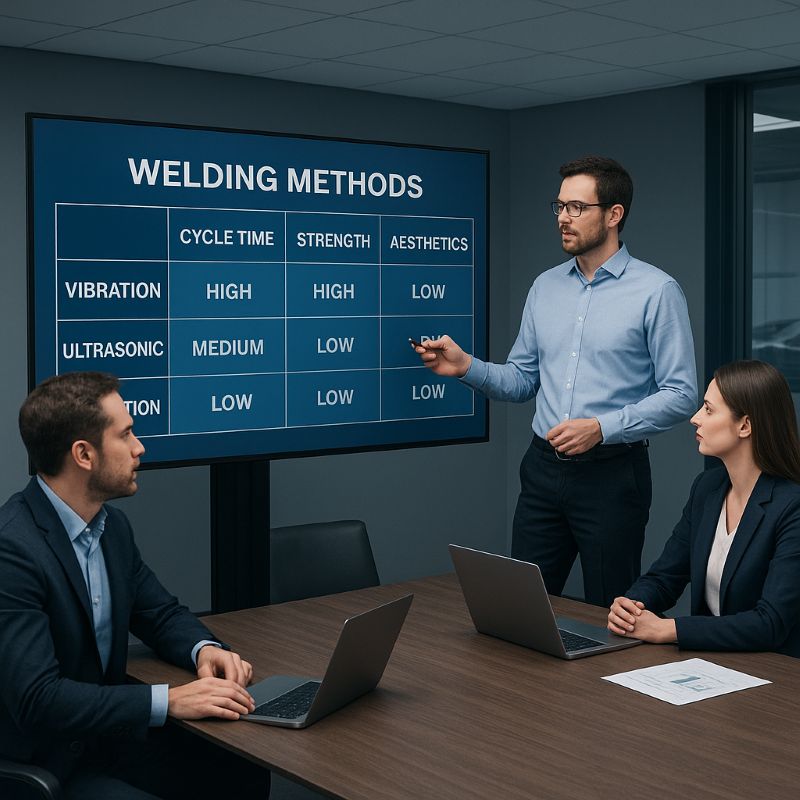
| Criteria | Vibration Welding | Ultrasonic Welding | Laser Welding |
|---|---|---|---|
| Best For | Large parts (bumpers, spoilers) | Small/medium parts with energy directors | Complex contours, clear lenses (tail lights, logos) |
| Cycle Time | Medium (6-15 s) | Very Fast (0.5-3 s) | Fast (3-10 s) |
| Joint Strength | Excellent (deep, homogeneous) | High | High |
| Aesthetics | Good (may require flash trimming) | Good (risk of marking on sensitive surfaces) | Excellent (invisible weld line) |
| Hermetic Seal | Excellent | Good | Excellent |
| Automation Integration | High (robotic fixturing common) | Very High | Very High |
Key Insight: No single process is best for all applications. Vibration welding is the workhorse for structural, large-scale bonding, while laser welding is unmatched for cosmetic perfection on lighting components.
4. Your Decision Framework: A 5-Step Guide to Selecting the Right Plastic Welding Process for Automotive Exteriors
Use this proven decision-making workflow, refined through our projects with global automakers, to identify the best technology for your component.
Step 1: Analyze Part Geometry & Size
Start with the physical reality of your component.
- Large & Linear (e.g., bumper weld >500mm): Prioritize Vibration.
- Small/Medium & Complex (e.g., sensor housing): Consider Ultrasonic.
- 3D Contours & Thin-Walls (e.g., tail light lens): Laser is often mandatory.
Step 2: Evaluate Material Compatibility
Material dictates feasibility. Key guidelines:
- PP/TPO (Bumpers): Excellent for Vibration, challenging for Ultrasonic.
- PC/PMMA (Lenses): Requires Laser for clarity.
- ABS/PC-ABS (Painted Trim): Compatible with all three; choose based on other factors.
Step 3: Define Production & Quality Goals
- Speed: Cycle time <5s pushes you toward Laser or Ultrasonic.
- Strength: Maximum structural integrity favors Vibration.
- Cosmetics: Zero-visible seams demand Laser.
- Traceability: IATF 16949 compliance requires systems with full data logging.
Step 4: Calculate Total Cost of Ownership (TCO)
Look beyond the machine price. Over 8 years:
- Vibration: Moderate CapEx, low consumable cost.
- Laser: Higher CapEx, very low running cost, periodic optics maintenance.
- Ultrasonic: Low CapEx, higher tooling (horn/booster) wear cost.
Step 5: Prototype & Validate
The final step is always empirical testing. We recommend running feasibility trials on shortlisted technologies with your exact material batch and geometry.
5. 2025 Trends: Sustainable Materials and Lightweighting
The automotive industry's push towards sustainability is reshaping material choices, which in turn impacts welding. Key trends for automotive exterior welding include:
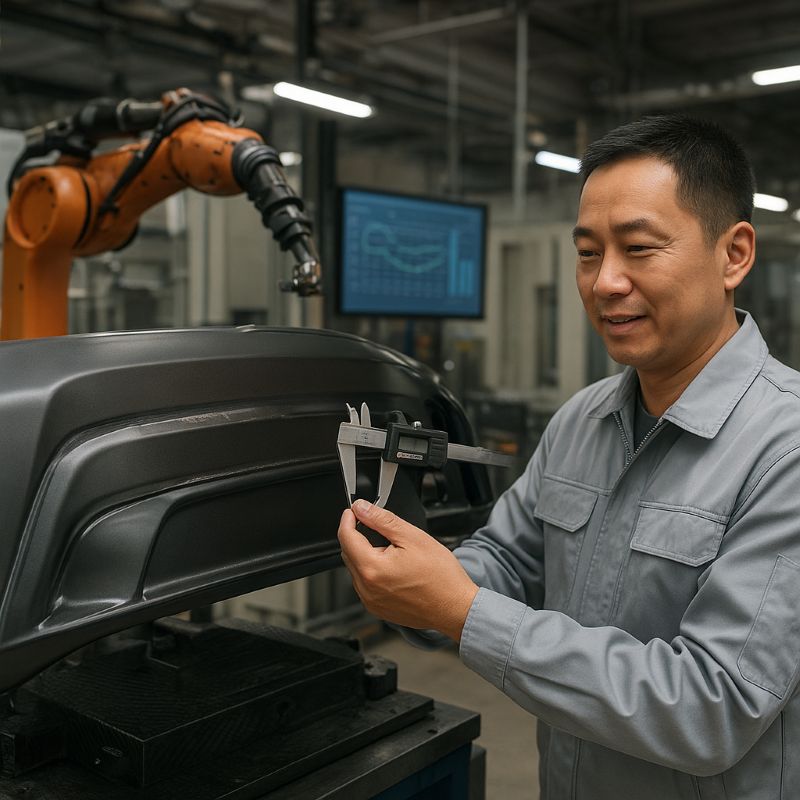
- Welding Recycled & Bio-Based Plastics: These materials often have inconsistent melt flows. Processes with precise, localized heat input (like servo-controlled vibration or laser) are essential to prevent defects.
- Lightweighting with Thin-Wall Designs: Thinner components are more susceptible to marking and distortion. The gentle nature of 35KHZ+ ultrasonic and laser welding protects delicate geometries.
- Adhesive-Free for Circular Economy: Welding simplifies end-of-life disassembly and material recycling compared to bonded assemblies, supporting sustainability goals.
At Dizo Sonics, we are at the forefront of developing processes to reliably weld these next-generation, sustainable materials.
6. Beyond Standard Machines: When Custom Solutions Are Essential
Standard welding equipment excels for about 80% of applications. The remaining 20%---the most complex and critical parts---require a tailored approach. Here are real scenarios where we engineered custom solutions:
Real-World Example 1: Large EV Bumper with Integrated Ducting (Chinese OEM)
Challenge A major EV maker needed to weld a 1.8 m wide PP bumper with deep ribs and curved air channels. Standard vibration welders produced visible flash on the Class-A surface and weak joints in the corners --- scrap rate hit 18 %.
Dizo Sonics Solution We designed a servo-electric vibration system with independent multi-zone amplitude control and a custom 2.2 m × 0.8 m fixture using carbon-fiber nesting. Real-time melt-depth monitoring (closed-loop collapse control) was added.
Results
- Scrap rate dropped from 18 % to under 1 %
- Weld strength variation reduced by 40 %
- Cycle time 9.8 s, fully integrated into robotic cell
- Equipment still running 24/7 after four years with >98 % uptime
Real-World Example 2: Seamless Illuminated Logos for a German Premium Brand
Challenge The client wanted a 450 mm wide illuminated logo with zero visible weld line on the outer PC lens and perfect light uniformity. Standard quasi-simultaneous laser systems overheated the thin clear layer, creating haze around the LEDs.
Dizo Sonics Solution We developed a simultaneous laser welding system using our proprietary multi-ring fiber optic layout and adaptive power modulation (0--100 % in 50 ms steps). Combined with active cooling masks and in-line transmission testing.
Results
- 100 % invisible weld line (passed Mercedes-Benz Class-A approval on first article)
- Light transmission variation <2 % across the entire logo
- Cycle time reduced from 28 s to 4.2 s versus hot-plate baseline
- ROI achieved in 11 months through eliminated rework and higher premium pricing
These results are made possible by our in-house R&D team and partnerships with leading institutes, ensuring confidential, cutting-edge solutions.
7. Key Factors for Successful Production Implementation
Technology selection is only half the battle. Successful, sustained production hinges on:
- Early Supplier Involvement: Collaborate with your welding partner during the part design phase to optimize joint geometry for manufacturability (DFM).
- Comprehensive Process Validation: Insist on full IATF 16949 validation reports, including statistical process capability (Cpk) studies for critical weld parameters.
- Operator Training & Maintenance: Establish robust training and preventive maintenance schedules for tooling (horns, optics) to prevent quality drift and downtime.
8.Frequently Asked Questions About Plastic Welding for Automotive Exteriors
What Are the Best Plastic Welding Solutions for Lightweight Automotive Components?
Vibration welding is usually the top choice when maximum structural strength and weight reduction are priorities. It creates deep, homogeneous bonds in materials like PP and TPO that easily withstand crash loads and thermal cycling while consolidating parts and eliminating fasteners. For the clearest tail lights and light guides, however, laser welding (especially TTIr or quasi-simultaneous) wins because it produces completely invisible joints without adding any particulate that could scatter light. The real "best" solution often combines both technologies in the same assembly line --- something we routinely design for OEMs.
How Does Vibration Welding Improve Bumper Durability?
Vibration welding generates heat through controlled friction across the entire joint, melting and then intimately mixing the polymer chains. The result is a true monolithic structure that often exceeds the strength of the base material itself. Unlike adhesives or mechanical fasteners, there are no weak interfaces that can delaminate over time. In our testing laboratory, bumpers welded on servo-controlled Dizo systems consistently achieve >95 % of parent material tensile strength and survive -40 °C to +85 °C cycling for 2,000+ hours with zero failures.
What Is Quasi-Simultaneous Laser Welding for Illuminated Logos and Tail Lights?
Quasi-simultaneous laser welding scans the entire weld contour dozens of times per second with a single laser beam, effectively heating the joint uniformly until the plastic collapses by a precise amount. This delivers perfect aesthetics (zero visible weld line) and excellent hermetic sealing while being extremely tolerant of complex 3D shapes. It's the go-to process for premium illuminated logos, light strips, and clear lens assemblies where even 0.1 mm of marking is unacceptable. Our systems add real-time power modulation so light transmission stays within ±2 % across the entire part.
How Do I Choose Between Vibration Welding and Hot-Plate Welding for Large Exterior Panels?
Start with cycle time and surface requirements. Vibration welding typically finishes in 6--12 seconds with superior strength and hermeticity, while hot-plate takes 20--40 seconds and can leave contact marks on Class-A surfaces. If your takt time is tight and you need maximum impact resistance (bumpers, roof rails, large grilles), vibration almost always wins. Hot-plate is still useful for very thick walls or when joining painted parts where strength is adequate and cost is the main driver. In practice, 9 out of 10 modern bumper lines we build use vibration.
How to Achieve Reliable Hermetic Seals in Automotive Tail Lights and Light Strips?
The seal is only as good as your process control. Use collapse-distance triggering instead of time (we target 1.2--2.0 mm depending on wall thickness), keep clamp force uniform within ±5 %, and maintain joint gaps below 0.15 mm. Laser systems with active gap compensation or servo vibration with multi-zone pressure mapping are the most repeatable. In our experience, adding in-line helium leak testing at 10⁻⁶ mbar·l/s catches the last 0.3 % of potential leaks before parts leave the cell.

9.Conclusion: Your Roadmap to Zero-Defect Automotive Exterior Assembly
You now have a comprehensive understanding of plastic welding for automotive exteriors---from core science and technology comparisons to a practical selection framework and the realities of custom solutions.
The difference between a good outcome and a world-class one lies in matching the unique demands of your part with not just a process, but a partner possessing deep application expertise.
At Dizo Sonics, we combine over two decades of focused experience with a collaborative engineering approach. We are your partner in turning complex exterior welding challenges into reliable, high-volume production reality.
Ready to solve your welding challenge?
- Download our free checklist: "Specifying a Plastic Welding System for Automotive Exteriors."
- Schedule a free, 30-minute consultation with our engineering team to review your part drawings and goals.
- Contact us at sales@dizo-global.com or via WhatsApp: +86 181 2150 6765 for a confidential assessment.
Send us your challenge, and we'll provide a tailored process recommendation within 48 hours. Let's build stronger, lighter, and more beautiful vehicles together.