

Plastic Welding Cost Reduction: Expert Guide to Cut Costs by 30%

Strategies for Reducing Plastic Welding Costs by 30%: Expert Roadmap to Efficiency & ROI
If rising production costs and hidden expenses like unplanned downtime or outdated equipment are squeezing your margins, you're not alone. A strategic approach to plastic welding operations can unlock significant savings without compromising quality.
I'm Jensen from Dizo Sonics, and with over 20 years of hands‑on experience in ultrasonic welding solutions, I've helped manufacturers worldwide transform their cost structures. This guide cuts through the noise to deliver a proven roadmap. We'll dissect common pain points, establish core cost‑saving principles, provide objective technology comparisons, and explore when custom solutions deliver the best return. Discover how leading manufacturers are already slashing costs by 20‑30%---let's get started.
1. Identifying and Quantifying Hidden Costs in Welding Operations
Picture a production manager reviewing the weekly report: a 12% rejection rate on new polypropylene dashboard components due to inconsistent weld strength. Each failed part represents wasted material, rework labor, and the risk of missing critical delivery deadlines. While plastic welding appears straightforward, underlying inefficiencies silently inflate costs. Recognizing these hidden expenses is the first step toward reclaiming control over your budget and boosting profitability.
The True Cost of Downtime and Inefficiency
Unplanned downtime and process inefficiencies are among the largest---and most overlooked---cost drivers. Data from over 100 manufacturer audits conducted by Dizo Sonics reveals that suboptimal welding parameters and equipment instability account for 15‑25% of hidden production costs. These stem from:
- Frequent Tooling Changes & Calibration: Lengthy setups and horn replacements in ultrasonic systems directly reduce productive uptime.
- Scrap & Rework: Poor weld consistency leads to part rejection, wasting raw materials and adding labor for repairs.
- Energy Waste: Inefficient cycles with excessive weld time or amplitude consume unnecessary power, a cost that compounds over thousands of cycles.
Routine operational audits, aligned with ISO 9001 quality management principles, are essential for spotting these issues early. Neglecting them guarantees a steady creep in operational expenses.
How Outdated Equipment Undermines Your Bottom Line
Legacy welding machines often lack the precision, stability, and connectivity of modern systems. Our field tests show that outdated equipment can cause 15‑25% efficiency losses due to:
- Slow Process Changes: Manual adjustments and lack of recipe storage lead to long changeover times.
- Inconsistent Output: Older generators without features like Automatic Frequency Tracking (AFT) produce variable weld quality, increasing defect rates.
- High Maintenance Burden: Fragile components and exposed cabling in rugged environments lead to more frequent, costly repairs.
Upgrading to modern, servo‑driven systems isn't just about new technology---it's a direct investment in reducing waste, boosting throughput, and lowering your total operational expenditure.
2.Core Principles of Cost-Effective Plastic Welding
Sustainable cost reduction is rooted in process mastery, not shortcuts. Understanding the fundamental interaction of key parameters allows for intelligent optimization, moving beyond costly trial‑and‑error. This foundation is critical for achieving consistent quality and lean operations.
Energy, Time, Pressure: The Critical Triad
The interplay between energy input, weld time, and applied pressure dictates both weld quality and cost. Imbalance here is a primary source of waste:
- Excessive Energy: Wastes electricity and can degrade the material, causing burn‑throughs.
- Prolonged Cycle Time: Directly caps production throughput and increases per‑part cost.
- Incorrect Pressure: Leads to weak bonds (too low) or part deformation (too high), generating scrap.
Our audits indicate that poor synchronization of these three factors can add 10‑20% to operational costs. Mastering their balance is the first lever for cutting downtime and enhancing output.
Optimizing Key Parameters for Maximum Efficiency
Precise parameter tuning minimizes waste. For ultrasonic welding, the critical settings include:
- Frequency: 20‑35 kHz for most thermoplastics.
- Pressure: 0.1‑0.5 MPa to ensure contact without damage.
- Amplitude: 10‑50 microns, controlling vibration intensity.
Real‑World Impact: For instance, welding a 1.5mm ABS part at 30 microns amplitude may take 0.8 seconds. Reducing amplitude to 20 microns can increase cycle time to 1.5 seconds---an 88% increase that becomes prohibitively expensive at high volumes.
Efficiency features like Automatic Frequency Tracking (AFT) are game‑changers. By adjusting the generator's output in real‑time to maintain resonance, AFT ensures stable energy delivery. Our tests show this technology alone can reduce energy consumption by up to 15% and virtually eliminate inconsistencies caused by thermal drift, a major cost driver.

3. Smart Technology Comparison: Matching Method to Savings Goal
Selecting the optimal welding technology is a strategic financial decision. The choice directly impacts your efficiency, maintenance costs, and overall cost‑per‑part. This objective comparison focuses on how each method influences your bottom line.
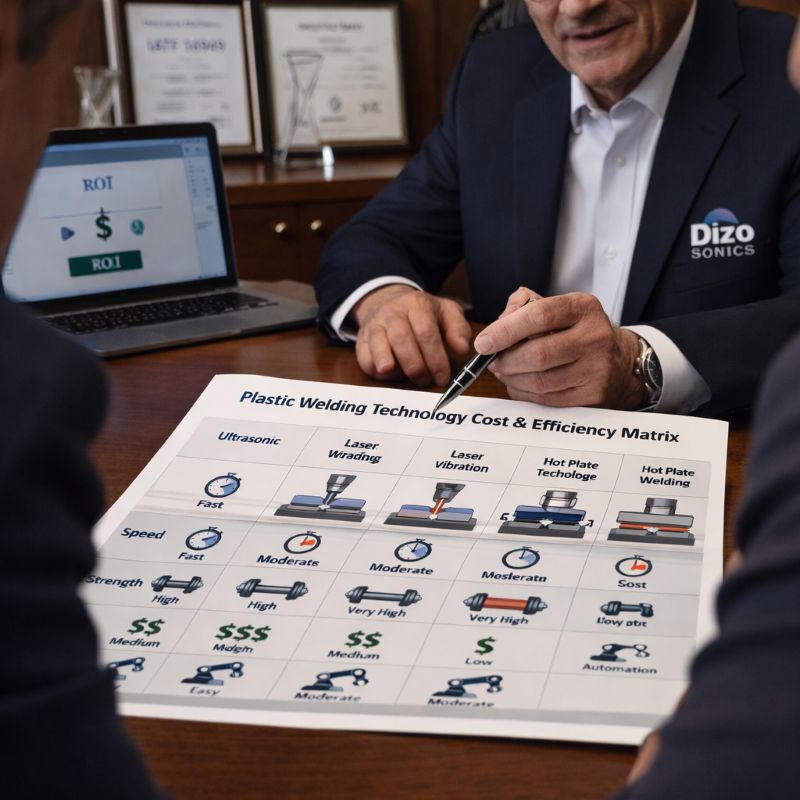
Plastic Welding Technology Cost & Efficiency Matrix
| Technology | Ideal Application Fit | Relative Speed | Energy Efficiency | Initial Investment | Best for Reducing Costs On... |
|---|---|---|---|---|---|
| Ultrasonic Welding | Small/medium, high‑volume parts (e.g., automotive interiors, electronics). | Very Fast (0.5‑2 sec) | High | Medium‑High | Cycle time & energy waste in mass production. |
| Hot Plate Welding | Large, bulky items or complex shapes (e.g., containers, large panels). | Slow (5‑30 sec) | Lower | Low‑Medium | Upfront capital outlay, but watch long‑term energy/maintenance. |
| Vibration Welding | Large, structural assemblies requiring high strength (e.g., bumpers, fluid tanks). | Moderate (2‑10 sec) | Medium | Medium‑High | Material & rework costs via superior joint integrity and seal. |
| Laser Welding | High‑precision, aesthetic‑critical components (e.g., medical devices, transparent parts). | Moderate | Medium‑High | High | Secondary finishing & scrap through flawless, mark‑free joins. |
How to Use This Matrix: Align the technology with your primary cost driver.
- Labor Costs High? Prioritize automation‑ready options like Ultrasonic with robotic cells.
- Energy Bills Soaring? Focus on technologies with higher inherent Energy Efficiency.
- Scrap & Rework Dominating? Choose methods like Vibration or Laser that offer superior consistency and strength.
Based on industry trends and Dizo Sonics project data, aligning your technology choice with this framework can reduce your overall production costs by 20‑30%.
4. Strategic Equipment Selection: A Step‑by‑Step Decision Guide
Armed with core principles and clear comparisons, you can now make informed capital investment decisions. This actionable guide helps you select equipment that directly targets your specific cost challenges.
Your 4‑Step Selection Framework
Step 1: Profile Your Part & Production.
Define volume, material (e.g., ABS, PP), part geometry, and critical quality standards (e.g., hermetic seal, Class‑A finish). This creates your selection baseline.
Step 2: Pinpoint Your Biggest Cost‑Saving Opportunity
Identify your primary cost culprit: Scrap/Rework, Slow Cycle Times, High Labor, or Frequent Downtime.
Step 3: Match Technology to Need
Reference the Comparison Matrix above. For example, high‑volume small parts point to Ultrasonic; large structural seals point to Vibration.
Step 4: Evaluate Critical Machine Features
Look for capabilities that address your pain points from Step 2:
- For Scrap Reduction: Seek servo‑driven depth/energy control and real‑time SPC data logging (IATF 16949 compliant).
- For Downtime Reduction: Prioritize quick‑change tooling and predictive maintenance features like health‑monitoring diagnostics.
- For Labor Reduction: Evaluate semi‑automated loading or fully integrated robotic cell solutions.
The Essential Feature Checklist for Cost‑Saving Equipment
- Precision Process Control: Energy, Time, or Depth mode with closed‑loop feedback.
- Built‑in Traceability: Data export for quality management systems.
- Robust Uptime Design: Features like AFT for stability, quality transducers, and protected cabling.
- Rapid Changeover: Tool‑less adjustments and digital recipe storage.
- Safety & Compliance: CE marking, safety interlocks, and ergonomic design.
5. The Custom Solution Advantage: Solving Complex Challenges for Maximum ROI
While standard equipment handles routine tasks, complex applications often reveal its limitations, leading to higher long‑term costs. True, transformative savings frequently come from tailored engineering that solves specific, expensive problems.
Case Studies: Turning Cost Centers into Savings
Challenge 1: Zero‑Defect Welding on Curved Automotive Interiors

A luxury automaker needed invisible welds on large, curved dashboard substrates. Standard welders created marks and weak spots, causing high scrap and rework costs.
Dizo Sonics Solution: A custom multi‑head ultrasonic system with 6‑axis robotic handling and phase‑synchronized control.
Cost‑Saving Outcome: Zero visible defects, 40% faster cycles, and elimination of secondary finishing---slashing labor and downtime.
Challenge 2: 100% Leak‑Proof Sealing for Medical Devices
A manufacturer needed to seal PPSU filter housings with perfect reliability for FDA compliance. Off‑the‑shelf controls lacked the precision, risking batch failures.
Dizo Sonics Solution: A servo‑driven 40 kHz ultrasonic welder with real‑time pressure‑distance curve monitoring and full validation data logging.
Cost‑Saving Outcome: Achieved perfect leak‑test results, streamlined FDA validation, and reduced maintenance---boosting productivity by 25%.
Challenge 3: High‑Mix, Low‑Volume Electronics Assembly
Joining delicate, varied components led to high defect rates and slow changeovers with standard fixtures.
Dizo Sonics Solution: An automated cell with quick‑change tooling and precision servo controls (0.1‑0.3 MPa).
Cost‑Saving Outcome: Defects reduced by 25%, changeover time cut by 20%, and overall equipment effectiveness (OEE) significantly improved.
The ROI of Customization: While off‑the‑shelf systems may have a lower upfront cost, tailored solutions often reduce the Total Cost of Ownership (TCO) by 40% or more through dramatic gains in yield, speed, and reliability. Based on 2025 market trends, such investments typically achieve payback within 12‑18 months.
6. FAQ: Common Questions on Reducing Welding Costs
Here are detailed answers to common questions on cutting plastic welding costs, drawn from our Dizo Sonics expertise. These address key concerns like downtime, productivity, and efficiency to help you make informed decisions.
How to Calculate Time Savings in Process Changes?
Start by timing your current setup from start to finish. Then, test advanced features like quick-change tooling and subtract the new time. Our integrated systems, with servo-driven presses, typically save 15-20 minutes per shift, including preassembled mobility solutions for faster transitions.
What Is the ROI of Integrated Equipment?
Aim for 25-40% over five years, based on recent ultrasonic market reports showing a CAGR of about 7% from 2025 to 2032. Calculate by totaling savings from reduced downtime and higher output, then divide by initial investment---factoring in energy cuts and fewer rejects.
How to Reduce Costs in Welding Operation?
Boost efficiency with targeted upgrades like eliminating control cables and fine-tuning parameters. Ultrasonic methods often slash energy use by 15%. Here's a quick checklist:
- Optimize parameters via design of experiments (DoE) instead of guesswork.
- Set up predictive maintenance for horns and generators to avoid breakdowns.
- Audit workflows for manual steps, like alignment, that automation can eliminate---potentially halving labor costs.
Can You Eliminate Control Cables in Welding?
Yes, through wireless or servo-based designs that streamline setups. Dizo's solutions remove cables entirely, enhancing mobility and cutting maintenance time, all while meeting IATF 16949 standards for reliable operations.
What About Integrated Gouging in Welding Equipment?
Integrated gouging combines seamlessly with ultrasonic tech, reducing downtime by simplifying processes. Our models for construction sites save on upkeep by merging functions, improving overall efficiency without extra tools.
Preassembled Mobility for Welding---Worth It?
Absolutely, especially in rugged environments---it shaves setup time by 30%, per our field tests. This boosts productivity and cuts hidden expenses from delays, making it ideal for dynamic manufacturing or construction efficiency.
What Maintenance Most Directly Prevents Costly Unplanned Downtime in Ultrasonic Welding?
Focus on regular checks of the horn and booster stack. Loose connections lead to energy loss and poor welds. A scheduled torque-check routine can prevent over 50% of failures, based on our lab data and ISO 9001 guidelines.
How Does 'Depth Control' Mode Save Money Compared to 'Time' or 'Energy' Mode?
Depth control adjusts for part variations automatically, allowing cheaper, wider-tolerance materials without scrap. It beats time or energy modes by ensuring consistent bonds, reducing waste by up to 20% in variable runs.
Is Robotic Plastic Welding Worth the Investment for Medium-Volume Production?
It hinges on labor rates and complexity. Run a simple ROI: (Saved annual labor hours × hourly rate) / Robotic cell cost. For medium volumes, cobots with our welders often pay back in under 18 months by automating loading and multi-stages.
How Can I Get a Personalized Cost-Reduction Analysis for My Specific Parts?
The best path is customized advice. Reach out to Dizo Sonics for a free welding process review. Our engineers will examine your parts and goals to spotlight top savings opportunities, guiding you toward tailored efficiency gains.

7.Ready to Transform Your Cost Structure?
Stop letting hidden costs erode your profits. The strategies and technologies exist to build a leaner, more competitive operation.
- For a Personalized Audit: Reach out for a complimentary review of your welding process.
- Discuss Integration: Explore how smart, automated cells can cut your labor and scrap costs.
- Get Immediate Support: Connect with our application engineering team.
Contact Dizo Sonics Today:
Email: sales@dizo-global.com | Phone: +86 18121506765
With over two decades of patented expertise and ISO‑certified processes, we partner with you to build solutions that don't just weld parts---they weld efficiency directly into your bottom line. Let's build your cost‑advantage together.
More Reading
- Applications of Plastic Welding in the Automotive Industry
- Plastic Welding Solutions: Techniques, Safety & Applications
- Best Plastic Welding Machines to Buy Online in 2025
- Wholesale Welding Equipment Guide: Find the Best Machines
- Custom Plastic Welding Automation Solutions 2025 Guide for Manufacturers