

Vibration Welding Material Compatibility Guide | Strong Thermoplastic Bonds
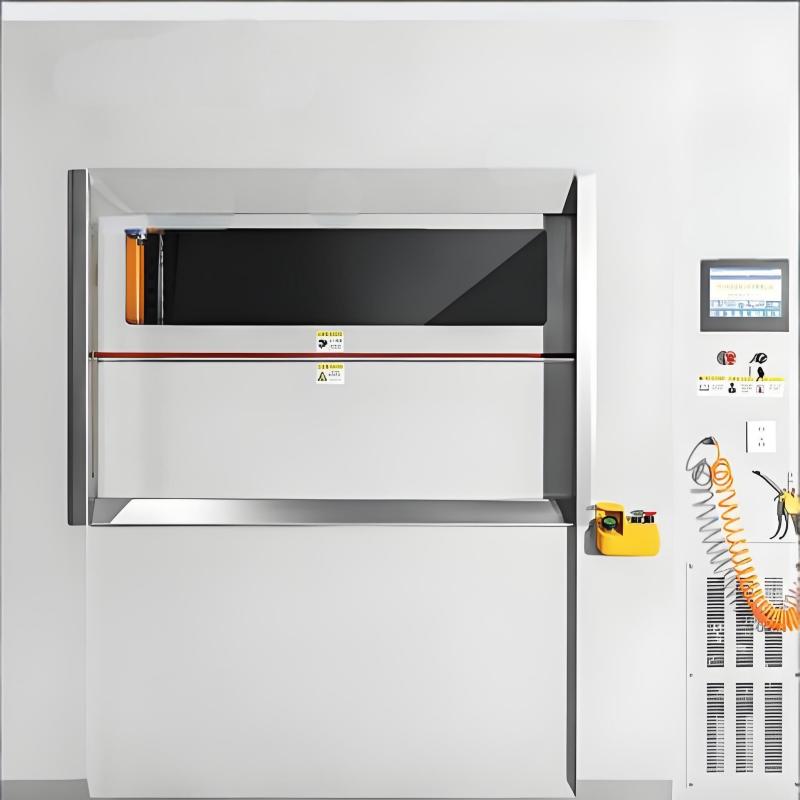
Vibration Welding Compatibility: The Ultimate Guide to Strong, Reliable Thermoplastic Bonds
Vibration welding compatibility is the precise alignment of chemical, thermal, and flow properties between thermoplastic parts, enabling them to fuse into a single, strong structure during the friction-based process. For manufacturing engineers and product designers, overlooking this compatibility leads to weak bonds, stress cracks, and high scrap rates---common failures that drive up costs and cause delays in industries like automotive and consumer appliances.
In this comprehensive guide, we break down the essential pillars: chemical compatibility for molecular bonding, closely matched melt temperatures, and aligned melt flow behavior. You'll gain access to practical tools like material compatibility charts, validated testing protocols (like the welded T-plaque test), and a framework for consulting material datasheets. As Jensen from Dizo Sonics, with over 20 years of hands-on experience solving these challenges for clients like Tesla and Tier-1 automotive suppliers, I'll share data-driven insights to help you verify materials and achieve consistent, high-yield production.
Consider this your definitive resource---from foundational principles to navigating complex scenarios where standard processes fall short. Proper compatibility, validated through ISO 9001-certified processes like ours, is not just a technical detail; it's a strategic lever for boosting production efficiency and cutting long-term operational costs.
1. Introduction to Vibration Welding and Its Strategic Importance
Vibration welding is a robust, friction-based process used to join large thermoplastic components. It works by oscillating one part under pressure against a stationary part, generating frictional heat that melts the interface. Once a set melt depth is achieved, vibration stops, and the parts are held under pressure to cool and form a solid, monolithic bond.
This method is particularly vital in automotive manufacturing for assembling large components like bumper fascias, instrument panels, air intake manifolds, and fluid reservoirs, where it offers a fast, reliable, and automatable joining solution.
Why Material Compatibility is Non-Negotiable
The strength and hermeticity of the final weld are fundamentally dictated by how well the two material surfaces interact at a molecular level. Successful vibration welding requires the materials to have:
- Similar Polymer Chemistry: To entangle and form strong covalent bonds.
- Overlapping Melt Temperature Ranges: To ensure both surfaces reach a viscous state simultaneously.
- Comparable Melt Viscosity under High Shear: To promote uniform mixing and flow at the weld interface.
Ignoring these factors doesn't just cause a weak joint; it triggers a cascade of production failures. Our ISO 9001-certified process validation at Dizo Sonics consistently shows that selecting compatible materials can reduce defect rates in high-volume lines by 70% or more.
The Tangible Cost of Incompatibility
The financial impact of poor material matching is severe and multifaceted:
- Increased Scrap & Rework: Weak bonds lead to non-conforming parts, directly increasing material waste and labor for rework.
- Unplanned Production Downtime: Line stoppages to address failures result in significant losses in output and capacity utilization.
- Accelerated Tooling Wear: Inconsistent melting from mismatched materials can cause abrasive wear on welding horns and fixtures.
- Elevated Warranty & Liability Risk: Parts that fail in the field lead to costly recalls, repairs, and brand reputation damage.
Industry data suggests that in automotive assembly, rework stemming from welding incompatibilities can consume up to 5% of total part cost. Proactive compatibility assessment is a simple, high-return investment.
2. The Three Pillars of Thermoplastic Compatibility for Vibration Welding
Achieving a perfect weld extends beyond the machine parameters; it begins with the intrinsic properties of the materials themselves. Compatibility rests on three interdependent scientific pillars.
Pillar 1: Chemical Compatibility -- The Foundation of Molecular Bonding
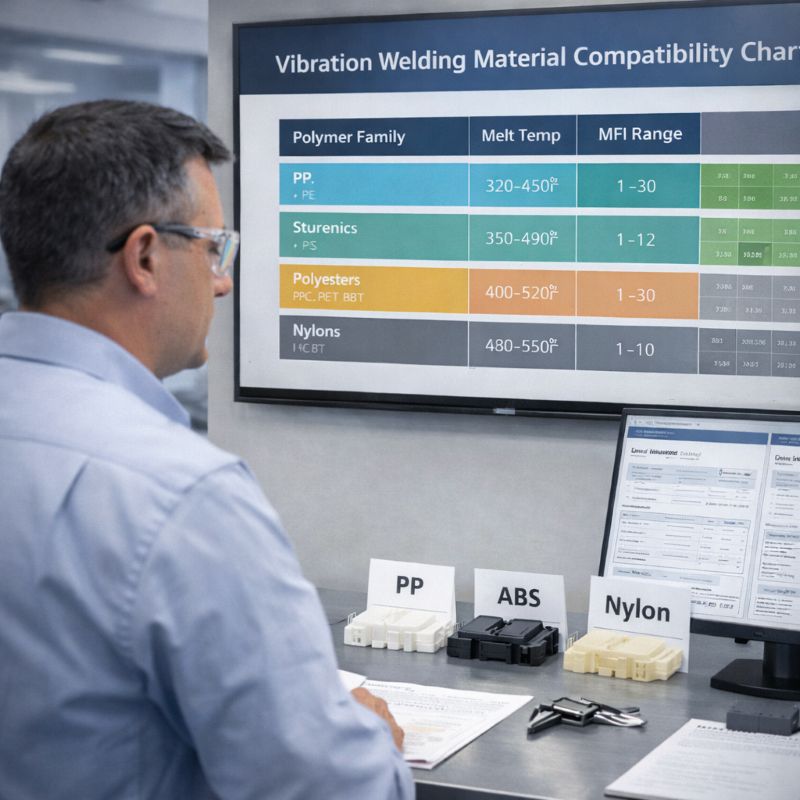
Chemical compatibility refers to the affinity between the polymer chains of the two parts. For the strongest bonds, the materials should be of the same family (e.g., PP to PP, ABS to ABS). This allows polymer chains to diffuse across the interface and entangle, creating a bond often stronger than the base material.
Semi-Crystalline vs. Amorphous: Semi-crystalline materials (PP, PE, Nylon) generally weld well to themselves but require precise control. Amorphous materials (ABS, PC, PS) are typically more forgiving.
The Role of Additives & Fillers: Flame retardants, impact modifiers, and fillers (like glass or mineral) can significantly alter surface chemistry and must be accounted for. For instance, a high glass-fill content can impede chain mobility.
Dizo Sonics Insight: For hygroscopic polymers like Nylon (PA), pre-drying is a non-negotiable step to prevent moisture vaporization (venting) during welding, which can create voids and weaken the bond by over 50%.
Pillar 2: Thermal Compatibility -- Managing the Melt Temperature Window
For a uniform weld, the two materials must reach their melt or softening ranges simultaneously. A general rule is to keep the melt temperature differential below 40°F (22°C).
Consequence of Mismatch: A material with a significantly lower melt point will over-degrade before the higher-melting material begins to flow, leading to a weak, carbonized joint.
Key Reference Data:
| Material (Generic) | Typical Melt Temperature Range | Key Consideration for Vibration Welding |
|---|---|---|
| Polypropylene (PP) | 320 - 350°F (160 - 177°C) | Excellent vibration weldability; widely used for automotive interiors. |
| Acrylonitrile Butadiene Styrene (ABS) | 400 - 450°F (204 - 232°C) | Good weldability; common in housings and cosmetic parts. |
| Polyethylene (PE) | 250 - 300°F (121 - 149°C) | HDPE welds well; LDPE can be more challenging due to its high melt viscosity. |
| Nylon 6 (PA6) | 420 - 440°F (216 - 227°C) | Must be thoroughly dried (<0.2% moisture) before welding. |
Pillar 3: Rheological Compatibility -- Aligning Flow Under Pressure
Rheology is the study of material flow. In vibration welding, materials are subjected to high shear rates. Their viscosity under these conditions must be similar to ensure they mix homogeneously.
Melt Flow Index (MFI) as a Guide: While a basic indicator, MFI measured at a single, low-shear condition is often insufficient. A useful starting point is to select materials with MFI values within a factor of 3-4 of each other.
High-Shear Viscosity is Critical: The actual viscosity during the vibration process can differ dramatically from standard MFI. Advanced material characterization using rheometers provides a more accurate prediction of weld flow behavior.
Practical Outcome: Mismatched viscosities cause one material to flow excessively while the other remains rigid, resulting in incomplete intermixing, poor seal integrity, and excessive flash.
Key Process Parameters in Vibration Welding
These parameters must be tuned in conjunction with material properties:
- Frequency: Typically 100-240 Hz. Lower frequencies (100-120 Hz) are often used for larger, heavier parts; higher frequencies for smaller components.
- Amplitude: Ranges from 0.5 mm to 2.0 mm. Higher amplitudes generate more frictional heat faster, crucial for semi-crystalline materials.
- Pressure: Applied in two stages: weld pressure (0.5-2.0 MPa) to generate heat, and hold pressure to consolidate the melt during cooling.
- Weld Depth / Collapse: The most critical control parameter. The process terminates once the parts have moved together a pre-set distance, ensuring a consistent volume of molten material is created, regardless of minor part variations.
3. Objective Process Comparison: Vibration vs. Ultrasonic vs. Hot Plate Welding
Selecting the right welding technology is a critical decision. The following comparison highlights where vibration welding excels and where alternatives may be preferable.
| Process | Best-Suited Materials | Optimal Part Size & Geometry | Cycle Time | Joint Strength & Hermeticity | Relative Equipment Cost | Key Limitation |
|---|---|---|---|---|---|---|
| Vibration Welding | Semi-crystalline (PP, PE, PA) & most amorphous | Large, flat or long linear seams | Medium (5-30 sec) | Excellent strength & sealing | Moderate-High | Requires significant machine footprint; less ideal for small, intricate parts. |
| Ultrasonic Welding | Amorphous (ABS, PC, PS) | Small-to-medium, often complex 2D/3D joints | Very Fast (<1 sec) | Good for small areas; can achieve hermetic seals | Low-Moderate | Limited by energy transmission distance; challenging for some semi-crystalline materials. |
| Hot Plate Welding | All thermoplastics, incl. dissimilar pairs | Large, thick, or complex 2D contours | Slow (20-60+ sec) | Excellent strength & sealing | Moderate-High (for automation) | Longer cycle time; risk of plate contamination; visible weld bead often requires trimming. |

When to Choose Vibration Welding:
- Your primary material is semi-crystalline (PP, PE, Nylon).
- The parts are large (over 150 mm) with long, straight, or gently curved seams.
- The application demands high structural strength and/or a hermetic seal (e.g., automotive fluid containers, air ducts).
- Production volume justifies the equipment investment and floor space.
When to Consider Alternatives:
- For small, delicate electronic housings: Ultrasonic welding offers superior speed and precision.
- For very large, irregular parts with tight tolerances: Hot plate welding provides excellent compensation for part warpage.
Evaluating ROI: While vibration welders have a higher initial cost than ultrasonic systems, their payoff comes in the ability to reliably join large, structural components that other methods cannot handle, reducing assembly complexity and secondary operations.
4. Practical Validation: How to Test Material Compatibility Before Production
Relying solely on datasheets is risky. A structured validation protocol de-risks your project and provides the data needed for process qualification.
Step 1: Assemble and Analyze Material Data
Gather technical data sheets (TDS) for all candidate materials. Create a comparison matrix focusing on:
- Polymer Type & Grade
- Melting Point / Glass Transition Temperature (Tg)
- Melt Flow Rate (MFR) or Melt Volume Rate (MVR) at conditions relevant to your process.
- Filler/Additive Content (e.g., "% Glass Fiber").
Step 2: Conduct the Welded T-Plaque Test
This is the industry-standard method for assessing weldability.
- Sample Preparation: Injection mold or machine "T-shaped" plaques from your exact production materials.
- Welding: Weld the plaques together using a representative set of vibration welding parameters (amplitude, pressure, weld depth).
- Testing: Perform tensile or lap-shear tests on the welded samples per ASTM D638 or ISO 527.
- Analysis: The gold-standard result is cohesive failure---the test sample breaks in the parent material, not at the weld line. This indicates the weld is as strong as or stronger than the material itself.
Step 3: Implement Real-World Process Validation
- Build Functional Prototypes: Weld actual production parts or sections.
- Perform Application-Specific Tests: Burst pressure tests for containers, peel tests for cosmetic seams, environmental stress tests (thermal cycling, chemical exposure).
- Document Everything: Maintain a validation dossier with all material certs, test parameters, results, and micrographs of weld cross-sections. This is essential for IATF 16949 (automotive) or ISO 13485 (medical) compliance.
5. Advanced Applications and Custom Solutions for Complex Challenges
While standard vibration welding is highly capable, certain scenarios demand engineered solutions. Recognizing these complexities early is crucial for project success.
Complex Scenarios Requiring Specialized Approaches:
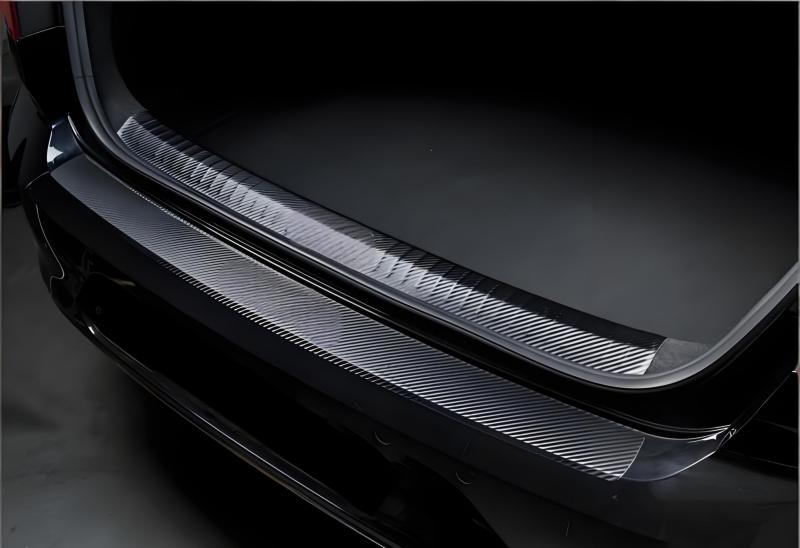
- 3D Contoured Seams: Welding non-linear paths on complex parts like automotive tailgate trim or sculpted appliance housings.
- Dissimilar Material Welding: Joining polymers from different families (e.g., PA to PP) where chemical compatibility is low.
- High-Filler or Reinforced Materials: Welding polymers with >30% glass fiber or heavy mineral fill, which abrade tools and alter flow.
- Ultra-High Volume & Precision: Demanding cycles under 30 seconds with micron-level consistency for consumer electronics.
- In-Line 100% Quality Assurance: The need for integrated vision systems or process monitoring to verify every weld.
Dizo Sonics' Engineered Solutions:
Where standard machines reach their limits, custom engineering bridges the gap.
- Servo-Driven Amplitude & Pressure Control: For precise, repeatable energy input, especially critical for semi-crystalline and filled materials.
- Patented Adaptive Process Controls: Our systems can adjust frequency and pressure in real-time based on sensor feedback, compensating for material batch variations.
- Hybrid Joining Strategies: For dissimilar materials, we design solutions incorporating mechanical interlocks, energy directors, or compatible tie-layer films to achieve robust bonds.
- Turnkey Automated Cells: Fully integrated systems with robotic handling, in-process monitoring (tracking weld depth, power, and time), and data traceability for full compliance.
Case Study: Automotive Battery Housing
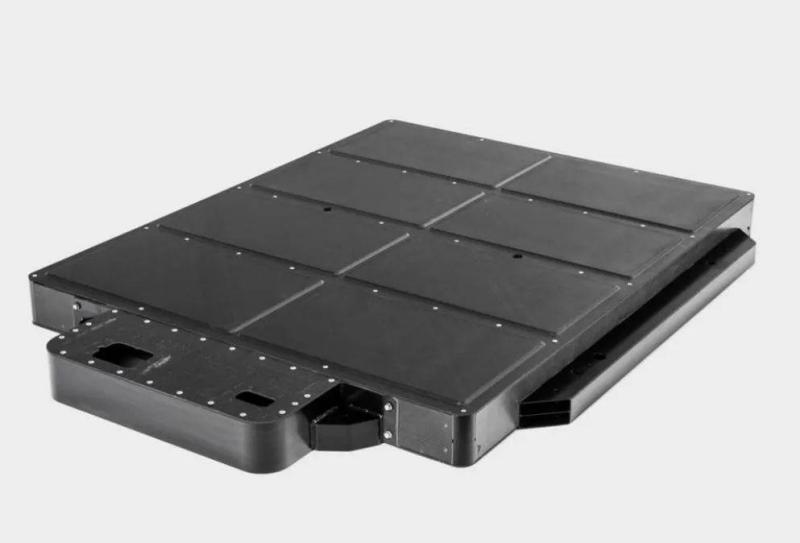
A supplier for electric vehicles needed to weld a large, glass-filled
polypropylene battery tray with a complex perimeter seal. Standard
welders produced inconsistent melt and leakage.
Dizo Sonics Solution: We provided a servo-driven vibration welder
with Adaptive Frequency Tracking (AFT) and real-time pressure-force
profiling.
Result: Weld strength consistency improved by 25%, cycle time
reduced by 15%, and the system delivered a zero-defect leak rate,
enabling the client to meet stringent EV production targets.
6. Expert FAQ on Vibration Welding Compatibility
What is a compatible materials chart for vibration welding?
It's a quick reference matching thermoplastics like ABS with blends. Check for chemical fits to predict bonds. We use these in our assessments to spot risks early.
How do melt temperatures within 40 degrees F affect welding?
They keep melting even, avoiding weak spots from overheating one side. Wider gaps disrupt flow. Always cross-check data sheets for smooth results.
What role do melt flows within 3 to 4 play?
They match viscosity for even mixing under pressure. Mismatches cause lumpy joints. This ensures strong bonds in friction processes.
How to use welded T plaque for testing?
It's a simple check:
- Fabricate plaques from your materials.
- Weld at proposed parameters.
- Conduct tensile test.
- Analyze failure mode---aim for parent material break, not the weld.
What are material suppliers data sheets, and why consult them?
They list specs like viscosity ratings and melt points. Consulting catches errors in bonding thermoplastic parts early, saving rework.
Can ultrasonic welding replace vibration for semi-crystalline materials?
No, vibration handles them better with larger amplitudes for even melts. Ultrasonic suits amorphous types. We've seen vibration cut issues in tough cases.
Can I vibration weld nylon (PA) to polypropylene (PP)?
Polarity mismatch makes it tricky---direct bonds are weak. Use hybrid methods like mechanical interlocking. Dizo offers solutions for these challenges.
What is the effect of moisture on vibration weld quality?
Moisture in hydroscopic materials like PA turns to steam, creating voids. Pre-dry parts to fix this. Our systems integrate pre-heat stations for better results.
How do I adjust parameters for glass-filled or flame-retardant materials?
Fillers raise viscosity and wear, so boost amplitude and pressure. Use robust tooling. Consult makers like us for tuning to avoid damage.

7.Conclusion: Implementing a Successful Vibration Welding Strategy
You now have a comprehensive understanding of vibration welding compatibility---from the core scientific principles of chemical, thermal, and rheological alignment to practical validation methods and strategies for complex applications.
For projects with well-understood material pairs and standard geometries, success lies in meticulous parameter setup and rigorous validation, as outlined in Sections 1-4. This disciplined approach is the foundation of reliable, high-volume production.
However, when faced with 3D contours, dissimilar materials, extreme performance requirements, or the need for full digital traceability, a standard machine may not suffice. This is where partnership with an application expert delivers transformative value.
Partner with Dizo Sonics for Your Welding Challenge
With over two decades of specialized experience, CE & ISO certifications, and patented technologies in adaptive welding control, Dizo Sonics is your partner for both standard and pioneering thermoplastic assembly projects.
Your Next Steps:
- For Standard Setups: Download our free Vibration Welding Parameter Checklist & Validation Template to ensure you cover all critical steps.
- Facing a Complex Challenge? Schedule a complimentary 30-minute technical consultation with a Dizo Sonics application engineer. We'll review your materials, design, and goals to recommend the optimal path forward.
- Ready to Spec Your System? Contact our team for a detailed feasibility and ROI analysis based on your production volume and part data.
Build Stronger. Weld Smarter.
Contact Dizo Sonics Today: sales@dizo-global.com | +86 510 83773953
More Reading
- Vibration Welding: Revolutionizing Insulated Trays Assembly
- Vibration Welding: An Innovative Solution for Aviation Overhead Storage Bins Assembly
- Vibration Welding: Revolutionizing Air Diverter Valves Assembly
- Exploring the Potential of Vibration Welding in Automotive Fluid Reservoirs Assembly
- Vibration Welding Design Guidelines: Creating Strong and Reliable Bonds
- Plastic Vibration Friction Welding Machine: A Comprehensive Guide