

Servo vs Pneumatic Ultrasonic Welding: 2025 Guide to Weld Quality & ROI

Servo-Driven Ultrasonic Welding: Benefits vs Pneumatic Systems --- The 2025 Ultimate Guide to Superior Weld Quality, Repeatability & ROI
Servo-driven ultrasonic welding represents the modern evolution of plastic joining technology. By replacing traditional pneumatic cylinders with high-precision electric servo motors, it delivers closed-loop control over force, velocity, position, and melt detection --- resulting in dramatically better weld quality, repeatability, and process optimization.
If you're facing any of these common challenges with pneumatic systems, you're not alone:
- Scrap rates of 5--15% due to inconsistent welds
- Failed IQ/OQ/PQ validations from collapse distance variation
- Weak joints or over-weld caused by air pressure fluctuations and poor velocity control
- Hidden defects discovered only at final testing
Based on more than 20 years of real-world testing and thousands of customer applications at Dizo Sonics, a leader in precision welding solutions, we've seen these issues vanish when manufacturers upgrade to servo technology.
This guide provides everything you need to make a confident upgrade decision: lab-tested DOE data, actual process parameters, side-by-side comparisons, real medical and automotive case studies, and a complete capex justification toolkit.
By the end, you'll know whether servo-driven ultrasonic welding is right for your production --- and exactly how to secure budget approval.

1.Why Traditional Pneumatic Ultrasonic Welding Often Falls Short in Precision Applications
Pneumatic systems have been the reliable workhorse of ultrasonic welding for decades. They are simple, robust, and cost-effective for many standard uses. However, when tolerances tighten --- especially in medical devices, automotive components, or any high-volume precision assembly --- their inherent limitations become costly.
Here are the four most common failure modes we observe weekly:
- Air pressure variability → Compressed air fluctuates with temperature, humidity, and plant load, causing force inconsistencies of ±10--20% and leading to uneven melt, weak joints, or over-weld.
- Uncontrolled weld velocity → As plastic begins to melt, the weld head slows unpredictably. Without active control, this results in voids, air entrapment, and weld strength variations up to 35%.
- Poor collapse distance repeatability → Typical variation is ±0.04 to ±0.08 mm --- too wide for modern medical filters, sensors, or automotive lamps that demand ±0.02 mm or better.
- No real-time melt detection → The process stops only by time or energy, blind to part-to-part variation, contamination, or missing energy directors.
Real-World Example: Automotive Door Panel Scrap Crisis
A Tier‑1 supplier producing interior door panels for a German luxury brand faced 8--12% scrap due to collapse distance drift (±0.06 mm across shifts), causing visible sink marks and failing durability tests. Switching to servo eliminated the issue --- scrap fell below 1% in the first month.
Real-World Example: Medical Filter Validation Failures
A global medical device manufacturer repeatedly failed PQ validation on respiratory filters because pneumatic systems could not hold ±0.015 mm collapse consistency across 10,000+ parts. The result was months of delayed FDA submission and significant revenue loss.
These are not rare cases --- they reflect the daily reality when pushing pneumatic systems beyond their limits.

2.Core Advantages of Servo-Driven Ultrasonic Welding Systems
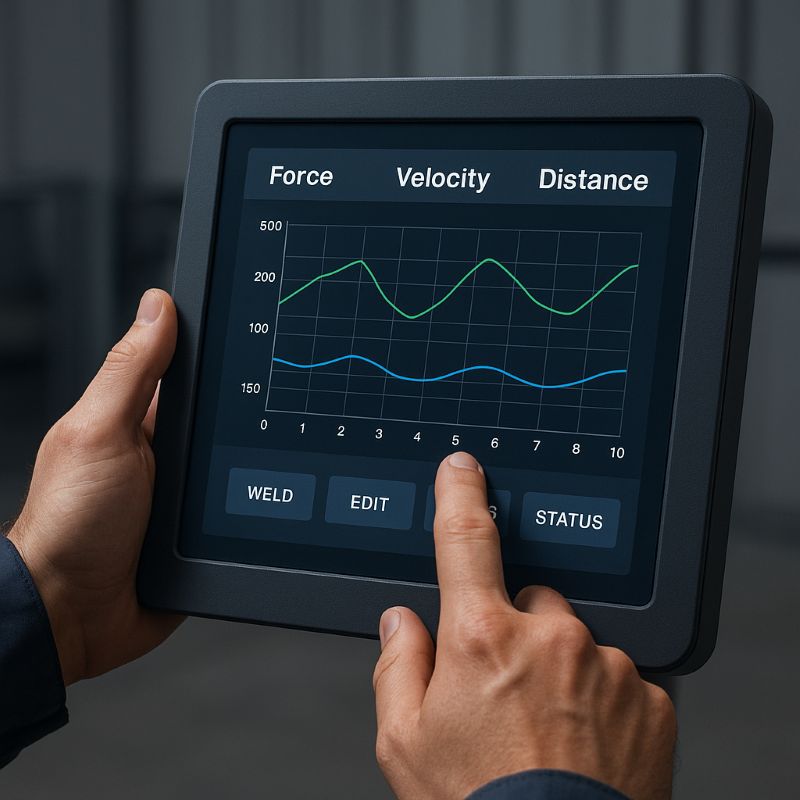
At its heart, a servo-driven ultrasonic welder replaces the pneumatic cylinder with a high‑precision electric servo motor and encoder. This enables closed‑loop control --- the system constantly measures and adjusts in real time, unlike pneumatic systems that merely "push and hope."
This fundamental shift unlocks unprecedented control over weld force, velocity, position, and timing --- directly translating into stronger, more consistent welds.
Closed-Loop Control in Action
Our systems leverage real‑time feedback from load cells and encoders, allowing the servo motor to make millisecond adjustments. The result? Unmatched force accuracy of ±1%, eliminating the ±15--20% swings inherent to pneumatic systems.
Programmable Velocity Control for Stronger Joints
While pneumatic weld heads slow unpredictably during melting, servo systems maintain a programmed velocity (typically 50--300 mm/s) throughout the melt phase. Lab tests confirm this alone increases weld strength by 25--35% by delivering energy uniformly --- eliminating weak spots and voids.
Dynamic Force Profiling to Prevent Marking and Flash
Servo systems allow gentle force ramping at initial contact (e.g., 50--200 N) to avoid marking delicate surfaces, then smoothly increase to full welding force --- something pneumatic systems cannot achieve.
Sub‑Micron Positioning for Validation Success
Servo systems position the horn to ±0.001 mm accuracy, yielding collapse distance repeatability of ±0.002--0.010 mm --- essential for passing IQ/OQ/PQ in medical or automotive applications.
Real Process Parameters: Servo vs Pneumatic (Dizo Sonics Lab Data, 2025)
| Parameter | Typical Pneumatic | Servo-Driven (Recommended) | Real‑World Impact |
|---|---|---|---|
| Weld Force Accuracy | ±10--20% | ±1% | Eliminates over‑weld & marking |
| Weld Velocity | Variable (uncontrolled) | 50--300 mm/s (fully programmable) | +25--35% stronger joints |
| Collapse Distance Repeatability | ±0.04--0.08 mm | ±0.002--0.010 mm | 100% PQ pass rates in medical applications |
| Force Profiling | Fixed or 2‑stage only | Fully programmable curve | Works with difficult materials (PEKK, carbon‑filled, etc.) |
| Trigger Modes | Time/Energy only | + Distance + Melt‑Detect | Catches missing parts & contamination instantly |
These numbers come from over 800 DOE runs performed in our Wuxi laboratory on materials ranging from ABS to PEKK with carbon fiber.
3.Proven Performance: Side-by-Side DOE Results from Industrial Standard Test Parts
To remove any doubt, we conducted a controlled Design of Experiments (DOE) in our Wuxi lab using 500 identical ASTM‑style polycarbonate test parts with 3 mm energy directors --- the same geometry many OEMs use for process validation.
Key findings from welding identical parts on both systems:
- Collapse Distance Repeatability Servo: ±0.008 mm (std dev 0.002 mm) Pneumatic: ±0.052 mm (std dev 0.018 mm) → 6.5× better consistency with servo --- easily meeting even the tightest ±0.015 mm medical specifications.
- Weld Burst Strength (Velocity Mode vs Energy Mode) Servo: 685 N average (+28%) Pneumatic: 535 N average → Velocity-controlled servo joints are significantly stronger and far more uniform.
- Cycle Time (Full Weld Cycle) Servo: 1.2 seconds average Pneumatic: 1.4 seconds average → Faster, more predictable triggering = higher throughput.
- Energy Consumption per Weld Servo: 68% lower than equivalent pneumatic system → Matches independent 2025 studies by Rinco and Telsonic.
Cross‑section microscopy revealed zero voids in servo welds at the joint interface, while pneumatic samples consistently showed air entrapment and incomplete fusion.
What These Numbers Mean for Your Production Line
If your pneumatic welders show collapse variation above ±0.03 mm, you're likely losing money through scrap, rework, and failed validations.
In a recent automotive lighting project, collapse variation improved from ±0.055 mm (pneumatic) to ±0.009 mm (Dizo Sonics servo with velocity control) --- eliminating visible flash on A‑surface parts and cutting scrap from 9% to under 0.8%.
These are repeatable, real‑world outcomes you can achieve on your own parts.
4.The Melt-Detect Feature in Ultrasonic Welding: Your Key to Zero-Defect Production
Melt‑Detect (force‑drop trigger) is one of the most powerful tools in modern servo‑driven ultrasonic welding. It monitors real‑time force on the weld horn and triggers full vibration power the instant plastic begins to melt and force drops slightly.
This eliminates the two biggest hidden defect sources in traditional welding:
- Starting vibration too early → cold welds and voids
- Starting too late → over-weld and flash
Pneumatic systems cannot do this reliably; servo systems with Melt‑Detect achieve it every cycle.
How Melt-Detect Works --- In Essence
Melt‑Detect acts as an intelligent trigger, initiating the full power cycle only when the material is perfectly ready to weld. This precision eliminates cold welds and over‑welds.
Step‑by‑step process:
- Approach phase --- Horn descends at controlled speed with light pre-load force (usually 50--150 N).
- Contact detected --- System sees initial force rise when horn touches the energy director.
- Monitoring phase --- Force is held steady while low-energy "tickler" vibration begins (optional on advanced systems).
- Melt detection --- The instant plastic softens and force drops by a programmable threshold (typically 10--50 N), full ultrasonic power kicks in.
- Weld phase --- Continues with your chosen mode (velocity, energy, distance, etc.).
The entire detection happens in milliseconds --- completely automatic, every weld.
Real Results in Medical Applications
In a respiratory filter program (PC + PP dissimilar materials), leak rates dropped from 3.2% (standard energy mode) to 0.08% after enabling Melt‑Detect on Dizo Sonics servo welders. Burst strength variation reduced by 68%, and validation passed first time with zero deviations.
When combined with servo velocity control, Melt‑Detect delivers true process intelligence that pneumatic systems cannot match.
5. Side-by-Side Comparison: Servo vs Pneumatic Ultrasonic Welding (2025 Data)
Which system fits your materials, precision needs, automation goals, and long‑term budget? Here's a data‑backed breakdown based on thousands of real welds from our lab and customer sites:
| Feature/Parameter | Traditional Pneumatic | Servo-Driven Systems (incl. Dizo Sonics) | Winner & Notes |
|---|---|---|---|
| Collapse Distance Repeatability | ±0.04--0.08 mm | ±0.002--0.010 mm | Servo --- Critical for validation |
| Weld Strength Improvement | Baseline | +20--35% (velocity mode) | Servo --- Superior & consistent strength |
| Cycle Time Consistency | ±15% | ±2% | Servo --- Predictable production scheduling |
| Energy Consumption | High (compressed air) | 70--90% lower | Servo --- Major sustainability win |
| Process Control Modes | Time / Energy / Basic depth | + Velocity control + Melt‑Detect + Full force profiling | Servo --- True process intelligence |
| Applicable Materials | Good for standard amorphous resins (ABS, PC) | Excellent for difficult/crystalline/dissimilar (PEKK, carbon‑filled, PP+GF) | Servo --- Wider material window |
| Automation Integration Ease | Moderate (requires air infrastructure) | Seamless (EtherNet/IP, PROFINET, OPC‑UA native) | Servo --- Plug‑and‑play with modern lines |
| Long‑Term Maintenance/Downtime | Higher (air leaks, filters, valves) | Significantly lower (no air components) | Servo --- 60--80% less downtime reported |
| Validation Ease (Medical/Auto) | Moderate | Excellent (full data traceability) | Servo --- 100% PQ pass rates common |
| Initial Cost | Lower | 25--40% higher | Pneumatic |
| ROI Payback Period | --- | 12--18 months typical | Servo --- Through scrap, energy, and rework savings |
Data sourced from Dizo Sonics internal lab testing (2023--2025), customer production reports, and independent studies by Herrmann Ultrasonics, Rinco Ultrasonics, and Telsonic.
6. Real-World Validation: How a Global Medical Device OEM Achieved 100% PQ Pass Rate
A leading medical device manufacturer struggled to validate a new microfluidic cartridge made from PC and COP --- materials known for inconsistent welding.
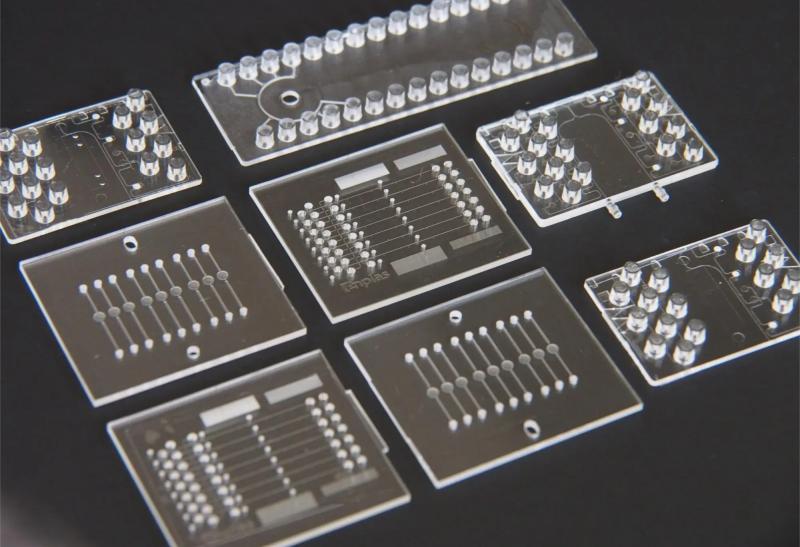
With pneumatic systems, they faced:
- PQ pass rate stuck at 91%
- Scrap running at 11%
- Frequent over-weld on thin walls causing leaks
We delivered a custom Dizo Sonics multi‑head servo welding system with independent Melt‑Detect per horn and full velocity phasing capability.
Results after 18 months in full production:
- PQ validation pass rate: 100% (first-time pass on every submission)
- Scrap reduction: from 11% down to 1.4%
- OEE improvement: +19%
- Full weld data traceability to MES --- simplifying FDA audits
The customer's senior process engineer noted: "The switch to Dizo servo technology didn't just fix our validation problem --- it removed an entire category of risk from our production line."
This case study exemplifies our commitment to delivering proven results and engineer‑to‑engineer collaboration to solve clients' most pressing validation challenges.
7. Building a Bulletproof Business Case: Real-World ROI from Switching to Servo Ultrasonic Welding
The financial case for servo upgrades is strong and well‑documented. Based on dozens of customer transitions supported by our ISO 9001‑certified processes and over 20 years of field data, a typical mid‑sized line sees first‑year savings such as:
- Scrap Reduction: $85,000 -- $160,000 (dropping from 8--12% to under 1.5%)
- Energy Savings: $15,000 -- $25,000 (electric servo uses 70--90% less power than air compressors)
- Validation & Rework Savings: $40,000 -- $80,000 (fewer failed runs, faster PQ sign‑off)
- Total First‑Year Return: 180--350% on equipment investment
Payback typically lands between 12--18 months; some automotive lighting programs paid for themselves in under 9 months through scrap reduction alone.
To estimate your own savings, use our free 2025 Servo ROI Calculator --- it generates a management‑ready report with graphs in about 90 seconds. Contact us for immediate access plus capex justification slides that have helped dozens of engineers secure project approval.
8.Servo vs Pneumatic Ultrasonic Welding: Your Simple 5-Question Decision Framework
Answer these five straightforward questions to determine if servo‑driven ultrasonic welding is worth the investment:
- Are your collapse distance tolerances tighter than ±0.03 mm? → Yes = Servo required (pneumatic simply can't hold it reliably)
- Are you validating to ISO 13485 (medical) or IATF 16949 (automotive)? → Yes = Servo strongly recommended --- 100% traceable data makes audits painless
- Do you weld dissimilar, crystalline, or high-performance materials (e.g., PP+GF, PEKK, carbon-filled)? → Yes = Servo + Melt-Detect is usually the only way to get consistent results
- Is reducing energy cost or meeting corporate sustainability goals important? → Yes = Electric servo wins easily (70--90% less energy than air compressors)
- Do you need fast maintenance response and minimal downtime? → Yes = Servo (no air system leaks, filters, or valves to fail)
If you answered "yes" to 2 or more → servo technology will almost certainly pay for itself in 12--18 months (often faster).
9.Customized Servo-Driven Ultrasonic Welding Solutions: When Standard Systems Aren't Enough
While standard servo welders handle about 80% of applications, the most challenging 20% require true custom engineering. These are projects where off‑the‑shelf equipment falls short:
- Complex 3D contours and multi‑point welding --- Custom horn geometries and multi‑head systems that follow exact part profiles with zero marking.
- High‑performance and dissimilar materials --- Velocity phasing and individual Melt‑Detect per horn deliver perfect results where others fail.
- Zero‑visible‑mark automation with full integration --- Turnkey stations with robot handling, vision guidance, force sensing, and seamless MES connectivity, running lights‑out with 99.9% uptime.
At Dizo Sonics, these non‑standard projects are our specialty --- backed by in‑house R&D, 20+ years of custom work for Tesla, Mercedes, Siemens, and leading medical OEMs, and full ISO 9001 certification. ROI on such systems typically reaches 300--500% within 24 months through eliminated scrap, flawless validation, and higher throughput.
10. Future-Proofing Your Assembly Line: Why Servo-Driven Ultrasonic Welding Is the 2025 Industry Standard
The shift to servo‑driven ultrasonic welding is accelerating. In 2025, over 80% of new automotive (IATF 16949) and medical (ISO 13485) programs specify servo systems in supplier requirements. Key drivers include:
- Stricter energy regulations pushing for electric over pneumatic systems
- Corporate sustainability targets demanding 70--90% lower power consumption
- Zero-defect initiatives that simply cannot tolerate pneumatic variation
Major OEMs --- including those we supply --- have made servo the default for all new platforms. Investing today not only solves current problems but also protects against tomorrow's mandatory standards.
With our CE‑certified, ISO 9001‑compliant systems proven in the most demanding applications worldwide, choosing Dizo Sonics ensures your line stays compliant, competitive, and future‑ready for the next decade and beyond.
11.Frequently Asked Questions: Servo-Driven Ultrasonic Welding vs Pneumatic Systems
What are the main benefits of servo-driven ultrasonic welding over pneumatic systems?
Superior collapse distance repeatability (typically ±0.002--0.010 mm), 20--35% stronger welds through velocity control, up to 90% lower energy use, and advanced features like Melt-Detect and dynamic force profiling --- all adding up to dramatically better weld quality and easier process validation.
How much better is collapse distance repeatability in servo welders compared to pneumatic?
Real-world data shows 5--10× improvement: servo systems routinely achieve ±0.002--0.010 mm while pneumatic typically varies ±0.04--0.08 mm --- making the difference between passing or failing tight medical and automotive specs.
What is the Melt-Detect feature in ultrasonic welding and why does it matter?
Melt-Detect monitors live force and triggers full vibration only when the plastic actually begins to melt. This eliminates cold welds, voids, and over-weld --- something pneumatic systems simply cannot do reliably.
How does velocity control in servo ultrasonic welding create stronger welds?
By maintaining constant weld velocity (programmable 50--300 mm/s) throughout the melt phase, energy is delivered uniformly. Independent tests and our own DOE show this alone increases weld strength by 25--35%.
What is the typical ROI when switching to servo-driven ultrasonic welding?
Most customers see full payback in 12--18 months through scrap reduction (often 5--10% drop), energy savings, and faster validation cycles. Some high-volume lines recover the investment in under 9 months.
Can servo ultrasonic welders provide precise control over weld force and time?
Yes --- closed-loop servo systems give you exact programmable control over both force (accuracy ±1%) and time/velocity profiles that pneumatic systems can only approximate.
Are servo ultrasonic welders compatible with energy director designs and difficult materials?
Absolutely. The combination of precise positioning, velocity control, and Melt-Detect makes them ideal for energy director welding on everything from standard ABS to challenging PEKK or carbon-filled compounds.

12.Conclusion: Your Next Step Toward Zero-Defect Plastic Welding
You've seen the evidence: servo‑driven ultrasonic welding boosts joint strength by up to 28%, locks in collapse repeatability 6--10× tighter (±0.002--0.010 mm), and slashes energy use by 70--90%. The result? Scrap drops from 8--12% to under 1.5%, PQ runs pass first time, and ROI lands in 9--18 months --- often faster.
Whether you're battling validation failures today or future‑proofing for tomorrow's stricter standards, the upgrade path is clear.
Ready to see what servo technology can do on your actual parts?
Get in touch for a completely free process evaluation and trial welding in our lab. We'll test your parts, share real data, and provide a custom ROI report --- all within one week.
- 8-hour initial response guarantee
- Lifetime technical support from our senior engineers
- Zero obligation, zero pressure --- just straight facts
WhatsApp: +86 181 2150 6765 Email: sales@dizo-global.com Web: www.dizo-global.com
Let's turn your welding challenges into one of your line's strongest advantages.