

POM Plastic Welding – Techniques, Tools & Pro Tips

POM (Polyoxymethylene) plastic is a high-performance thermoplastic material known for its exceptional mechanical properties and versatility.
POM exhibits exceptional mechanical properties, including strength, dimensional stability, and wear resistance (See case studies in the industrial applications section). These characteristics make it an ideal choice for a wide range of industrial and consumer applications.
But when it comes to welding, POM isn't the easiest material to work with. Its high strength and thermal sensitivity require specific techniques to get strong, clean welds.
In this guide, we'll break down the best welding methods for POM, walk you through the process step by step, and share tips to overcome common issues.
Whether you're in manufacturing or just curious, this is your go-to resource for welding POM the right way.

Table of Contents
1. Key Properties of POM Plastic Material
2. Popular Welding Methods for POM Plastic
3. Step-by-Step POM Plastic Welding Processes
4. Common Challenges in POM Plastic Welding
5. Industrial Applications of POM Plastic Welding
6. Standards and Quality Assurance in POM Plastic Welding
7. Advanced Techniques in POM Plastic Welding
8. Future Trends in POM Plastic Welding
9. Case Studies and Examples
10. Conclusion
1. Key Properties of POM Plastic Material
POM plastic welding is highly valued for its ability to join POM plastic material, which has a unique combination of properties:
- Mechanical Strength: POM plastic exhibits high tensile strength and rigidity, making it suitable for components that require withstanding significant mechanical stress.
- Dimensional Stability: It maintains its shape and size under varying temperatures and pressures, ensuring consistent performance.
- Wear Resistance: POM plastic material is highly resistant to wear and abrasion, extending the life of parts in demanding environments.
- Chemical Resistance: POM plastic exhibits resistance to various chemicals, including oils, greases, and solvents.
- Low Friction: Its low coefficient of friction makes it suitable for parts that require smooth movement, such as gears and bearings.
These properties make POM plastic a popular choice for applications where precision, durability, and reliability are critical.
2. Popular Welding Methods for POM Plastic
Several POM plastic welding methods are commonly used, each with its own advantages and applications. The choice of method depends on factors such as part geometry, material thickness, and production requirements.
2.1 Hot Air Welding
POM plastic welding using hot air is one of the most popular methods. It involves using a hot air gun to heat the plastic material to a molten state, allowing it to be joined with another piece of POM plastic.
- Key Advantage: Repair flexibility
- Detail Section (see details in 3.1)
2.2 Ultrasonic Welding
POM plastic welding through ultrasonic methods uses high-frequency vibrations to create frictional heat between the parts. This method is highly efficient and can produce strong joints quickly.
- Key Advantage: Rapid and precise welding.
- Detail Section (see details in 3.2)

2.3 Thermal Welding
Thermal welding involves heating the plastic material using a heat source such as a heating element or a hot plate. This method is suitable for larger parts and can produce strong, durable joints.
- Key Advantage: Suitable for larger parts.
- Detail Section (see details in 3.3)
3. Step-by-Step POM Plastic Welding Processes
3.1 Hot Air Welding Process
- Surface Preparation: Clean the POM plastic material with 99% isopropyl alcohol to remove any dirt or contaminants.
- Heating: Apply heat within the optimal range (Reference table1), until the surface has a glossy appearance. This indicates that the plastic is ready for welding.
- Welding: Use a hot air gun to direct the heat at the joint area, ensuring that both pieces of POM plastic are heated evenly.
- Cooling: Allow the joint to cool slowly at a rate of 2-3°C/minute to prevent warping (see details in 4.2).
3.2 Ultrasonic Welding Process
- Surface Preparation: Clean the POM plastic material with 99% isopropyl alcohol.
- Positioning: Place the parts together in the desired position, ensuring proper alignment.
- Welding: Use an ultrasonic welding machine to apply high-frequency vibrations to the joint area. The machine will automatically control the time and pressure to ensure a strong bond.
- Cooling: Allow the joint to cool naturally.
 Ads
Ads
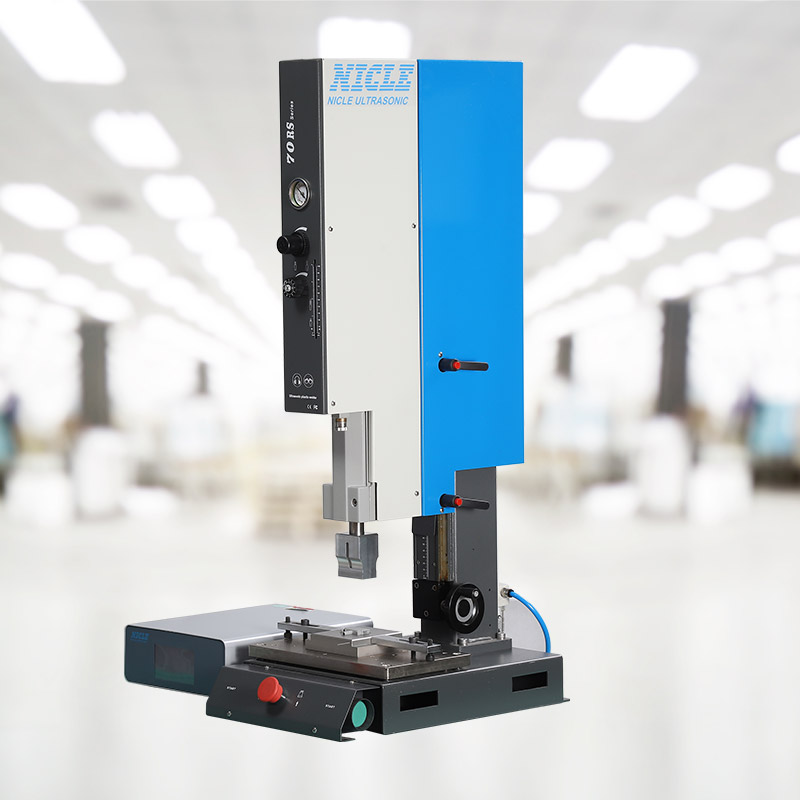
Manual Plastic Ultrasonic Welder/h3>
Manual ultrasonic welding machine deliver exceptional precision and reliability in automotive parts manufacturing, creating strong, dimensionally accurate welds that meet stringent industry requirements.
Learn More
Manual ultrasonic welding machine deliver exceptional precision and reliability in automotive parts manufacturing, creating strong, dimensionally accurate welds that meet stringent industry requirements.
3.3 Thermal Welding Process
- Surface Preparation: Clean the POM plastic material with 99% isopropyl alcohol.
- Heating: Use a heating element or hot plate to heat the plastic to its melting point. Ensure that the temperature is controlled to prevent overheating.
- Welding: Press the heated parts together, ensuring even contact across the joint area.
- Cooling: Allow the joint to cool slowly at a rate of 2-3°C/minute.
4. Common Challenges in POM Plastic Welding
4.1 Surface Preparation
Surface preparation is critical for successful POM plastic welding. Any contaminants on the surface can weaken the bond and lead to joint failure. To address this, always clean the POM plastic material with 99% isopropyl alcohol before welding.
4.2 Warping
Warping can occur if the POM plastic material cools too quickly. To prevent this, control the cooling rate to 2-3°C/minute (Reference table 1). This ensures that the material cools evenly and maintains its shape.
4.3 Joint Strength
Ensuring sufficient joint strength is essential for the durability of the welded parts. Verify joint strength through testing (Conduct ASTM D903 validation). This helps identify any potential weaknesses and allows for adjustments to the welding process if necessary.

5. Industrial Applications of POM Plastic Welding
POM plastic welding is used in a wide range of industries due to its ability to create strong, durable joints. Some common applications include:
5.1 Automotive Industry
POM plastic is used in various automotive components, such as gears, fuel system parts, and interior components. POM plastic welding allows for the production of complex parts with high precision and strength.
For example, POM plastic gears in transmission systems require high strength and dimensional stability, which can be achieved through POM plastic welding.
5.2 Medical Industry
In the medical field, POM plastic is used for components that require high precision and biocompatibility. For example, laser welding is used to join POM plastic gears in insulin pumps, with tolerances as tight as +0.015mm, meeting ISO 13485 standards.
These components must be free from contaminants and meet stringent quality standards to ensure patient safety.

5.3 Consumer Electronics
POM plastic is used in electronic devices for its excellent mechanical properties and electrical insulation. POM plastic welding is used to assemble components such as housings and connectors, ensuring a strong and reliable bond.
For example, POM plastic is used in the casings of smartphones and laptops, where precision and durability are critical.
6. Standards and Quality Assurance in POM Plastic Welding
Ensuring that POM plastic welding meets industry standards is crucial for the reliability and safety of the final product. Several standards and quality assurance processes are used to verify the quality of POM plastic welding.
6.1 ISO 13485 Compliance
In the medical industry, POM plastic welding must comply with ISO 13485 standards to ensure biocompatibility and safety. This standard covers the entire production process, from material selection to final product testing.
Compliance with ISO 13485 ensures that medical devices are safe for patient use.
6.2 Joint Strength Testing
To verify the strength of POM plastic welding joints, tests such as ASTM D903 are performed. These tests measure the tensile strength of the joint and ensure that it meets the required specifications.
Regular testing helps identify any potential weaknesses and allows for adjustments to the welding process if necessary.
6.3 Cooling Rate Control
Controlling the cooling rate is essential to prevent warping and ensure the dimensional stability of the welded parts. A cooling rate of 2-3°C/minute is recommended for most POM plastic welding processes. This helps prevent warping and ensures that the final product meets dimensional requirements.
7. Advanced Techniques in POM Plastic Welding
As technology advances, new methods and techniques are being developed to improve POM plastic welding. These advanced techniques offer additional benefits and can be used to address specific challenges in POM plastic welding.
7.1 Laser Welding
Laser welding is a highly precise method of POM plastic welding that uses a focused laser beam to melt and join plastic components. This method offers several advantages, including minimal distortion, high precision, and the ability to weld complex geometries.
Laser welding is particularly useful for applications where high precision and minimal heat input are required, such as in the medical and electronics industries.
7.2 Friction Stir Welding
POM plastic welding through friction stir welding is a relatively new technique that uses a rotating tool to generate frictional heat. This method offers several advantages, including high joint strength, minimal distortion, and the ability to weld large parts.
Friction stir welding is particularly useful for applications where high joint strength and dimensional stability are required, such as in the automotive and aerospace industries.
7.3 Hybrid Welding
Hybrid welding combines multiple welding techniques to leverage the advantages of each method. For example, combining hot air welding with ultrasonic welding can provide the flexibility of hot air welding while achieving the precision and speed of ultrasonic welding.
Hybrid welding is particularly useful for complex applications where a single welding method may not be sufficient.
8. Future Trends in POM Plastic Welding
As technology continues to advance, new trends and developments are emerging in the field of POM plastic welding. These trends are driven by the need for increased efficiency, precision, and sustainability.
8.1 Automation and Robotics
The use of automation and robotics in POM plastic welding is increasing. Automated welding systems can improve precision, consistency, and efficiency, reducing the risk of human error.
Robotics can also handle complex welding tasks with high precision, making them ideal for applications such as automotive and aerospace manufacturing.

8.2 Sustainable Materials
There is a growing focus on using sustainable materials in POM plastic welding. Recycled POM plastic and bio-based materials are being developed to reduce the environmental impact of plastic production.
These sustainable materials offer similar mechanical properties to virgin POM plastic while reducing waste and carbon footprint.
8.3 Advanced Testing and Quality Control
Advanced testing and quality control methods are being developed to ensure the reliability and safety of POM plastic welding.
These methods include non-destructive testing (NDT) techniques such as ultrasonic testing and X-ray inspection, which can detect defects and weaknesses in the welded joints without damaging the components. Advanced quality control systems can also monitor the welding process in real-time, ensuring consistent quality and reducing the risk of defects.
9. Case Studies and Examples
9.1 Automotive Gearbox Assembly
In the automotive industry, POM plastic welding is used to assemble gearbox components. For example, POM plastic gears are welded to form a complete gearbox assembly.
The welding process must ensure high precision and dimensional stability to prevent gear misalignment and ensure smooth operation. Hot air welding is commonly used for this application due to its flexibility and ability to handle complex geometries.
9.2 Medical Device Manufacturing
In the medical device industry, POM plastic welding is used to assemble components such as insulin pump housings and gears. For example, a medical device manufacturer uses laser welding to join POM plastic gears with a tolerance of +0.015mm.
The welding process must comply with ISO 13485 standards to ensure biocompatibility and patient safety. Laser welding is chosen for its precision and minimal heat input, which helps prevent warping and ensures dimensional stability.
9.3 Consumer Electronics Assembly
In the consumer electronics industry, POM plastic welding is used to assemble components such as smartphone casings and connectors. For example, a smartphone manufacturer uses ultrasonic welding to join POM plastic components.
The welding process must ensure high precision and dimensional stability to prevent component misalignment and ensure proper fit. Ultrasonic welding is chosen for its speed and precision, which helps increase production efficiency.

10. Conclusion
POM plastic welding is a versatile and reliable method for joining POM plastic material. With its excellent mechanical properties and wide range of applications, POM plastic is a popular choice for many industries.
By understanding the different welding methods, processes, and challenges, manufacturers can ensure high-quality and durable joints. As technology continues to advance, POM plastic welding will continue to play a crucial role in modern manufacturing, driven by the need for increased efficiency, precision, and sustainability.