

Polypropylene Welding Guide: Techniques, Best Practices & Solutions

The Ultimate Guide to Welding Polypropylene: Techniques, Best Practices & Industrial Solutions
Are you struggling with weak seams, fluid leaks, or inconsistent results when joining polypropylene (PP) components? These common issues stem from PP's inherent low surface energy and semi-crystalline structure, which make bonding challenging. Whether you're assembling automotive fluid reservoirs, medical device housings, or consumer packaging, achieving strong, reliable welds is critical for performance and durability.
This comprehensive guide provides a practical roadmap for successfully welding polypropylene. Drawing from extensive industrial experience, we cover the material science behind strong bonds, objectively compare all major joining methods, and provide a step-by-step framework for selecting the right process. For complex applications where standard approaches fall short, we explore advanced engineering solutions that deliver consistent results in high-volume production environments.
1. Understanding Polypropylene: Material Properties and Welding Fundamentals
Polypropylene (PP) is one of the most versatile and widely used thermoplastics globally, valued for its excellent chemical resistance, low density, and cost-effectiveness. However, these advantages come with specific joining challenges that must be understood to achieve reliable assemblies.
Key Material Characteristics Affecting Weldability
PP's weldability is directly influenced by its molecular structure and physical properties:
- Semi-Crystalline Nature: Unlike amorphous plastics that soften gradually, PP has a distinct melting point (typically 160-170°C) and crystallizes upon cooling, which can create residual stresses at weld interfaces.
- Low Surface Energy: With a surface tension of approximately 29-30 dynes/cm, PP resists wetting and adhesion, making surface preparation critical.
- High Thermal Expansion: PP expands significantly when heated (coefficient of 100-150 × 10⁻⁶/K), requiring careful fixturing to prevent distortion during welding.
- Material Variations: Homopolymer, copolymer, and talc or glass-filled grades exhibit different flow characteristics and shrinkage rates that impact welding parameters.
Understanding these properties is essential for selecting appropriate joining methods and optimizing process parameters.
Why Welding Becomes the Preferred Joining Method
While adhesives and mechanical fasteners have their place, welding offers distinct advantages for PP assemblies:
- Structural Integrity: Properly executed welds can achieve 80-95% of the base material strength, creating joints that withstand pressure, vibration, and long-term loading.
- Chemical Resistance: Welded joints maintain PP's inherent resistance to chemicals, solvents, and moisture, unlike adhesive bonds that may degrade at interfaces.
- Aesthetics and Cleanliness: Welding produces smooth, flush joints without external fasteners or adhesive residue, crucial for medical and food-contact applications.
- Process Efficiency: Modern welding methods enable cycle times under one second, supporting high-volume manufacturing requirements.
2. The Science Behind Strong Polypropylene Welds
Achieving consistent, high-quality PP welds requires more than just melting two surfaces together. It involves creating molecular interdiffusion where polymer chains from both parts entangle across the joint interface.
The Molecular Mechanism: Diffusion and Chain Entanglement
When PP is heated above its melting point, polymer chains gain sufficient mobility to move across the interface. Under applied pressure, these chains intermingle and entangle. As the material cools and solidifies, these entanglements "lock" in place, creating a bond at the molecular level. The depth of this interdiffusion zone—typically 0.1-0.5 mm in optimized welds—directly correlates with joint strength.
Energy Delivery Methods for PP Welding
Different welding processes deliver thermal energy through distinct mechanisms:
- Conductive Heating (Hot Plate/Tool Welding): Direct contact with heated surfaces transfers thermal energy. Best for large parts and materials with similar melting characteristics.
- Frictional Heating (Ultrasonic/Vibration Welding): Mechanical vibrations create interfacial friction, generating localized heat precisely at the joint. Ideal for automated assembly.
- Electromagnetic Heating (Infrared/Laser Welding): Radiant energy absorption creates precise, controlled melting without contact. Excellent for complex geometries and clean-room applications.
Critical Process Parameters: The Welding Triangle
Three interdependent factors determine weld quality:
- Temperature: Must exceed PP's melting point (160-170°C) but remain below degradation threshold (~280°C).
- Pressure: Ensures intimate contact for chain interdiffusion without squeezing out all molten material (typically 0.3-0.8 MPa).
- Time: Sufficient duration for heating, diffusion, and controlled cooling.
The optimal balance varies with part geometry, wall thickness, and PP formulation. For example, glass-filled PP requires approximately 10-15% higher pressure to overcome reduced melt flow.
Managing the Heat-Affected Zone (HAZ)
The HAZ is the region adjacent to the weld that experiences thermal cycles without full melting. In PP, excessive HAZ can lead to:
- Reduced crystallinity and mechanical properties
- Visible discoloration or degradation
- Increased susceptibility to chemical attack
Precision welding methods with rapid energy delivery (like ultrasonic welding) minimize HAZ to typically 1-2 mm, preserving material properties.
3. Comprehensive Comparison of Polypropylene Joining Methods
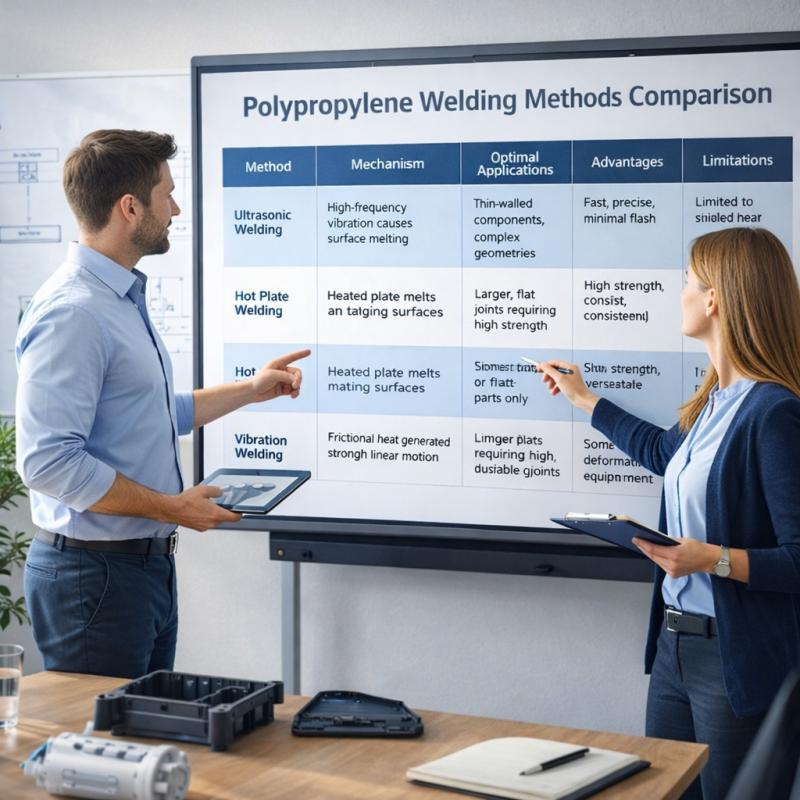
Selecting the optimal joining method requires balancing technical requirements with production realities. Below is an objective comparison of primary options for PP assemblies.
| Method | Mechanism | Optimal PP Applications | Key Advantages | Limitations | Typical Cycle Time |
|---|---|---|---|---|---|
| Hot Plate Welding | Conductive heating via heated tool | Large containers, tanks, piping systems | Excellent for thick sections; handles contaminated surfaces well; strong, hermetic seals | Visible weld bead; slower cycles; tool maintenance required | 10-60 seconds |
| Ultrasonic Welding | High-frequency frictional heating | Small-to-medium components (filters, housings, automotive interior parts) | Very fast; minimal flash; excellent for automated lines; clean appearance | Limited to smaller joints (<100 mm typical); requires precise part design | 0.2-1.5 seconds |
| Vibration Welding | Linear friction via oscillatory motion | Large automotive components (bumpers, reservoirs, battery trays) | Handles large, complex joints; tolerates surface contaminants; very high strength | Higher equipment cost; more flash generation; requires robust fixturing | 2-10 seconds |
| Hot Gas Welding | Convective heating with filler rod | Field repairs, large sheet fabrication, tank lining | Portable; versatile; low equipment cost | Operator-dependent quality; slower process; requires skill | 30-300 seconds |
| Infrared/Laser Welding | Radiant energy absorption | Medical devices, precision components, clear assemblies | No contact or particulates; excellent for complex 3D contours; clean process | Higher capital cost; requires part transparency/color matching | 2-15 seconds |
| Adhesive Bonding | Chemical adhesion via reactive polymers | Dissimilar material joining; low-stress applications; temporary assemblies | No thermal stress; simple application; accommodates complex geometries | Long cure times; chemical compatibility concerns; lower strength | 60 seconds - 24 hours |
Selection Insight: For structural applications requiring maximum strength and chemical resistance, hot plate or vibration welding typically deliver the best results. For high-volume assembly of smaller components, ultrasonic welding offers unmatched speed and consistency.
4. Practical Framework for Selecting Your PP Joining Process
This decision framework helps systematically evaluate your application requirements against method capabilities to identify the optimal approach.
Step 1: Define Application Requirements
Create a specification document addressing:
- Performance Needs: Required strength (tensile, shear, peel), pressure rating, chemical exposure, temperature range, and expected service life.
- Production Parameters: Annual volume, target cycle time, automation level, available floor space, and operator skill requirements.
- Quality Standards: Acceptable defect rate, cosmetic requirements, traceability needs, and compliance certifications (ISO, FDA, automotive).
- Economic Factors: Capital budget, operating costs (energy, consumables, maintenance), and target cost per assembly.
Step 2: Material and Design Assessment
- Material Testing: Verify PP grade and filler content. Test weld coupons to establish baseline compatibility.
- Joint Design Evaluation: Assess whether current joint geometry supports selected welding methods. Common modifications include adding energy directors for ultrasonic welding or shear joints for vibration welding.
- Prototyping: Create representative samples for process testing and parameter development.
Step 3: Technology Screening
Use this quick-reference guide based on key drivers:
| Primary Driver | Recommended Method(s) | Reasoning |
|---|---|---|
| Maximum Strength | Vibration or Hot Plate Welding | Highest molecular interdiffusion and weld area |
| Ultra-High Speed | Ultrasonic Welding | Sub-second cycles with proper part design |
| Large/Complex Parts | Vibration or Hot Plate Welding | Handles size and contour variations |
| Minimal HAZ/Flash | Infrared/Laser Welding | Precise energy control with no particulate generation |
| Field/Repair Work | Hot Gas Welding | Portable equipment with manual control |
| Low Capital Investment | Hot Gas Welding or Adhesives | Minimal equipment requirements |
Step 4: Process Development and Validation
- Parameter Optimization: Use design of experiments (DOE) to establish robust operating windows for temperature, pressure, time, and cooling rate.
- Quality Testing: Implement destructive (tensile, burst, peel) and non-destructive (visual, leak, ultrasonic inspection) testing protocols.
- Process Documentation: Create detailed work instructions, control plans, and maintenance schedules.
Step 5: Implementation and Continuous Improvement
- Training: Ensure operators understand critical parameters and quality standards.
- SPC Monitoring: Track key process indicators (weld energy, collapse distance, cooling time) for early problem detection.
- Periodic Revalidation: Retest process capability after material changes or significant production volumes.
5. Advanced Solutions for Demanding Industrial Applications
While standard welding methods satisfy most applications, certain industrial scenarios require engineered solutions that push beyond conventional capabilities.
Challenges Exceeding Standard Method Limits
- 3D Contoured Seams: Automotive fluid reservoirs and complex ducting require consistent energy delivery across non-planar surfaces.
- Ultra-High Volume Production: Applications exceeding 500,000 units annually demand exceptional reliability with minimal maintenance.
- Reinforced Material Grades: Glass-filled PP (20-40% content) accelerates horn wear in ultrasonic welding, increasing downtime.
- Regulated Industry Requirements: Medical and automotive applications mandate full traceability and validation documentation.
Engineered Welding Systems: Capabilities Beyond Standard Equipment
Purpose-built welding systems address these challenges through:
- Adaptive Process Control: Servo-driven systems with real-time pressure and position feedback compensate for material and dimensional variations.
- Custom Tooling Design: Finite element analysis (FEA) optimizes horn and fixture geometry for uniform energy distribution on complex parts.
- Multi-Head Synchronization: Phased ultrasonic systems weld large areas simultaneously without interference patterns.
- Integrated Quality Assurance: In-process monitoring captures every weld parameter, enabling 100% inspection and traceability.
Case Study: Automotive Battery Coolant Manifold
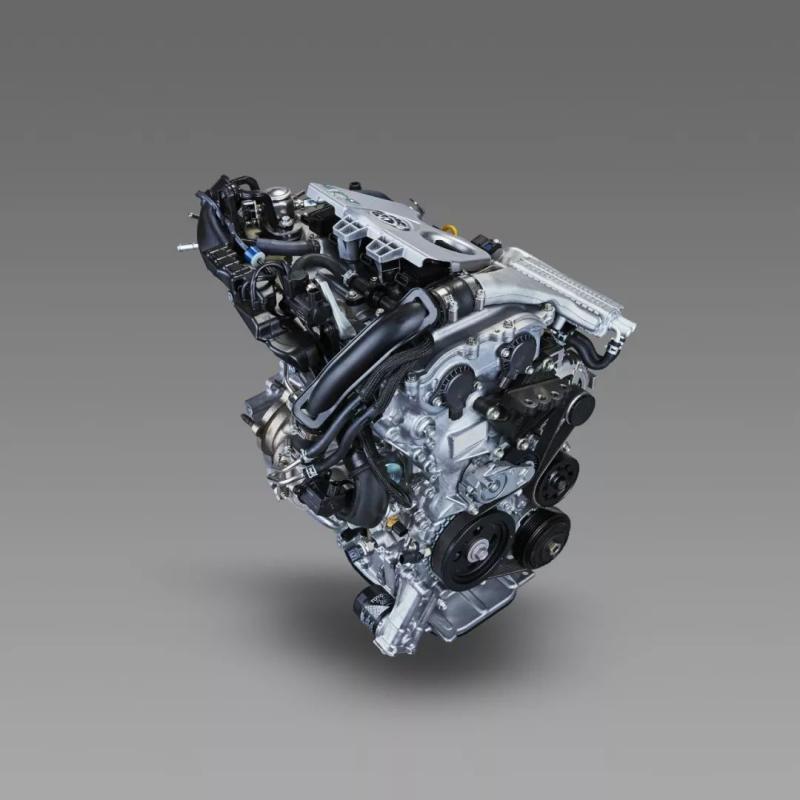
Application Challenge: A tier-1 automotive supplier needed to weld large, glass-filled PP coolant manifolds with a 3D sealing surface. Initial attempts with standard vibration welding yielded inconsistent seals and excessive flash, resulting in 8% rejection rates.
Engineered Solution: Our team developed a servo-driven hot plate welding system with:
- Multi-zone temperature control to accommodate varying wall thicknesses
- Programmable pressure profiling during cooling to minimize residual stress
- Integrated vision system for pre-weld alignment verification
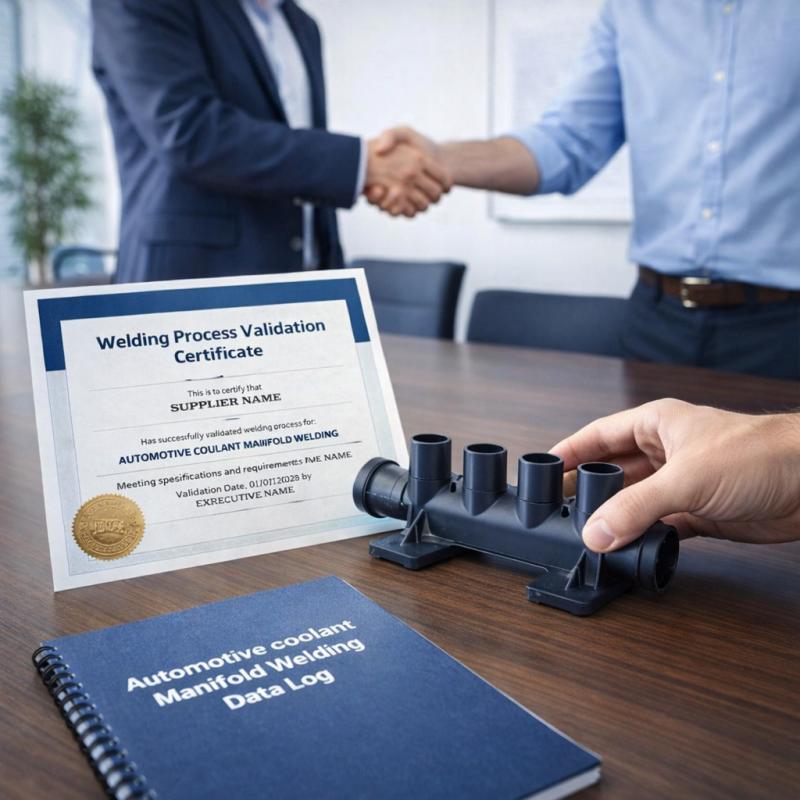
- Real-time data logging for each weld (temperature, pressure, displacement)
Results: Rejection rates decreased to 0.5%, cycle time improved by 25%, and the system provided complete traceability for automotive quality documentation. The investment achieved ROI in 14 months through scrap reduction and increased throughput.
For applications where standard equipment delivers marginal results, a custom-engineered approach often provides the reliability and consistency needed for production success.
6.Frequently Asked Questions About Polypropylene Welding
These common questions cover practical concerns we hear from engineers and manufacturers. Answers draw from real-world experience.
How to Achieve Strong Welds on PP Sheets?
Strong welds start with preparation and control:
- Clean thoroughly—use 99% isopropyl alcohol to remove contaminants (acetone can leave residue).
- Roughen surfaces lightly with 120-grit sandpaper for better grip.
- Weld at 300-320°C with consistent speed, pushing filler rod into the melt pool.
- Test: A good weld tears the base material, not the joint.
Our systems help maintain these for repeatable results (see science section).
What Are Alternatives to Traditional Welding?
Adhesives work when heat risks distortion. Pros: Simple, no equipment. Cons: Longer cure, lower strength under load. Ultrasonic or vibration welding offers faster, cleaner options for compatible parts.
What Are Industrial Polypropylene Welding Best Practices?
Automate where possible—multi-head systems with real-time monitoring boost efficiency. Key: Consistent parameters, regular calibration, and 100% traceability for regulated industries like automotive.
How to Handle Surface Roughening for PP?
Light sanding (120-180 grit) increases surface area without damage. Follow with alcohol cleaning—our tests show this can boost bond strength by up to 50%. Avoid over-sanding, which creates stress points.
Is Preheating Plastic Necessary for Better Welds?
Yes, for thicker parts (over 5mm). Preheat to 100-150°C to even out temperature and reduce warpage. This ensures the interface melts fully before the surface overheats.
What Are Effective Adhesive Alternatives for Polypropylene?
Specialized structural adhesives (e.g., with primers for low-energy surfaces) work well for non-weldable cases. Pros: Flexible for dissimilar materials. Cons: Not as strong for high loads. Always test compatibility first.
For challenges beyond these basics—like custom geometries—our tailored solutions often make the difference. Share your project for personalized advice.

7. Conclusion: Implementing Successful Polypropylene Welding Solutions
Achieving consistent, reliable polypropylene welds requires a systematic approach that combines material understanding, appropriate method selection, and precise process control. From fundamental principles to advanced engineering solutions, this guide has provided the framework for making informed decisions about PP joining.
The journey from concept to production typically follows these phases:
- Material Evaluation: Understand your specific PP formulation and its welding characteristics
- Method Selection: Choose the joining process that best aligns with technical requirements and production realities
- Process Development: Establish robust parameters through structured testing and optimization
- Implementation: Deploy with proper training, documentation, and quality controls
- Continuous Improvement: Monitor performance and refine processes based on production data
For straightforward applications, standard welding equipment with optimized parameters often delivers excellent results. For complex geometries, high-volume requirements, or stringent quality standards, custom-engineered solutions provide the reliability and consistency needed for production success.
Next Steps for Your Project:
- Download Our PP Welding Parameter Guide - A practical reference for common material grades and joint configurations
- Request a Feasibility Assessment - Submit your part drawings for preliminary method recommendations and parameter estimates
- Schedule a Process Demonstration - See potential solutions in action with your actual components
Contact Our Engineering Team:
Website: https://www.dizo-global.com/
Email Us: sales@dizo-global.com
Whatsapp: +86 18121506765