

Plastic Welding Guide: Techniques, Tips & Industrial Solutions

Plastic Welding: The Complete Guide to Techniques, Tips, and Advanced Industrial Solutions
Are your plastic welds cracking under stress or showing visual defects, leading to scrapped batches and production delays? These common issues often arise from using mismatched methods for engineering-grade materials like ABS, PE, PP, or PVC. In this comprehensive guide, you'll learn how to create strong, reliable plastic welds---whether you're a hobbyist making repairs or an engineer optimizing a production line. We cover everything from basic principles and manual techniques to advanced industrial plastic welding methods, backed by practical parameters and a clear framework for selection. Discover how a scientific approach to thermoplastic fusion can transform inconsistent results into durable, production-ready bonds.
What You'll Learn:
- The science behind thermoplastic fusion and material compatibility.
- Step-by-step manual techniques, with tips to avoid burning plastic.
- Advanced industrial methods like ultrasonic and vibration welding.
- A detailed comparison table of pros, cons, and costs.
- Key process parameters for secure welds and quality monitoring.
- A practical framework to choose the right method, including troubleshooting.
- How customized solutions from Dizo Sonics solve complex challenges, with real cases.
Ready to turn inconsistent results into reliable bonds? Let's dive in. For tailored advice, reach out to our team at sales@dizo-global.com.
1.What Is Plastic Welding? The Core Principles of Thermoplastic Fusion
Plastic welding is a fabrication process that joins thermoplastic materials by melting and fusing them under controlled heat, pressure, and time. Unlike adhesives, welding creates a bond that often matches or exceeds the strength of the base material, making it ideal for demanding applications with materials like polypropylene (PP) or acrylonitrile butadiene styrene (ABS). The process relies on the unique behavior of thermoplastics, which soften when heated and harden upon cooling without losing their structural properties.
The Three Critical Elements: Heat, Pressure, and Time
Every plastic welding process depends on the precise balance of three factors:
- Heat: Softens the material to enable molecular interdiffusion without causing thermal degradation. The temperature must exceed the polymer's melting point (Tm) to allow chain mobility, yet stay within a safe window to avoid burning---a range characterized for each material through rigorous testing.
- Pressure: Applies force to maintain intimate contact between the parts, ensuring the melted surfaces mix thoroughly without displacing the molten material.
- Time: Allows for proper heating, molecular intermingling, and controlled cooling to solidify a strong, homogeneous joint.
Laboratory adhesion tests show that mechanically abrading the oxide layer prior to welding ABS components can increase peel strength by 25--30%, a critical step for preventing field failures in applications like automotive interiors.
The Science Behind the Bond: From Polymer Chains to Molecular Entanglement
Thermoplastics differ from thermosets: they can be repeatedly melted and reshaped, whereas thermosets undergo irreversible curing. During welding, heat supplies the energy for polymer chains to move freely above the material's glass transition temperature (Tg) and melting temperature (Tm). For instance, ABS has a Tg around 105°C and a Tm between 200--250°C. Pressure then promotes the mixing of the viscous melts, enabling polymer chains from each part to entangle across the joint interface. Controlled cooling "freezes" this entangled structure, creating a durable bond. Practical welding requires precise temperature control to avoid weak spots; tests with polypropylene show that poor thermal management can reduce joint strength by up to 20%.
Common Materials and Compatibility
Not all plastics weld equally. Material compatibility is crucial for success. For example, ABS bonds well with itself, but welding ABS to PVC can lead to chemical incompatibility and joint failure. Always verify compatibility using recognized standards like ASTM D543, which assesses chemical resistance. Addressing material-specific traits---like the low surface energy of polyethylene (PE)---through proper pre-treatment is essential for achieving secure, long-lasting welds.
2.Common Plastic Materials and Their Weldability
Each thermoplastic has unique properties that influence weldability. Understanding these traits helps prevent common failures such as poor adhesion, cracking, or warping. Below is a breakdown of key materials---ABS, PE, PP, and PVC---with practical welding tips supported by industry data.
Welding ABS: Tips and Challenges
ABS offers good strength and impact resistance but is sensitive to overheating, which can cause warping or sink marks. For hot air welding, a temperature range of 200--250°C is typical. Using a compatible welding rod improves durability.
Handling PE and PP: Overcoming Low Energy Surfaces
Polyethylene (PE) and polypropylene (PP) have non-polar, low-surface-energy surfaces, making them challenging to bond. Surface pre-treatment---such as flame, corona, or atmospheric plasma treatment---is often necessary to increase wettability and adhesion. Welding temperatures typically range from 150--200°C for PE and 220--280°C for PP.
PVC Welding: Safety and Precision
PVC softens between 140--180°C but can release hydrochloric acid fumes if overheated. Adequate local exhaust ventilation is mandatory. Controlled pressure during welding helps prevent part distortion.
Quick Reference: Material Welding Parameters
| Material | Recommended Welding Temp (°C) | Key Consideration | Common Pre-treatment |
|---|---|---|---|
| ABS | 200--250 | Avoid overheating; pre-heat to reduce stress | Abrasion, solvent wipe |
| PE | 150--200 | Low surface energy; requires activation | Flame, plasma, corona |
| PP | 220--280 | Semi-crystalline; needs precise temperature control | Flame, plasma |
| PVC | 140--180 | Requires ventilation; monitor for fume release | Cleaning, abrasion |

3.Manual Plastic Welding Techniques (Hot Air, Extrusion, Speed Tip)
Manual welding methods are cost-effective and accessible for DIY repairs, prototyping, or low-volume work. While they require skill to master, following structured steps can yield consistent, reliable results.
Hot Air Welding Step-by-Step
Hot air welding uses a dedicated tool to direct heated air onto the plastic seam and a filler rod. It's versatile for sheets, tanks, and repairs involving ABS, PVC, PE, or PP.
- Prepare the surfaces: Clean thoroughly and remove any oxide layer using abrasion or a dedicated plastic cleaner.
- Set the temperature: Adjust the hot air tool to the appropriate range for your material (e.g., 200--250°C for ABS).
- Heat and apply filler: Direct the hot air evenly along the seam while simultaneously feeding and pressing the welding rod into the joint.
- Cool gradually: Allow the weld to cool naturally without force to prevent stress cracks.
Extrusion and Hand Extruder Methods
A hand extruder melts plastic filler material and deposits it through a nozzle, ideal for building up thick seams or filling gaps in tanks, liners, or large sheets. Feed speed is typically maintained between 2--5 mm/s for optimal control.
This method allows for substantial material deposition but can be slower for large areas. Combining extrusion with proper surface pre-treatment has been shown to reduce voids by about 15%, improving joint integrity.
Speed Tip Techniques for Quick Repairs
Speed tips (also known as welding tips) attach directly to a hot air welder, heating both the base material and filler rod simultaneously through a single nozzle. This technique is fast and efficient for linear seams on thin sheets or small components.
Focus on maintaining a consistent travel speed and angle to produce a smooth, continuous bead. While excellent for quick fixes and cosmetic repairs, speed tip welds may not provide the same structural strength as other methods for heavy-duty applications.
4. Advanced Industrial Plastic Welding Methods
Automated welding processes deliver the consistency, speed, and strength required for manufacturing. These methods build on the fundamental principles of heat, pressure, and time but are optimized for precision and integration into production lines.
Ultrasonic Welding
Ultrasonic welding uses high-frequency mechanical vibrations (typically 20--35 kHz) to generate frictional heat at the joint interface. The process is extremely fast (often under one second) and produces clean, flash-free welds without consumables.
It is particularly suitable for small, intricate parts in electronics, automotive, and medical devices. Under controlled conditions, ultrasonic welds can achieve strengths up to 90% of the parent material. Consistent results require precise part design, consistent material properties, and tuned amplitude and pressure settings.
Hot Plate Welding
In hot plate welding, the surfaces to be joined are pressed against a heated platen until they melt. The platen is then retracted, and the parts are brought together under pressure to fuse. This method excels at welding large, irregular parts like automotive ducts, containers, or plumbing components.
Precise temperature control across the plate surface is critical. For semi-crystalline materials like PP, a deviation of just 5°C can mean the difference between full molecular fusion and a weak, crystalline boundary layer prone to failure---a correlation documented in material welding validation reports.
Vibration Friction Welding
Vibration welding (also called linear friction welding) holds parts under pressure while one part oscillates at a fixed frequency (usually 100--300 Hz). The resulting friction melts the interface, and the vibration stops to allow alignment and cooling.
This process provides very high strength and excellent hermetic seals, making it ideal for large structural assemblies like automotive fluid reservoirs or industrial containers. Maintaining a pressure of 0.5--2 MPa during vibration helps prevent gaps and ensures consistent melt layer formation.
Multi-Head and Robotic Welding Systems
Automated systems equipped with multiple welding heads or integrated robots handle complex geometries and high-volume production with precision. Servo-driven robots can follow 3D seam paths consistently, while multi-head ultrasonic units weld several points simultaneously, significantly reducing cycle times.
Real-time monitoring and statistical process control (SPC) are often integrated to detect deviations and maintain quality.
5. Comparing Plastic Welding Methods: Advantages and Limitations
Choosing the right plastic welding technique involves balancing factors like material, part design, production volume, required strength, and budget. The table below provides an objective comparison to help narrow your options.
| Method | Best For Materials | Speed | Joint Strength | Cost (Initial) | Automation Potential | Pros | Cons |
|---|---|---|---|---|---|---|---|
| Hot Air | ABS, PE, PP, PVC | Medium | Medium | Low | Low | Low cost, easy to learn, portable | Operator-dependent, risk of burns/overheating, limited to simpler geometries |
| Ultrasonic | Most thermoplastics | High | High | Medium to High | High | Very fast, clean, no fumes/consumables, excellent for small parts | Limited to smaller joint areas, requires precise part design, higher initial investment |
| Hot Plate | Large, irregular parts (PP, PE, ABS) | Medium | High | Medium | Medium | Excellent for large parts, compensates for minor tolerances, strong hermetic seals | Longer cycle times, requires flat or matching surfaces, thermal degradation risk if uncontrolled |
| Vibration Friction | Large structural parts (PP, PE, ABS) | High | Very High | High | High | Excellent strength and sealing, handles complex 2D geometries, consistent melt layers | Higher equipment cost and energy use, not suitable for very small or delicate parts |
How to Use This Table: Identify your project's primary driver. Need low-cost flexibility for prototypes or repairs? Hot air welding may suffice. Manufacturing small, delicate components at high speed? Ultrasonic welding is a strong candidate. Joining large, structural parts with critical strength requirements? Evaluate hot plate or vibration welding. This high-level overview helps filter options before applying the detailed selection framework in Section 8.
6. Key Process Parameters for Consistent, High-Quality Welds
Achieving reliable plastic welds requires careful control of process variables. Below are practical guidelines based on industry testing and standards.
Temperature and Heating Guidelines
- ABS: 200-250°C
- PP: 220-280°C
- PE: 150-200°C
- PVC: 140--180°C
Why it matters: These ranges safely exceed each material's melting point to enable flow and chain entanglement while avoiding thermal degradation. Adjust for part thickness---thicker sections may require slightly higher temperatures or longer heating times.
Pressure and Time Controls
- Pressure range: 0.5--2 MPa is common for many methods. Viscous materials or complex joints may require higher pressure.
- Time: Ultrasonic welds often take 1--5 seconds; hot plate and vibration cycles vary from seconds to minutes based on part size.
The right pressure ensures proper melt consolidation without squeezing material out of the joint (flash). Insufficient pressure can lead to voids and weak bonds.
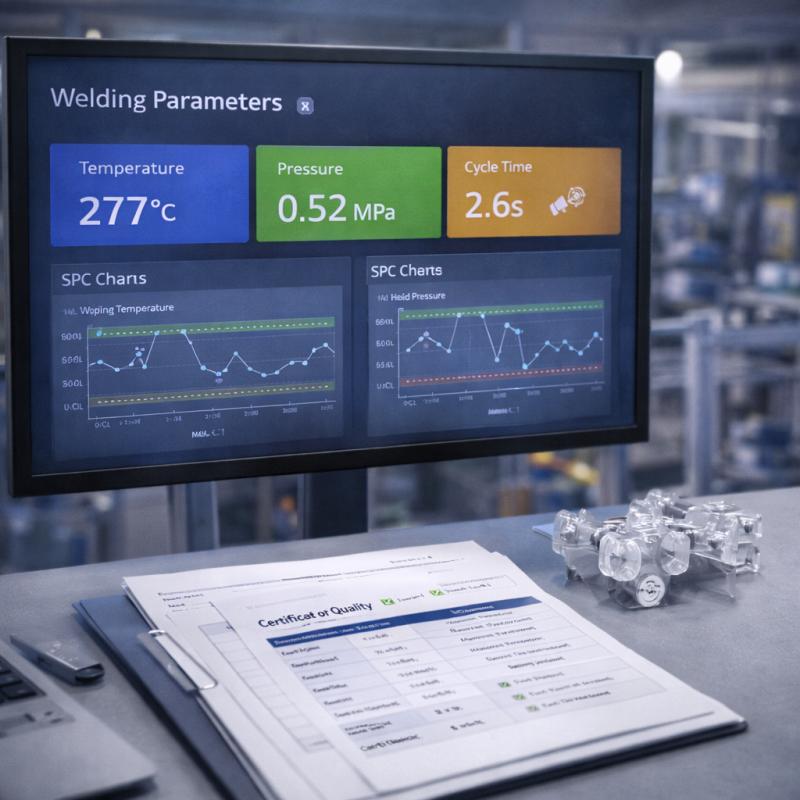
Monitoring Weld Quality
Implementing Statistical Process Control (SPC) is key in production. Monitor critical parameters such as:
- Actual weld energy (for ultrasonic)
- Peak pressure and displacement
- Temperature profiles
- Cooling time
Setting alarms for deviations greater than 5% from targets allows for real-time intervention, preventing defect batches. Non-destructive testing methods like pull tests, burst tests, or visual inspection with borescopes can further validate weld integrity.
7.When Standard Methods Aren't Enough: Customized Industrial Welding Solutions
While standard welding techniques handle most applications, high-stakes manufacturing can present unique challenges that demand engineered solutions. These typically involve:
- Complex 3D seam geometries that standard tools cannot follow.
- Multi-material assemblies with mismatched melting points or properties.
- Ultra-high production speeds requiring cycle times under 2 seconds.
- Sterile or cleanroom environments with zero particulate tolerance.
High-Volume Automotive Welding
Challenge: Welding large, contoured bumpers to brackets with varying thicknesses demands consistent melt depth along 3D paths to pass crash tests.
Our Approach: We develop servo-controlled vibration systems with pressure profiling that adjusts force in real-time based on geometry, ensuring uniform strength per ISO 26262 standards. This tailoring integrates seamlessly into assembly lines.

Precision Medical Device Welding
Challenge: Joining masks or tools requires sterility and tight tolerances to avoid contamination or weak spots in critical use.
Our Approach: Non-standard ultrasonic setups with HEPA-filtered enclosures ensure clean, validated processes. Our CE-certified designs use frequency tuning for precise energy delivery, meeting FDA guidelines without particulates.

Electronics and Consumer Goods
Challenge: Adapters or housings often involve thin walls and mixed plastics, risking distortion at high speeds.
Our Approach: Servo-driven hot plate systems adapt heating zones for unique shapes, cutting costs by 20% through optimized cycles. We incorporate real-time sensors for consistency in high-throughput runs.
If these scenarios sound familiar, a custom assessment can reveal efficiencies. Reach Dizo Sonics for a free process review to tackle your challenges.
If your application involves similar complexities, a dedicated feasibility study can identify potential efficiencies and tailor a solution to your specific needs.
8.How to Choose: A Proven Framework for Selecting Your Plastic Welding Process
A systematic approach eliminates guesswork when selecting a welding method. Evaluate your project against the following key drivers, rating each as High, Medium, or Low priority.
Key Decision Drivers to Rate Your Project
Rate each driver as High, Medium, or Low for your needs:
- Production Volume & Rhythm: Prototype/low-batch favors manual; high-volume continuous needs automation for scalability.
- Part Size, Geometry & Weld Seam Complexity: Small/simple suits hot air; large/3D contours require vibration or robotic for precision.
- Required Joint Strength & Performance: Cosmetic needs basic; load-bearing/hermetic seals demand high-strength like ultrasonic.
- Material Compatibility & Specifics: Standard thermoplastics work with most; glass-filled or TPEs need specialized tuning.
- Budget & Investment Horizon: Upfront low for DIY; consider ROI---ultrasonic often pays back in under 12 months via zero scrap and speed gains.
Selection Framework Steps
- Define Requirements: Identify your material, part dimensions, joint design, and strength needs.
- Rate the Drivers: Assign High/Medium/Low to each driver above. A project scoring High in multiple categories (e.g., high volume, complex geometry, high strength) strongly points toward advanced automated methods.
- Consult Comparison Data: Use the table in Section 5 to see which methods align with your rated priorities.
- Consider ROI: For production applications, calculate total cost of ownership, including labor, scrap, downtime, and energy. Automated solutions often offer lower cost-per-part at scale.
- Test and Validate: Once a method is shortlisted, conduct trials with representative parts to fine-tune parameters (temperature, pressure, time) and confirm performance.
Troubleshooting Common Welding Issues
- Weak Welds: Check surface preparation (oxide removal), verify temperature is within range, and increase pressure within the 0.5--2 MPa window if voids are suspected.
- Burning or Degradation: Reduce temperature by 10--20°C, shorten weld time, ensure even heat distribution (use a diffuser), and verify material grade.
- Inconsistent Results: Implement SPC monitoring. For automated systems, check for tooling wear, material batch variations, or fluctuations in utility supply (air pressure, voltage).
9.Frequently Asked Questions (FAQ)
How do I weld plastic without burning it?
Precise temperature control is key. Use equipment with adjustable settings, start at the lower end of the recommended range, and perform test welds on scrap material. For hot air welding, a diffuser attachment can help distribute heat evenly and reduce hot spots. Continuously monitor the air stream temperature with a thermocouple for sensitive materials.
What's the best method for welding PP (polypropylene)?
Hot air welding with a PP-compatible filler rod is effective for repairs and fabrications. Ensure surfaces are cleaned and pre-treated (e.g., flame treatment) to overcome PP's low surface energy. Maintain a temperature between 220--280°C and apply consistent pressure. For production, consider hot plate or vibration welding for superior strength and consistency.
Ultrasonic vs. hot air welding: which is better for DIY?
Hot air welding is generally better for DIY due to its lower cost, ease of learning, and versatility across many materials and part sizes. Ultrasonic welding offers higher precision and speed but requires a significant equipment investment and is typically used for small, designed-for-ultrasonic parts in batch or production settings.
How should I prepare weld seams for the strongest connection?
- Clean thoroughly to remove dirt, grease, and mold release agents.
- Remove the oxide layer via abrasion (e.g., sanding) or chemical etching.
- Ensure mating edges are even and fit well without gaps.
For critical applications, a surface roughness (Ra) of about 3.2 µm after abrasion is often recommended to promote mechanical interlocking, as per ASTM guidance.
What equipment is used for high-volume plastic welding?
Automated systems such as multi-head ultrasonic welders, robotic welding cells, servo-driven hot plate machines, and linear vibration welders are standard in high-volume manufacturing. Selecting the right system requires a capacity analysis that considers part design, cycle time targets, and required uptime. Many suppliers offer feasibility studies to match equipment capability to production goals.
What are the key temperature tips for welding PVC?
Keep the welding temperature between 140--180°C to soften PVC without causing excessive fume generation. Always work in a well-ventilated area or use local exhaust ventilation. Apply steady, moderate pressure to achieve fusion without distorting the part.

10.Conclusion
Mastering plastic welding involves understanding the interplay of material science, process parameters, and production economics. This guide has provided a foundation---from core principles and manual techniques to advanced industrial methods and a structured selection framework---to help you make informed, confident decisions for your projects.
For over two decades, our team has specialized in transforming complex welding challenges into reliable, production-ready solutions. Our ISO 9001-certified process development and validation expertise bridges the gap between theory and guaranteed performance in real-world manufacturing.
If your project involves high-stakes applications, high-volume production, or geometrically complex parts, a technical consultation is the logical next step. We invite you to contact our solutions team for a confidential, no-obligation process assessment. Let's discuss how to translate your specific requirements into an efficient, robust welding reality.
Ready to optimize your plastic welding process?
Contact our engineering team today to schedule your assessment.
More Reading
- Automatic Welding Machines for Plastics: The Definitive Guide
- Welding Machine Distributor: Find Reliable Suppliers Today
- Top Plastic Welding Machine Manufacturers Comparison
- Ultrasonic Plastic Welder Guide: Benefits, Uses & Tips
- Plastic Welding Guide: Techniques for Automotive, Medical, Electronics
- Ultrasonic Plastic Welding Guide for Precision OEM Parts | Dizo Sonics