

Plastic Welding Guide 2024: Processes, Selection & Custom Solutions

Plastic Welding Technology: The Ultimate Guide to Processes, Selection & Custom Solutions
Meta Description: Master plastic welding for automotive, medical, & electronics. This definitive 2024 guide compares ultrasonic, vibration, hot plate, laser & spin welding. Get expert selection criteria, parameter tables, and insights into custom automation from Dizo Sonics.
If you're a manufacturing engineer battling inconsistent weld strength in automotive assemblies, or an R&D designer struggling to achieve medical-grade hermetic seals without adhesives, you understand the high cost of failure: product recalls, warranty claims, and compromised safety. I'm Jensen, a Senior Applications Engineer at Dizo Sonics. With over 15 years of field experience and direct involvement in more than 1,000 custom welding projects for clients like BYD and Siemens, I've witnessed what distinguishes a reliable process from a problematic one. This guide delivers more than a method list; it provides the proven decision-making framework used by our team, complete with actionable parameters, objective comparisons, and clarity on when to transition from standard to custom engineered solutions.
1. Introduction to Industrial Plastic Welding
Plastic welding is a suite of processes that join thermoplastic materials by applying controlled heat and pressure, creating a permanent, molecular-level bond. This method surpasses mechanical fastening and adhesives by producing hermetic, leak-proof assemblies with strength often exceeding that of the base material.
The High Stakes of Welding Quality
In critical industries, a flawed weld is not just a defect; it's a systemic risk with tangible consequences:
- Automotive: A leaking weld on an air intake manifold or EV battery cooling plate can lead to engine performance loss, safety hazards, and massive recall campaigns.
- Medical Devices: An imperfect seal on a fluid path housing risks patient safety and results in non-compliance with stringent FDA and ISO 13485 regulations.
- Consumer Electronics: Moisture ingress through a poorly welded sensor casing causes field failures, high return rates, and erosion of brand trust.
Core Principles: Thermoplastics and Weldability
Successful welding hinges on material science. Thermoplastics like Polypropylene (PP), Acrylonitrile Butadiene Styrene (ABS), and Polycarbonate (PC) soften when heated and re-harden upon cooling, enabling fusion. Two key properties dictate weldability:
- Glass Transition Temperature (Tg): The point at which polymer chains become mobile. Welding must occur above this temperature.
- Melt Flow Index (MFI): Indicates material viscosity when melted. Matching MFI between parts is critical for uniform flow and strong intermixing at the joint.
Common Failure Modes & Root Causes
Understanding why welds fail is the first step toward prevention. Based on Dizo Sonics' failure analysis data, these are the most frequent issues:
- Weak Bond Line: Caused by insufficient energy input (low amplitude/pressure) or incorrect time, leading to incomplete molecular entanglement.
- Excessive Flash (Burr): Results from over-melting due to excessive heat, pressure, or time, affecting aesthetics and requiring secondary operations.
- Part Distortion/Warpage: Caused by uneven heating or cooling, compromising dimensional accuracy and assembly fit.
- Inconsistent Seals: Often stems from part-to-part variation, material contamination (e.g., moisture), or unstable process parameters.
2. The Science Behind a Perfect Weld: Principles & Parameters
Achieving a consistent, high-strength weld is a precise balancing act governed by fundamental principles of physics and material science.
The Interplay of Heat, Pressure, and Time (The Welding Triangle)
Every welding process manipulates these three interdependent variables:
- Heat: Provides the energy to bring the polymer interface to a molten state. Can be generated via friction (ultrasonic/vibration), conduction (hot plate), or electromagnetic energy (laser).
- Pressure: Forces the molten surfaces into intimate contact, enabling polymer chain interdiffusion and expelling air pockets.
- Time: Allows for sufficient heat transfer and molecular entanglement (hold time) to form a robust structure upon cooling.
Disrupting this balance leads to failure: insufficient heat/pressure causes weak bonds; excessive heat/time causes degradation and flash.
Material Compatibility & Joint Design
Not all plastics weld well together. Amorphous polymers (like ABS, PC) generally weld more easily than semi-crystalline ones (like PP, PE). For difficult pairs or to enhance performance, joint design is critical:
- Energy Director: A small, triangular ridge used in ultrasonic welding to concentrate energy for rapid startup.
- Shear Joint: Ideal for vibration and hot plate welding, it creates a long, sealed path excellent for hermetic applications.
- Tongue-and-Groove: Provides self-alignment and contains flash for clean aesthetic results.
Critical Process Parameters & Ranges
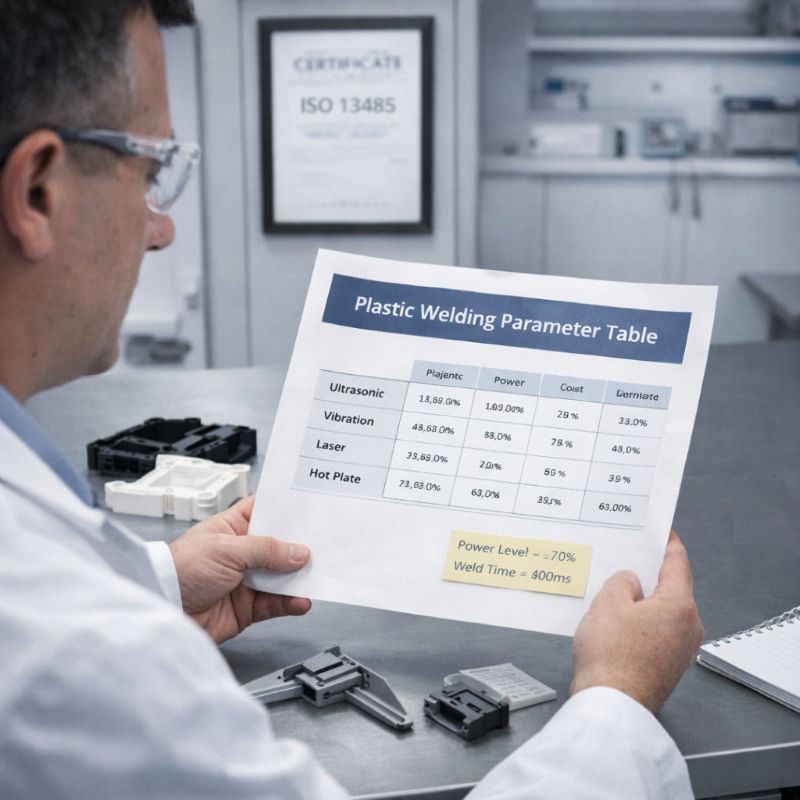
Fine-tuning these parameters is key to optimization. The following table, based on Dizo Sonics' application lab data and ASTM/ISO test methods, provides a baseline for common thermoplastics.
| Parameter | Typical Range | Influence on Weld Quality | Application Example / Note |
|---|---|---|---|
| Frequency (Ultrasonic) | 20, 28, 35, 40 kHz | Determines energy delivery rate and depth of penetration. | Higher frequencies (40 kHz) for delicate, small electronics; lower (20 kHz) for larger, tougher parts. |
| Amplitude (Vibration/Ultra.) | 20-100 μm (Ultra.); 0.5-2 mm (Vib.) | Controls frictional energy intensity. | Higher amplitude increases melt rate but risk of part damage. Servo-control ensures consistency. |
| Pressure | 0.2 - 0.8 MPa | Ensures contact, affects melt flow and flash. | Critical for hot plate welding to compensate for part warpage; too high can squeeze out molten material. |
| Weld Time / Spin Speed | 0.2 - 5 sec; 1000-3000 RPM | Duration of energy application. | Spin welding speed must generate sufficient frictional heat before material degrades. |
| Hold/Cool Time | 1 - 10+ seconds | Allows solidification under pressure, defining final crystallinity and strength. | Often overlooked; insufficient hold time is a common cause of de-lamination under stress. |
Pro Tip: For materials like Nylon or Polycarbonate that are hygroscopic, pre-drying to <0.02% moisture content is a non-negotiable parameter often more critical than machine settings.
3. In-Depth Guide to Key Welding Processes
Here are the main plastic welding techniques, each tailored to specific needs in automotive, electronics, or repair work. We'll break them down consistently so you can quickly compare and choose.
Ultrasonic Welding for Precision Applications
How It Works: High-frequency vibrations (20-40 kHz) create frictional heat at the joint, fusing parts in under a second.
Ideal For / Best Applications:
- Small electronic components like sensors or casings
- Medical devices requiring hermetic seals
- Automotive interior parts needing clean assembly
Key Advantages:
- Extremely fast cycle times
- No fumes or consumables
- Precise control for delicate parts
Limitations & Design Considerations:
- Limited to smaller parts (typically under 300 mm)
- Requires a rigid path for vibration energy
- Sensitive to part geometry---flat or energy-dampening designs can reduce effectiveness
Dizo Sonics' Insight / Enhancement: Our generators feature Automatic Frequency Tracking (AFT), which automatically adjusts for load and temperature changes. This keeps energy consistent, reducing defects in electronics assembly and extending tool life---based on our internal tests.
Vibration Welding for Large Structures
How It Works: Linear oscillation (200-240 Hz) generates friction heat, melting large joint areas under pressure.
Ideal For / Best Applications:
- Automotive components like dashboards or bumpers
- Large plastic tanks or housings
- Structural parts needing strong, leak-proof seals
Key Advantages:
- Excellent bond strength for big planes
- Good for dissimilar materials
- Hermetic seals in demanding environments
Limitations & Design Considerations:
- Can produce dust or flash
- Needs flat or linear joints
- Higher initial setup for large parts
Dizo Sonics' Insight / Enhancement: To address dust concerns, our machines include enclosed chambers with integrated filtration. This makes vibration welding viable for clean-room-adjacent electronics or medical applications, while our servo-driven amplitude control ensures even fusion without excessive wear.
Hot Plate Welding for Large or Irregular Parts
How It Works: A heated plate melts joint surfaces, then parts are pressed together for cooling.
Ideal For / Best Applications:
- Large plastic fuel tanks or containers
- Thick or complex shapes
- Automotive structural components
Key Advantages:
- Handles size tolerances well
- Strong, uniform bonds
- No vibration or dust
Limitations & Design Considerations:
- Slower cycle times
- Risk of contamination from plate
- Requires precise alignment
Dizo Sonics' Insight / Enhancement: Our hot plate systems use multi-zone PID temperature control for uniform heating (±2°C). This reduces distortion in large tanks and ensures consistent quality, especially for high-volume production.
Spin Welding for Cylindrical Components
How It Works: One part rotates against the other, generating friction heat until fusion.
Ideal For / Best Applications:
- Cylindrical container lids or tubes
- Automotive fluid reservoirs
- Appliance parts with round interfaces
Key Advantages:
- Fast and clean
- Strong hermetic seals
- Minimal flash
Limitations & Design Considerations:
- Limited to circular joints
- Requires balanced rotation
- Potential for misalignment
Dizo Sonics' Insight / Enhancement: Our servo-controlled spin welders offer precise speed ramp-up, minimizing stress on parts. This works well for precision lids in electronics, with built-in alignment checks for repeatable results.
Hot Air Welding for Repair and Sealing
How It Works: Hot air melts surfaces, often with filler rods, for manual or semi-automated joins.
Ideal For / Best Applications:
- Plastic repair and sealing sheets
- Custom fabrication or prototyping
- Maintenance of automotive or appliance parts
Key Advantages:
- Versatile for irregular shapes
- Low equipment cost
- Easy for field repairs
Limitations & Design Considerations:
- Operator skill-dependent
- Risk of uneven heating
- Not ideal for high-volume
Dizo Sonics' Insight / Enhancement: While often manual, our hot air tools integrate precise temperature control to avoid burns or weak spots. For scaling repairs in consumer goods, we offer semi-automated options that boost consistency.
4.Objective Comparison of Plastic Welding Methods
The table below provides an at-a-glance comparison across key dimensions to help you narrow down feasible methods for your project. Data draws from industry practices and our internal testing.
| Welding Method | Best Suited Materials | Optimal Joint Design | Part Size (Typical) | Cycle Time (Relative) | Equipment Cost | Operational Cost/Complexity | Tolerance to Part Variation | Typical Weld Strength (% of Parent) | Key Advantage | Main Limitation | Ideal Industry Application |
|---|---|---|---|---|---|---|---|---|---|---|---|
| Ultrasonic | Amorphous thermoplastics (e.g., ABS, PC) | Energy director | Small (<300 mm) | Very Fast | $$ | Low | Poor | 80-95% | Speed & cleanliness | Size & geometry limits | Electronics assembly, medical devices |
| Vibration | Semi-crystalline (e.g., PP, PE) | Linear shear | Large (>500 mm) | Medium | $$$ | Medium | Good | 90-100% | Strength on large areas | Dust & flash | Automotive bumpers, tanks |
| Hot Plate | Broad thermoplastics | Flat or contoured | Large/irregular | Slow | $$ | Low | Excellent | 85-95% | Tolerance handling | Cycle time | Fuel tanks, structural parts |
| Spin | Thermoplastics with round interfaces | Circular shear | Cylindrical | Fast | $$ | Low | Fair | 90-100% | Hermetic seals | Shape restriction | Cylindrical lids, reservoirs |
| Hot Air | Most thermoplastics | Manual or semi-auto | Any (repair) | Variable | $ | High (skill-dependent) | Good | 70-90% | Versatility | Operator variability | Repair work, sealing sheets |
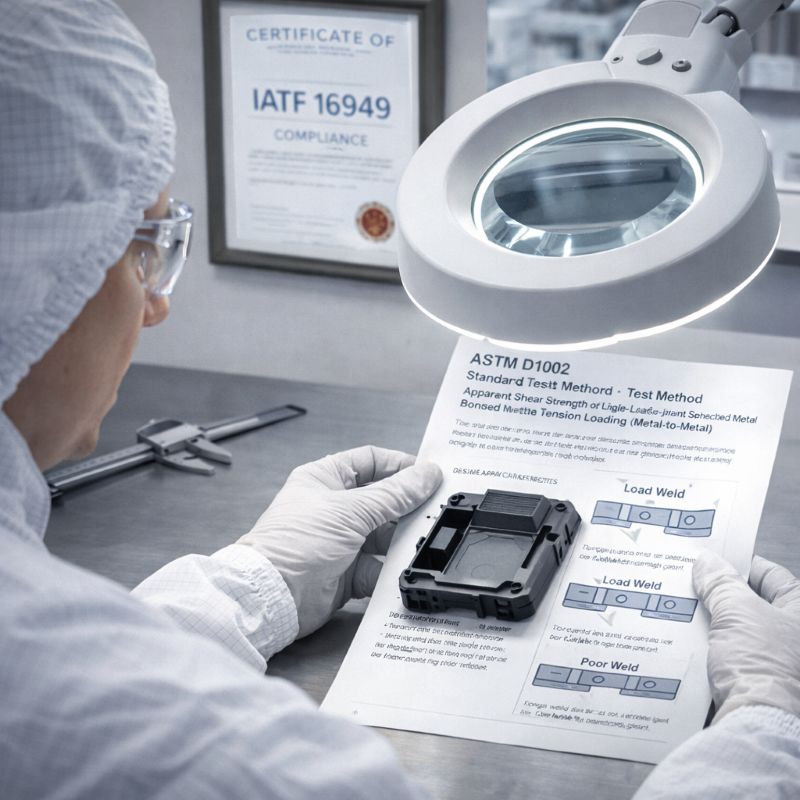
*Strength data based on Dizo Sonics internal tensile shear testing per ASTM D1002 on standard coupons. Actual results vary by material and joint design.
Key Trade-Offs and Decision Levers
Speed vs. Size: Ultrasonic is fastest but for small parts; large parts require vibration or hot plate, sacrificing speed.
Cost vs. Performance: Laser welding offers unparalleled cleanliness and control but at a premium. Vibration offers the best strength-to-cost ratio for large structural parts.
Flexibility vs. Simplicity: Hot plate handles the widest range of parts and materials but is slower. Spin welding is simple and effective but only for one geometry.
5. A 5-Step Framework for Selecting the Optimal Welding Process
Plastic welding powers critical applications in automotive (dashboards, bumpers), electronics (power adapters, sensor housings), medical devices (sealed housings), appliances, and consumer goods. With our 10-year lifespan data, it often reduces long-term costs by 20% through fewer failures and maintenance.
Follow this step-by-step framework to select the right technique---ask yourself these questions at each stage.
Step 1: Define Your Material & Part Geometry
- What are the exact material grades and fillers (e.g., 30% glass-filled Nylon 66)?
- Do you have material data sheets with Melt Flow Index (MFI)?
- What is the part size, wall thickness at the joint, and is the geometry 2D or complex 3D?
Step 2: Determine Your Quality & Performance Requirements
- What tensile or shear strength do you need (in MPa or PSI)?
- Is a hermetic seal required? To what pressure standard (e.g., IP67 or 10 kPa)?
- What level of visible flash or cosmetic marking is acceptable?
Step 3: Evaluate Production Volume & Cost Constraints
- What is your target cycle time and annual volume?
- How much can you invest in equipment vs. labor?
- Do you need full traceability for compliance (e.g., IATF 16949)?
Step 4: Assess Automation & Integration Needs
- Will this integrate into an existing line (e.g., with robots)?
- Do you need quick changeover for multiple parts?
- What level of operator skill is available?
Step 5: Check Regulatory & Environmental Factors
- Are there industry standards (e.g., FDA, ISO 13485 for medical)?
- Does the process need to avoid fumes or consumables?
- How critical is sustainability in your supply chain?
Real-World Success: Custom Solution for EV Battery Components
Client & Challenge: A Tier-1 supplier to BYD needed to weld complex, multi-chambered coolant manifolds for electric vehicle battery packs. The requirement was a 100% leak-proof seal at 3 bar, with a cycle time under 90 seconds for high-volume production.
Our Solution: Dizo Sonics designed a custom hot-plate welding system with multi-zone, PID-controlled heating plates to handle varying wall thickness, plus integrated vision for pre-weld verification.
The Result: Zero-defect leak rate in production, elimination of secondary sealing, and full digital traceability---exceeding IATF 16949 requirements while cutting costs.
6. Beyond Standard: Custom & Automated Welding Solutions
When project demands exceed the capabilities of standard machines---due to size, complexity, speed, or quality requirements---custom engineered solutions become necessary.

Triggers for Custom Engineering
Here are common scenarios where standard machines fall short:
- Complex 3D Contours: Welding non-linear paths on automotive body panels or medical device housings.
- Extreme Precision: Micron-level alignment for optical components or micro-fluidic devices.
- High-Speed Integration: Synchronizing welding with robotics for >99.9% uptime in a high-volume consumer electronics line.
- Advanced Material Challenges: Welding high-temperature polymers (PEEK, PPS) or composites.
Engineered Solutions from Dizo Sonics: A Problem-Solving Approach
We design tailored systems to overcome these challenges:
- For 3D contours: Robotic welding workcells integrate 6-axis robots with our heads, following exact paths for consistent pressure and energy.
- For difficult materials: Advanced process control adds precision pre-heating and specialized sonotrode coatings, plus proprietary frequency modulation for better energy coupling.
- For high speed/precision: Servo-driven systems and real-time monitoring ensure micron accuracy without flash.
- For automation: Full integration with EtherCAT/PROFINET for seamless line communication and traceability.
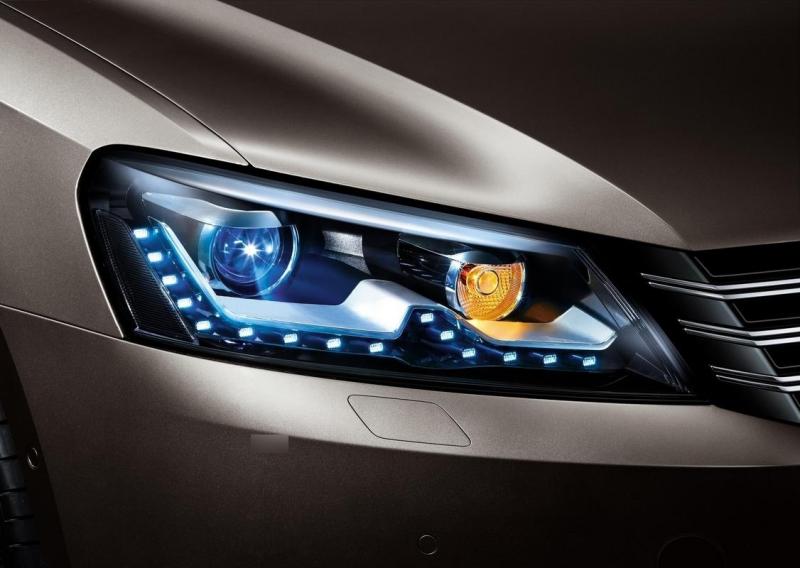
[Application Case]: For a European manufacturer of premium automotive lighting (Hella), our robotic approach eliminated manual rework and achieved perfect Class-A surface finish on complex lens housings.
The Partnership Advantage: From Feasibility to Lifetime Support
Choosing Dizo Sonics means more than equipment---it's a long-term collaboration. We offer 24/7 engineer hotlines, 8-hour response guarantees, and lifetime technical support to keep your operations running smoothly. If your project involves any of these challenges, let's discuss how custom engineering can deliver the reliability you need. Contact us for a complimentary feasibility study.
7.FAQ: Answering Common Questions on Plastic Welding
Here are answers to the most frequent questions we hear from engineers and managers. These cover basics, selection, and troubleshooting.
Basics & Principles
What are basic techniques for vibration welding in automotive parts? Vibration welding uses linear oscillation (typically 200-240 Hz) to generate frictional heat and fuse large joint areas. It's ideal for bumpers or dashboards. Pro Tip: Ensure even amplitude (0.5-2 mm) for consistent seals---our servo systems help maintain this precisely.
How does ultrasonic welding work for small electronic components? High-frequency vibrations (20-40 kHz) create localized friction heat to melt interfaces quickly, often in under a second. It's perfect for sensors or casings. Pro Tip: Use energy directors for focused melting; our AFT generators adjust automatically for reliable results.
What is hot plate welding for large plastic fuel tanks? A heated plate melts surfaces evenly before pressing parts together. It excels at handling size tolerances in tanks. Pro Tip: Multi-zone PID control (±2°C) prevents distortion---our systems deliver this for uniform, leak-proof bonds.
How to use spin welding for cylindrical container lids? One part rotates against the other (up to 2000 RPM) to create friction heat and fuse the joint. It's great for lids or reservoirs. Pro Tip: Precise speed ramp-up minimizes stress---our servo welders include alignment checks for repeatability.
What about hot air welding for plastic repair and sealing sheets? Hot air (300-500°C) melts surfaces, often with filler rods, for flexible repairs. It's versatile for sheets or prototypes. Pro Tip: Precise temperature control avoids burns---our tools integrate this for consistent, clean results.
Method Selection & Comparison
What's the difference between amplitude and frequency in ultrasonic welding? Frequency (e.g., 20-40 kHz) determines energy delivery speed; amplitude controls vibration strength. Higher frequency suits thin parts, while amplitude affects heat intensity. Pro Tip: Our generators balance both via AFT for optimal performance.
Is hot plate welding or vibration welding more expensive? Hot plate has lower equipment cost but slower cycles; vibration is pricier upfront but faster for large parts. Consider volume---high throughput favors vibration. Pro Tip: We help calculate ROI based on your production needs.
Troubleshooting & Quality Control
How do I troubleshoot a weak or inconsistent weld in vibration welding? Check for low amplitude, uneven pressure, or material mismatch. Inspect joint design for flatness. Pro Tip: Our monitoring systems record curves for quick diagnosis---often, servo adjustments fix it immediately.
Can I weld recycled plastics as reliably as virgin material? Recycled plastics can be reliable with matching grades and fillers, but contaminants may cause inconsistencies. Test MFI first. Pro Tip: Our frequency modulation helps couple energy better into variable materials.
What causes "whistling" during ultrasonic welding? Whistling signals harmonic vibrations or loose stack components, leading to inefficient energy and weak welds. Pro Tip: Our torque-controlled assembly and AFT suppress harmonics for stable operation.

8.Conclusion: Engineering Your Path to Welding Success
Selecting and implementing the right plastic welding technology is a strategic engineering decision with direct impact on product quality, manufacturing cost, and time-to-market. This guide has equipped you with the principles, data, and framework to make an informed choice.
The journey from concept to production often reveals complexities that standard equipment cannot solve. This is where deep application expertise becomes invaluable.
Ready for your next step? Choose what fits best:
- Want a quick-reference tool? Download our free Plastic Welding Method Selection Checklist to keep these criteria handy.
- Ready to apply this to your project? Submit your part specs for a complimentary Welding Process Feasibility Report---no obligation.
- Facing a complex challenge? Schedule a 30-minute technical deep-dive with one of our engineering leads to explore tailored options.
Build with Confidence. Weld with Precision.
Contact Dizo Sonics: sales@dizo-global.com | +86 510 83773953