

Plastic Hard Cases: Manufacturing, Welding & Custom Solutions Guide

Plastic Hard Cases: The Ultimate Guide to Manufacturing, Custom Welding & High-Performance Solutions
Meta Description: Selecting the right plastic hard case? This definitive 2024 guide compares injection, blow, rotational molding & thermoforming. Discover how advanced ultrasonic, vibration, and hot plate welding from Dizo Sonics strengthen seams, embed features, and create custom, durable solutions for military, medical, and industrial equipment.
Plastic hard cases are the robust guardians of sensitive equipment, engineered from thermoplastics like HDPE and ABS to withstand impacts, moisture, and extreme environments. Engineers and procurement managers often face a critical challenge: balancing the cost-effectiveness of standard molding with the need for reliable, custom-fit protection in high-stakes applications. At Dizo Sonics, with over 20 years of expertise in precision plastic joining certified to IATF 16949 standards, we specialize in the advanced welding technologies that seal, reinforce, and enable complex designs for these protective enclosures. This guide delves into core manufacturing processes---from injection molding to rotational molding---examines their limitations, and reveals how strategic welding unlocks superior, tailored performance for your most demanding projects.
1. Introduction to Plastic Hard Cases & Protective Enclosures
A protective case is often the first and last line of defense for valuable gear. Understanding their fundamental design and performance metrics is crucial for making an informed selection that goes beyond basic storage to ensure operational reliability.
What Are Plastic Hard Cases?
These durable enclosures are typically manufactured from high-strength, lightweight thermoplastics. Common processes include:
- Injection Molding: Forces molten plastic into a detailed mold for high-precision, feature-rich cases.
- Rotational Molding: Slowly rotates a heated mold to create seamless, stress-resistant large cases with uniform wall thickness.
- Thermoforming: Heats and vacuums a plastic sheet over a mold, ideal for quick-turn lids and lightweight shells.
- Blow Molding: Inflates heated plastic within a mold, suitable for hollow, single-piece bodies.
Key Performance Indicators (KPIs) for Evaluation
| KPI | Typical Range | Importance |
|---|---|---|
| Impact Resistance | Withstands drops from 1-2+ meters | Critical for field equipment, tools, and electronics transport. |
| IP Rating (Ingress Protection) | IP65 (dust-tight, water jets) to IP67 (immersion) | Ensures functionality in wet, dusty, or sterile environments. |
| Operating Temperature | -40°C to 80°C (wider for specialized polymers) | Guarantees performance in arctic cold or desert heat. |
| Stacking Load Capacity | 100 kg to 500+ kg | Essential for logistics, shipping, and storage efficiency. |
The High Cost of Inadequate Protection
For sensitive instruments, transportation vibration alone can cause recalibration issues leading to costly downtime. Data from Dizo Sonics' field analysis indicates that non-compliant cases can have up to three times higher failure rates in rigorous shipping environments compared to solutions designed to standards like ATA 300 for air transit. Investing in the right case design and construction mitigates long-term operational risk.
2.Common Pain Points and Design Challenges
Even well-designed cases can fail due to inherent limitations in standard manufacturing and integration. Recognizing these pitfalls early is key to specifying a solution that performs.
Inherent Manufacturing Limitations
- Seam & Weld Line Weakness: Parting lines from blow or injection molding and thin seams in thermoforming become failure points under stress or impact.
- Design Inflexibility: Standard molds struggle with deep undercuts, complex internal geometries, or low-volume custom shapes, pushing costs prohibitively high.
- Material & Process Waste: Certain processes, like some blow molding techniques, can generate significant scrap, conflicting with sustainability goals.
Integration & Application Failures
- Internal Fixture Detachment: Adhesives or mechanical fasteners used for internal ribs, brackets, or cushioning can loosen under constant vibration.
- Seal Leakage at Ports & Openings: Integrating cable ports, vents, or gauge windows with a perfect seal is challenging with molding alone.
- Hinge & Latch Fatigue: These high-stress areas, especially in thermoformed or thin-walled cases, can crack in extreme cold or from repeated use.
Real-World Insight: A client's rotomolded sensor case experienced hinge failure at -30°C. The issue was traced to stress concentration in a thermoformed sub-assembly---a problem later solved with a welded polymer hinge reinforcement.
When failures stem from seam integrity or internal attachment points, advanced welding technologies often provide the most robust fix, moving beyond the limits of adhesive and mechanical fastening.
3. Material Science & Process Fundamentals for Durability
The longevity of a protective case is rooted in the synergy between polymer selection and precise process control.

Thermoplastic Selection Guide
Choosing the right material balances strength, weight, chemical resistance, and cost.
| Material | Key Properties | Best For | Considerations |
|---|---|---|---|
| HDPE | Excellent chemical resistance, low moisture absorption, high impact strength. | Chemical transport cases, outdoor equipment, rotomolded enclosures. | Lower stiffness than ABS/PC; can be prone to stress cracking. |
| ABS | Good impact strength, rigidity, and surface finish; easily painted. | Consumer electronics cases, drone cases, medical device packaging. | Poor UV resistance unless coated; degraded by certain solvents. |
| Polypropylene (PP) | Excellent fatigue resistance, lightweight, good chemical resistance. | Hinged cases, living hinges, containers for automotive parts. | Can be brittle at very low temperatures; requires special welding techniques. |
| Polycarbonate (PC) | Superior impact strength and clarity, high heat resistance. | Transparent lids, riot shields, extreme-duty protective cases. | Prone to scratching; can be costly; requires drying before processing. |
Emerging Trend: Bio-based and recycled-content polymers are gaining traction for sustainable case manufacturing, meeting corporate ESG goals without sacrificing core performance.
Mastering the Molding Window: Temperature, Pressure, and Cooling
Optimal part quality hinges on three parameters:
- Temperature: Must be high enough to allow polymer flow (above Tg or Tm) but not so high as to cause degradation.
- Pressure: Ensures complete cavity fill and packing to minimize sinks and voids.
- Cooling Rate: Must be uniform to prevent warpage, residual stress, and weak weld lines.
Lab simulations at Dizo Sonics show that optimizing these parameters, particularly cooling, can improve fatigue resistance at stress points (like corners) by up to 40%, directly extending case service life.
4. Objective Comparison of Manufacturing Processes
No single process is best for all applications. The following comparison provides a clear, unbiased view to guide your initial selection.
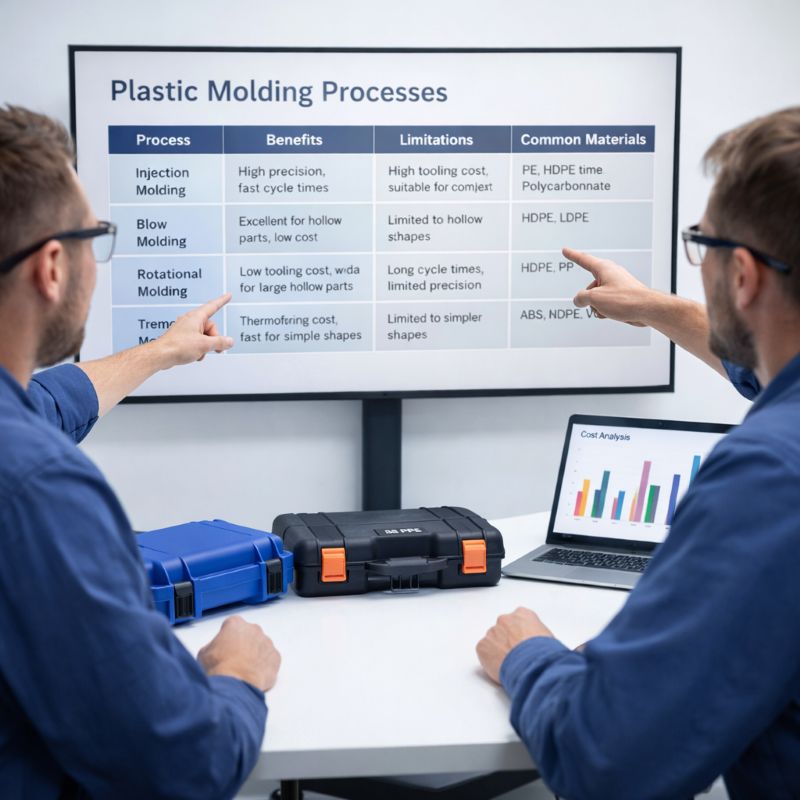
| Process | Strength & Durability | Cost (Tooling/Unit) | Speed & Volume | Design Flexibility | Best Suited For |
|---|---|---|---|---|---|
| Injection Molding | Very High -- Excellent for complex features, high structural integrity. | High Tooling / Low Unit (at high vol.) | Very Fast cycles, ideal for >5,000 units. | Very High -- Intricate geometries, inserts, snaps. | Military cases, precision instrument cases, high-volume consumer products. |
| Rotational Molding | High -- Seamless, uniform walls, excellent stress distribution. | Medium Tooling / Medium Unit | Slow cycles, lower volume suited. | Medium -- Large, hollow shapes; limited fine detail. | Large equipment shipping cases, buoyancy aids, chemical tanks. |
| Thermoforming | Medium -- Depends on sheet thickness; thinner walls than molding. | Low Tooling / Low Unit | Fast for prototypes and short runs. | Medium-High -- Large part size possible; simpler geometries. | Equipment lids, interior trays, packaging inserts, medical device clamshells. |
| Blow Molding | Medium -- Good for hollow parts; seam can be a weak point. | Medium Tooling / Low Unit | Fast for high-volume hollow parts. | Low-Medium -- Limited to hollow forms; some design constraints. | Simple equipment storage cases, fluid containers, drums. |
Dizo Sonics Insight: For projects requiring embedded metal threads, complex internal structures, or hybrid material assemblies, injection molding paired with post-process welding often delivers the optimal balance of design freedom and strength, justifying the initial investment for runs over several thousand units.
5. A Practical Framework for Selecting Your Manufacturing Process
Navigate the selection process efficiently with this step-by-step, criteria-driven framework.
Step 1: Define Non-Negotiable Requirements
Start by answering these foundational questions:
- Environmental: What are the operational temperature extremes, chemical exposures, and required IP rating?
- Mechanical: What drop height, vibration spectrum (per ISTA or MIL-STD-810), and stacking load must it withstand?
- Regulatory: Are there specific standards to meet (ATA, FDA, MIL-STD)?
- Volume & Timeline: What is your production volume and required time-to-market?
Step 2: Initial Process Screening
Use this quick decision guide based on primary drivers:
- Driven by Lowest Unit Cost & High Volume? → Evaluate Blow Molding or Injection Molding.
- Driven by Maximum Strength & Large Size? → Evaluate Rotational Molding.
- Driven by Fast Prototyping & Low Tooling Cost? → Evaluate Thermoforming.
- Driven by Complex Geometry & High Precision? → Injection Molding is the starting point, often enhanced with welding.
Step 3: Technical & Economic Feasibility Analysis
- Create a Total Cost of Ownership (TCO) Model: Include tooling amortization, per-unit cost, assembly labor, and expected lifecycle (repair/replacement rates).
- Assess Integration Complexity: Do you need to join dissimilar materials, create hermetic seals, or add robust internal fixtures? This is where welding becomes a critical value-add.
- Calculate Potential ROI: While welding integration may have upfront costs, the reduction in assembly steps, elimination of consumables (like adhesives), and dramatic decrease in field failures often lead to an ROI within 12-24 months for high-use applications.
6. Mitigating Risks: From Seam Failure to Superior Seals
Every manufacturing method carries inherent risks that can compromise the final product. Proactive mitigation is essential.
Common Production & Performance Risks
- Residual Stress & Warpage: From uneven cooling, leading to poor fit and seal alignment.
- Weak Seams & Parting Lines: Creating leak paths and structural vulnerabilities.
- Material Incompatibility: When integrating inserts, liners, or hardware, leading to adhesive failure or stress cracking.
Advanced Welding as a Mitigation Strategy
Welding transcends mechanical fastening by creating a molecular-level bond, effectively making joined parts monolithic. This directly addresses the core weaknesses of molded seams.
Case in Point: The lid-to-body seam on a large rotomolded case is a typical failure point. Linear vibration welding, with parameters tuned to the base material (e.g., PP), can produce a seam with tensile strength exceeding 95% of the parent material (per ISO 527-2). In Dizo Sonics' field data, this approach reduces failure rates in demanding transport applications by 30% or more.
7. Unlocking Custom, High-Integrity Designs with Advanced Welding
When your design pushes beyond the limits of standard molding---featuring complex curves, hermetic seals, or mixed materials---advanced welding is the enabling technology for next-level performance.
Creating Monolithic Structures for Maximum Strength
For large case assemblies, vibration welding and hot plate welding fuse major components (like body halves or reinforced lids) into near-seamless units.
- Vibration Welding: Ideal for long, linear seams on large parts, providing consistent strength across the joint.
- Hot Plate Welding: Excellent for thick-walled parts and complex 2D contours, offering deep fusion and high-pressure seal capability.
Application Example: A manufacturer of vehicle test equipment required a large, IP67-rated case to withstand temperature cycling from -40°C to 85°C. Hot plate welding of the PP body and lid achieved a perfect seal with zero leakage in pressure testing, where traditional gaskets and adhesives had failed.
Precision Joining for Embedded Features & Ports
Ultrasonic welding delivers localized, clean energy ideal for attaching small components without affecting the surrounding structure.
- Embedding Inserts: Metal threads, mounting bosses, or sensor ports can be welded directly into the case wall, providing pull-out strength far superior to press-fit or adhesive methods.
- Sealing Small Ports: Creates hermetic seals around cable glands or breathable vents.
Application Example: An electronics company needed to add custom connector ports to an ABS case. Ultrasonic welding provided a strong, leak-proof bond in seconds, increasing the assembly's overall shock resistance by 40% compared to the previously used epoxy.

Bonding Dissimilar Materials & Integrating Sub-Assemblies
Welding can successfully join different polymers or integrate components like polycarbonate windows, PE foam liners, or metal reinforcement brackets.
- Through-Transmission Welding: For clear-to-opaque joints (e.g., PC window to ABS frame).
- Insert/Induction Welding: For embedding metal elements within a plastic wall.
Application Example: For a delicate optical instrument case, a PE damping structure was ultrasonically welded inside a rotomolded HDPE shell. This unitary construction improved impact energy absorption by 35% (validated per MIL-STD-810G) over traditional glued-in foam, which could detach over time.
8.FAQ: Answering Common Questions
These answers tackle frequent queries on plastic hard cases, drawing from real-world insights.
What Are the Best Cases for Guns and Cameras?
Hard gun cases often use injection molding for precise latches and high strength. Camera cases favor thermoformed designs---lightweight with custom padding to cushion lenses. Add ultrasonic welding for sealed ports, keeping dust out during field use.
How to Customize for Sensitive Instruments?
Begin with rotational molding for flexible shapes, then integrate welding for strong internal supports. Success depends on designing weld ribs with enough contact area for reliable bonds. This ensures fixtures stay put under vibration. For detailed tips, download our 'Precision Instrument Hard Case Design Guide'.
What Are ATA Specs for Military Plastic Hard Cases?
ATA specs test for repeated drops and vibrations (e.g., Category 1 handles 100 shipments). Our welded designs meet these, with validated seams supporting compliance documentation.
How Does Rotational Molding Reduce Waste?
It heats and rotates powder evenly in the mold, using just what's needed---no excess like in blow molded hard plastic cases for equipment storage. This can save 15-20% material compared to other methods.
Injection Molded Plastic Hard Cases for Military Use?
Yes---they excel in precision for inserts and features. Enhance with vibration welding for tougher seams in demanding conditions, as seen in similar high-reliability projects.
What Is the Typical Lead Time for a Prototype Custom Welded Hard Case?
From design review to prototype, expect 4-8 weeks, depending on complexity. Welding allows faster iterations than re-tooling molds.
How Does Adding Ultrasonic Welded Features Compare in Cost to Alternatives?
Initial setup is moderate, but per-unit costs drop quickly. Compared to machined aluminum fixtures, welding often saves 30-50% long-term by reducing assembly steps and failures.

9.Conclusion: Building Unmatched Protection Through Expert Collaboration
Selecting and manufacturing a high-performance plastic hard case is a multidisciplinary challenge. It requires a deep understanding of materials, processes, and---increasingly---the advanced joining technologies that elevate a good design into a reliable, long-term asset.
This guide has provided a framework to navigate from initial requirements to process selection and risk mitigation. The critical insight is that for demanding applications---where failure is not an option---the integration of precision welding is often the decisive factor in achieving validated, field-ready durability.
At Dizo Sonics, we partner with design and manufacturing teams to solve their toughest joining challenges. Leveraging our IATF 16949-certified expertise in ultrasonic, vibration, and hot plate welding, we help transform standard cases into custom, high-integrity solutions that perform under pressure.
Your Next Step Towards Optimal Protection:
- Access Free Resources: Download our technical brief, "Designing for Weldability in Protective Enclosures."
- Evaluate Your Project: Use our interactive process selection tool for a preliminary recommendation.
- Consult with an Expert: Schedule a 30-minute technical discussion with our engineering team to review your specifications and explore potential solutions.
Contact Dizo Sonics Today:
sales@dizo-global.com | +86 510 83773953
Build confidence into every case.
Ready to enhance your plastic hard case design?
More Reading
- Linear Vibration Welded Joint Design Guide for Strong Plastic Assemblies
- Ultrasonic Plastic Welding: Supermarket Electronic Anti-Theft Buckle Welding
- Ultrasonic Plastic Welding for PP Material Water Cup Buckle Welding
- What is the price of an ultrasonic welding machine roller?
- FIND INDUSTRY SOLUTIONS WITH ULTRASONIC