

Non-Woven Polyester & Polypropylene Welding: Ultrasonic vs. Hot Air Techniques

The Ultimate Guide to Non-Woven Polyester and Polypropylene Welding: Techniques, Comparisons, and Customized Industrial Solutions
A Practical Expert Guide from Dizo Sonics -- 20+ Years of Ultrasonic Innovation for Filtration, Medical, and Geotextile Applications
Non-woven polyester and polypropylene fabrics are essential in filtration systems, medical protective wear, geotextiles, and pipeline rehabilitation due to their strength, chemical resistance, and superior filtration performance. Yet, achieving consistent, leak-free seams remains a common challenge---often leading to weak bonds, material damage from overheating, or slow production speeds that drive up costs.
This guide delivers actionable, field-tested insights to help you overcome these hurdles. You'll learn:
- Data-backed comparisons of welding methods for non-woven fabrics
- Specific process parameters for strong, repeatable seams
- A practical decision framework to choose the right welding technology
- How customized ultrasonic solutions address limitations of standard equipment
With over two decades of specialized expertise, CE/ISO certifications, and proven success in projects meeting EN 13795 (medical) and ISO 13485 standards, Dizo Sonics provides trusted strategies to enhance seam quality and production efficiency in non-woven polyester welding and non-woven polypropylene welding.
If you're dealing with inconsistent seams or low output, use the decision checklist below---or contact our team for a free application review.
1. Understanding Non-Woven Polyester and Polypropylene: Properties and Welding Implications
Non-woven fabrics are made by bonding fibers thermally, mechanically, or chemically---without weaving. This creates lightweight, porous materials that are strong, cost-effective, and highly versatile.
Key Material Characteristics
| Property | Polyester | Polypropylene |
|---|---|---|
| Melting Point | ~250--260°C | ~160--170°C |
| Chemical Resistance | Excellent against solvents, UV resistant | Excellent against acids, alkalis |
| Abrasion Resistance | High | Moderate to High |
| Moisture Absorption | Very low (<0.5%) | Very low (<0.5%) |
| Filtration Efficiency | Good | Excellent (fine fiber structure) |
Why These Properties Matter for Welding
The thermoplastic nature of both materials allows for reliable fusion bonding. However, their fine fiber structures are sensitive to excessive heat, which can weaken the fabric or create holes. Methods that deliver precise, localized energy---like ultrasonic welding---preserve abrasion resistance and chemical resistance far better than broad-heat techniques.
From Properties to Practice: Welding Parameters
Certain characteristics directly influence machine settings:
- Fine filtration structure → Requires controlled amplitude (50--80 µm) to avoid fiber damage.
- Chemical/abrasion resistance → Needs consistent pressure (1--3 bar) for uniform bonds without degradation.
- Higher polyester melt point → Often benefits from energy-mode welding (200--500 Joules) for deeper penetration without excess heat spread.
Understanding these links helps explain why some welding methods outperform others in real-world production.
2. Common Welding Techniques for Non-Woven Fabrics
Several methods are used to join non-woven polyester and polypropylene. Your choice depends on material thickness, seam width, production speed, and quality requirements---whether you're working on non woven filter bag welding, medical gowns, or large geo-liners.
Ultrasonic Welding: Precision for Delicate Fabrics
Ultrasonic welding uses high-frequency vibrations (20--40 kHz) to generate frictional heat exactly at the joint. The fibers melt and fuse at a molecular level without external heat sources.
Best for:
- High-speed, hygiene-critical seams
- Filter bags, medical gowns, precise sealing
- Thin or multi-layer non-wovens
Key Consideration: Requires careful amplitude and pressure control to avoid perforation.
Hot Air Welding: Reliable for Continuous Seams
Hot air welding directs heated air (up to 700°C) to soften fabric surfaces, followed by pressure rollers that bond them as they cool.
Best for:
- Wide, continuous seams (geo-liners, large industrial fabrics)
- Thicker materials where uniform heating is needed
Limitation: Broader heat application can affect thin or heat-sensitive fabrics.
Hot Wedge & Thermal Bonding
These methods use direct conductive heat via a heated element or plate. They work for basic joins but are less common in precision non-woven applications due to wider heat spread and potential fiber damage.
3. Why Ultrasonic Welding Excels for Non-Woven Fabrics
Ultrasonic welding stands out because it generates heat only where needed---through rapid mechanical vibrations---without affecting the surrounding material. Think of it as spot-welding with sound waves: precise, fast, and clean.
How It Works: Step by Step
- The horn (tool tip) presses the fabric layers together.
- High-frequency vibrations (20--40 kHz) cause fibers to rub intensely at the interface.
- Friction produces localized heat, melting the thermoplastic fibers just enough to intermingle.
- Pressure holds everything in place as it cools, forming a strong molecular bond.
This targeted approach preserves the porous structure critical for filtration and hygiene.
Key Advantages for Non-Woven Applications
- Minimal heat spread → Protects delicate fibers, maintaining strength and filtration efficiency.
- Fast cycles → Often 0.5--2 seconds per weld, ideal for high-volume production.
- Clean results → No consumables or fumes, perfect for medical gowns and food-grade filters.
Real-World Performance Insights
In lab tests for a polypropylene filter bag manufacturer, using 35 kHz, 75 µm amplitude, and 2.2 bar pressure produced welds achieving 93--97% of base material tensile strength---exceeding typical pressure-resistance requirements.
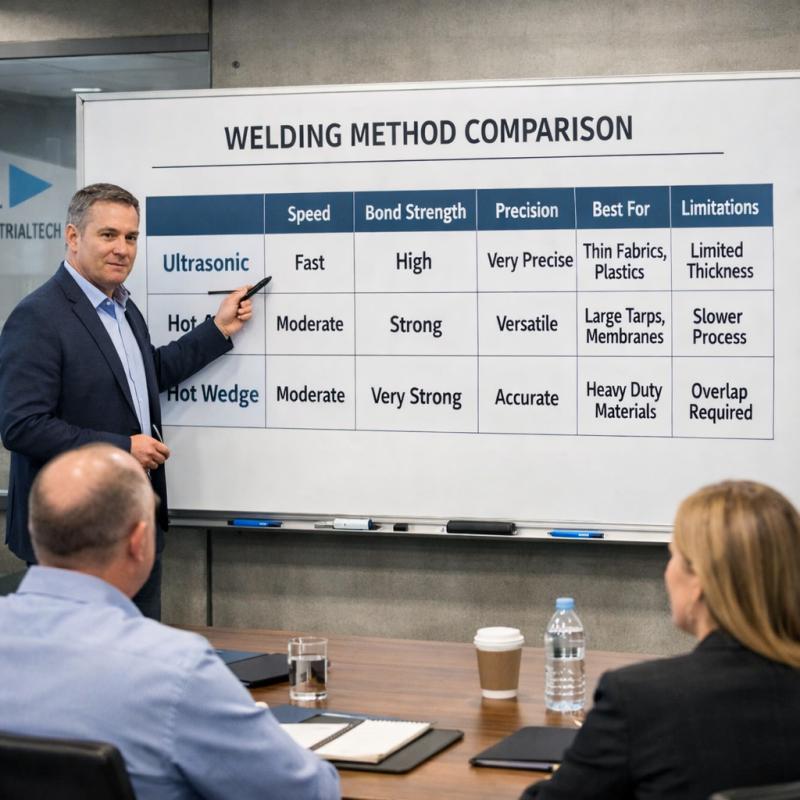
4. Ultrasonic vs. Hot Air vs. Other Methods: An Objective Comparison
| Method | Speed | Bond Strength | Precision/Hygiene | Best For | Key Limitation |
|---|---|---|---|---|---|
| Ultrasonic | Very high (0.5--2 s/point) | High (90--97% of material strength) | Excellent (clean, no residue) | Filter bags, medical gowns, precise sealing | Less ideal for very wide continuous seams |
| Hot Air | Medium (continuous flow) | Good | Moderate (possible residue) | Geo-liners, large industrial fabrics | Risk of overheating thin materials |
| Hot Wedge/Thermal | Medium | Moderate to High | Moderate | Thick-material bonding, cost-sensitive projects | Broader heat spread, potential fiber damage |
Quick Selection Guide
Consider these factors when deciding:
- Choose ultrasonic if you need hygienic, thread-free bonds; fast cycles for high volume; or precise control to protect filtration properties.
- Go with hot air for wide, continuous seams where uniform heating across large areas matters more than speed per point.
- Opt for hot wedge/thermal mainly for simpler, cost-sensitive projects with thicker fabrics.
5. Critical Process Parameters for Strong, Consistent Welds
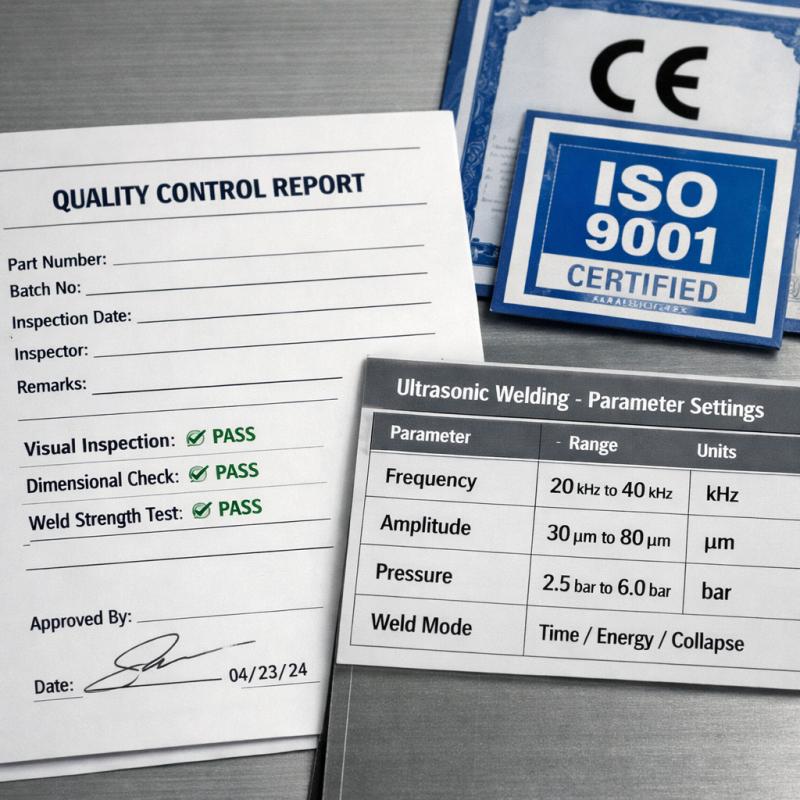
Getting the settings right is key to reliable ultrasonic welds. Here's a quick-reference table followed by tuning tips.
| Parameter | Typical Range for Non-Wovens | Effect |
|---|---|---|
| Frequency | 20--35 kHz | Higher frequencies (35--40 kHz) suit thinner materials. |
| Amplitude | 50--100 µm | Controls vibration intensity; start at 60--80 µm for 100--200 gsm fabrics. |
| Pressure | 1--3 bar | Ensures contact; too low = weak bond, too high = crushed fibers. |
| Weld Mode | Energy mode (100--500 J) | Compensates for thickness variations; preferred over time mode. |
Optimization Tips from Real Projects
Automatic frequency tracking keeps the system resonant even as temperature changes. In our testing, switching to servo-driven pressure control cut weld strength variability by 25% when handling non-wovens with ±10% thickness differences---directly reducing rejects in high-volume runs.
Troubleshooting Common Weld Defects in Non-Wovens
| Defect | Likely Cause | Corrective Action |
|---|---|---|
| Weak or inconsistent bonds | Insufficient energy or poor contact | Increase amplitude 10--20 µm or pressure slightly; check horn alignment |
| Perforation or holes | Excessive amplitude/pressure | Reduce amplitude by 10--20 µm; switch to energy mode |
| Over-melting or burn-through | Too much heat buildup | Lower energy setting; ensure proper cooling time |
| Incomplete fusion | Material variation or low energy | Use energy mode; verify material compatibility |
These guidelines come from hands-on experience with filtration and medical applications. Fine-tuning based on your specific fabric will give the best results. Next, we'll look at how these parameters play out in real-world uses.
6. Real-World Applications in Filtration, Medical, and Geotextiles
Ultrasonic welding proves its value across industries handling non-woven polyester and polypropylene. Here are practical examples showing how it delivers strong, reliable seams in demanding settings.
Filtration Products (Filter Bags)
In liquid and air filtration, seams must be completely leak-proof to maintain efficiency and prevent contamination. Ultrasonic sealing creates durable cuffs and bodies without threads or adhesives.
Application Case: A leading filter bag manufacturer faced frequent seam leaks with traditional methods. We implemented a custom rotary ultrasonic system, boosting daily output by 35% and virtually eliminating failures under high-pressure testing.
Medical Supplies (Gowns and Isolation Wear)
Medical gowns and isolation wear require thread-free, contamination-resistant bonds to meet strict hygiene rules.
Application Case -- Scaling PPE Production:
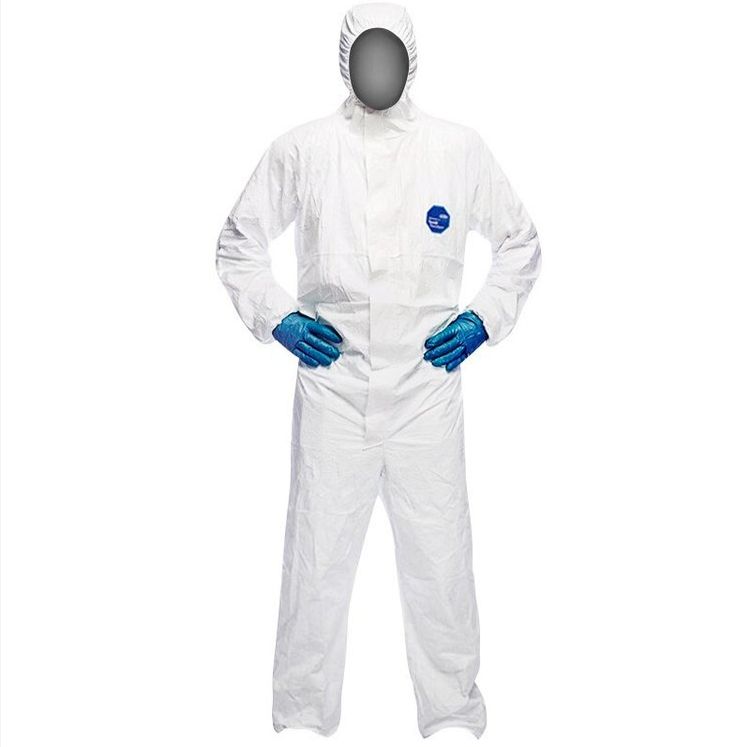
- Challenge: A manufacturer needed to produce 10,000 isolation gowns daily while achieving full fluid barrier protection (per EN 13795 and ASTM F1670/F1671 standards). Sewing was too slow and risked needle-hole leaks.
- Dizo Solution: We designed a 4-head rotary ultrasonic system with servo-controlled pressure and automated fabric handling.
- Results: Output reached 12,000 gowns per day, with seam failure rates below 0.1%. The clean, molecular bonds passed all barrier tests without adhesives.
This project highlights our multi-head and automation expertise---explored further in the customized solutions section.
Geotextiles and Pipeline Rehabilitation
For geotextiles and cured-in-place pipe liners, precision ultrasonic handles detailed sections effectively. Wider continuous seams often pair with hot air for optimal coverage.
These examples show ultrasonic welding solving real production challenges. When standard setups fall short, customization steps in---covered next.
7.Limitations of Standard Solutions -- and Why Customization Matters
Standard welding machines perform well for simple, repetitive seams in non-woven fabrics. However, when pushing for higher speeds, complex geometries, or specialized performance---as seen in advanced filtration housings or multi-layer medical products---they often fall short.
Common Challenges with Off-the-Shelf Equipment
- Material variations → Thickness differences create inconsistent bonds, leading to leaks in pressure-critical filter bags.
- Format restrictions → Limited tool sizes struggle with wide geo-liners or 3D contoured parts.
- Manual tuning → Frequent adjustments slow high-volume lines and increase operator dependency.
These issues can raise defect rates and production costs when scaling beyond basic applications.
Where Customization Becomes Essential
Customized ultrasonic systems bridge these gaps by tailoring design to your exact needs:
- High-mix, high-speed production → Integrating rotary indexing with multiple independently controlled heads allows simultaneous welding of varied seams without changeovers---ideal for diverse filter bag lines.
- Complex 3D geometries → Robot-mounted ultrasonic tools with force-sensing follow curved paths, ensuring uniform pressure on contoured medical or automotive non-woven parts.
- Extreme material demands → Multi-zone energy control and specialized horns weld challenging chemical-resistant or reinforced fabrics without degradation or sticking.
These tailored approaches deliver measurable gains in yield, speed, and quality.
Does your process face similar hurdles? Request a free, no-obligation welding feasibility study from our engineers to explore options tailored to your setup.
8.How to Choose the Right Welding Solution: Your Decision Checklist
Selecting the best welding method for non-woven polyester and polypropylene involves balancing material needs, production goals, and long-term costs. This practical checklist helps you evaluate options step by step.
Step-by-Step Evaluation Framework
- Define your material type and thickness
- Thin/delicate (under 200 gsm)? Favor precise, low-heat methods.
- Thick or reinforced (>300 gsm)? Consider broader heating capability.
- Determine required speed and volume
- Low (<500 units/hour): Manual or semi-automatic may suffice.
- Medium (500--2,000 units/hour): Single-head automation recommended.
- High (>2,000 units/hour): Multi-head or continuous systems needed for efficiency.
- Evaluate hygiene and precision needs
- Medical/filtration requiring contamination-free seams? Thread-free bonding essential.
- High precision for leak-proof results? Localized energy control critical.
- Assess integration with existing lines
- Standalone operation? Simple benchtop units work.
- Full automation required? Look for systems with robotic or conveyor compatibility.
- Review long-term support and total cost of ownership Consider energy use, consumables (threads/adhesives), scrap rates, maintenance, and scalability. Higher initial investment in robust systems often lowers overall costs through reduced downtime and rejects.
Quick Decision Guide
| Your Need | Recommended Approach | Next Consideration |
|---|---|---|
| Hygiene-critical (medical/filtration) | Prioritize ultrasonic | For >5,000 units/day? Explore multi-head automation. |
| Very wide seams (geo-liners) | Consider hot air | Need uniform heating across large panels? Evaluate specialized continuous systems. |
| Variable or complex parts | Explore customization | Facing 3D contours or material mixes? Discuss tailored designs. |
This framework draws from real projects to simplify your choice. If several items point to complexity or high volume, customization often delivers the best return.
Ready to map this to your setup? Request a free welding feasibility review from our engineers---we'll analyze your needs and suggest options.
9.Advanced Customized Ultrasonic Solutions from Dizo Sonics
The challenges highlighted earlier---such as variable thicknesses, complex geometries, and demanding hygiene standards---often go beyond what standard machines can handle. At Dizo Sonics, we design customized ultrasonic systems specifically to solve these real-world issues, starting from your material and production goals.
Key Capabilities That Make the Difference
- Full non-standard customization → From multi-head arrays for simultaneous seams to robot integration for 3D contours.
- Advanced controls → Servo-driven pressure, constant amplitude, and intelligent monitoring for consistent results across variations.
- Data-driven features → Real-time tracing and curve analysis to meet strict quality standards like ISO 13485.
Why Manufacturers Choose Dizo Sonics
- 20+ years focused on ultrasonic welding innovation
- CE and ISO 9001 certified, with multiple national patents
- Trusted partner to global leaders including Siemens, Bosch, and BYD
- Lifetime technical support with 8-hour response guarantee
Proven Impact in Action
Take the medical gown scaling project described earlier: Our 4-head rotary system with independent servo control delivered uniform bonds across multi-layer fabrics, cutting defect rates below 0.1% while boosting output to 12,000 units daily---all while fully complying with EN 13795 barrier requirements.
These tailored solutions consistently improve yield, speed, and reliability for demanding applications.
Ready to address your specific welding challenges? Schedule a free, no-obligation consultation with our engineers---we'll review your process and propose targeted improvements.

10.Frequently Asked Questions
These questions address common concerns from manufacturers working with non-woven polyester and polypropylene fabrics.
How to weld non-woven polyester without damaging the material?
Short answer: Use ultrasonic welding in energy mode with lower amplitude settings.
Detailed explanation: Polyester melts sharply around 250--260°C, so excess energy can tear fibers. Energy mode (typically 200--400 Joules) delivers consistent melt regardless of small thickness changes, while amplitude of 50--70 µm limits vibration intensity. Start low and test---our experience shows this prevents perforation while maintaining strength. See Section 5 for parameter tuning tips.
What is the best non-woven fabric welder for filter bags?
Short answer: Ultrasonic welders provide the most reliable, leak-proof results for high-volume filter bag production.
Detailed explanation: Filter bags demand seams that withstand pressure without leaks. Ultrasonic creates clean, molecular bonds without threads or residue---critical for filtration efficiency. Rotary or multi-head systems handle high speeds effectively. For precise sealing needs, ultrasonic outperforms broader-heat methods.
Ultrasonic vs hot air welding for medical isolation gowns---which performs better?
Short answer: Ultrasonic generally delivers cleaner, stronger, thread-free bonds required for hygiene.
Detailed explanation: Medical gowns need contamination-free seams meeting EN 13795 standards. Ultrasonic avoids fumes and adhesives, producing consistent bonds even on multi-layer fabrics. Hot air works for wider seams but risks residue or overheating thin layers. In hygiene-critical applications, ultrasonic reduces failure risk significantly.
What parameters ensure high-strength non-woven polypropylene welds?
Short answer: 20--35 kHz frequency, 1--2 bar pressure, and 200--400 Joules in energy mode.
Detailed explanation: Polypropylene melts at lower temperatures (~160--170°C), so controlled energy prevents burn-through. Use higher frequency for thinner materials and energy mode to compensate for variations. Validate with peel tests---our lab results show these ranges achieve 90%+ of base material strength. Refer to Section 5 for optimization details.
Can ultrasonic welding handle thick geotextile fabrics effectively?
Short answer: Yes for most industrial thicknesses, with adjustments for power and amplitude.
Detailed explanation: Thicker geotextiles (300+ gsm) require higher energy (400--600 Joules) and lower frequency for deeper penetration. Ultrasonic works well on detailed sections, though very wide continuous seams may pair better with hot air. Custom horn designs help maintain bond uniformity.
Does ultrasonic welding of non-wovens release harmful fumes?
Short answer: No---it's a clean process with virtually no emissions.
Detailed explanation: Unlike heat-based methods that can vaporize additives, ultrasonic generates heat through friction only at the joint. No fumes or residues form, making it safe for cleanroom and medical applications. This advantage supports compliance with strict workplace and product safety standards.
What is the difference between hot air and hot wedge welding for geo-textiles?
Short answer: Hot air offers continuous, uniform heating for wide seams; hot wedge provides direct contact for thicker materials.
Detailed explanation: Hot air circulates heated gas for even softening across large geo-liners. Hot wedge presses a heated metal element directly, better for very thick stacks but with higher risk of uneven heat. Both suit broad formats where precision is secondary.
These answers draw from practical experience across filtration, medical, and geotextile projects. For your specific setup, a customized assessment often reveals the optimal path---reach out for a free review.
11.Conclusion
Choosing the optimal welding approach for non-woven polyester and polypropylene fabrics requires balancing material properties, production demands, and performance goals. Ultrasonic welding frequently excels in precision applications like filtration and medical supplies, delivering clean, strong bonds efficiently. Hot air methods shine for wide, continuous seams in geotextiles and large formats.
True excellence, however, comes when welding becomes a fully optimized part of your process---reliable, scalable, and tailored to your unique challenges. This shift turns potential bottlenecks into consistent quality and competitive advantage.
Next Steps Tailored to Where You Are
- Still exploring options? Download our free Non-Woven Welding Comparison Guide for deeper insights.
- Ready for specifics? Use our online configurator for a quick system recommendation and estimate.
- Facing complex or high-volume needs? Schedule a free 30-minute consultation with our engineers---we'll review your setup and outline a customized path forward.
With 20+ years of innovation, CE/ISO certification, and proven partnerships worldwide, Dizo Sonics is committed to your long-term success through expert guidance and lifetime support. Let's discuss how we can elevate your non-woven welding results.