

Hot Plate Welder Teflon: Guide to Leak-Proof PTFE Welding

Hot Plate Welder Teflon: The Ultimate Guide to Leak-Proof PTFE Welding
By Richard, Senior Welding Engineer at Dizo Sonics --- Leveraging 20+ Years of Expertise in High-Performance Plastic Joining.
Welding Teflon (PTFE) is a task that demands respect. Its legendary chemical resistance and low friction are matched only by its notorious difficulty to join reliably. If you're a materials engineer battling leaks in chemical piping, or a production manager tired of PTFE components sticking to your welding platens, you've found the right guide.
This comprehensive resource cuts through the complexity. We'll walk you through the entire process---from why standard methods fail to how to select and optimize a hot plate welder for Teflon that delivers consistent, hermetic seals. Drawing from Dizo Sonics' archive of 500+ custom installations, you'll get actionable
insights that have helped clients slash defect rates by over 30% and achieve full compliance with standards like ASTM D638 and DVS 2207-4.

1.Why Hot Plate Welding is the Premier Choice for Teflon/PTFE
The Unique Challenge of Welding Teflon
Teflon isn't just another plastic. Its extremely high melt point (~327°C) and low thermal conductivity (0.25 W/m·K) create a perfect storm for welding challenges. Common failures include:
- Material Sticking: PTFE readily adheres to uncoated metal platens, tearing upon separation and ruining the part and the tooling.
- Thermal Decomposition: Heating beyond its safe window (above ~270°C) causes PTFE to break down, releasing hazardous fumes and creating weak, degraded joints.
- Inconsistent Melting: The poor heat conduction often leads to a scorched surface and an unmelted core, resulting in low bond strength.
This is where a specialized hot plate welding machine with PTFE-specific features becomes non-negotiable.
The Hot Plate Welding Advantage for PTFE
Hot plate welding counteracts PTFE's quirks through controlled, conductive heat transfer. A PTFE-coated platen heats the components interfaces until a molten layer forms. The platen retracts, and the parts are pressed together, allowing polymer chains to interdiffuse and create a bond that can approach the strength of the parent material.
Key Benefits for PTFE:
- Hermetic Seals: Capable of achieving leak rates of <10⁻⁶ mbar·l/s, ideal for chemical and medical fluid paths.
- Superior Strength: Produces bonds with tensile strength exceeding 25 MPa when parameters are optimized.
- Geometric Flexibility: Excellent for large, flat, or gently curved parts where ultrasonic or vibration welding fall short.
A Note on Limitations:
- Cycle Times are slower (20-40 seconds) compared to ultrasonic welding (3-8 seconds).
- Initial Investment is higher due to the need for specialized anti-stick coatings and precision temperature control.
From Our Experience: In a project for a chemical valve manufacturer, switching from a standard machine to a dedicated hot plate welder Teflon system reduced sticking-related scrap from 22% to under 2%, paying for itself in under 11 months.
2.Core Principles: The Science of Fusing PTFE
The Mechanics of the Weld
The process seems simple: heat, press, and join. But for PTFE, each stage is critical.
- Heating Phase: The PTFE-coated platen, typically set between 375-385°C, makes contact with the part. The low thermal conductivity of Teflon requires a sufficient dwell time (10-30 seconds) for the heat to penetrate and create a uniform melt layer without surface degradation.
- Change-Over & Joining: The platen rapidly retracts, and the two molten surfaces are brought together under controlled pressure (0.2-0.5 MPa). This pressure forces the polymer chains across the interface to mix.
- Cooling & Solidification: Pressure is maintained as the joint cools, allowing the entangled polymer chains to solidify and form a cohesive, monolithic structure.
Demystifying the Heat Transfer
At a molecular level, success depends on achieving enough chain mobility for interdiffusion. PTFE's semi-crystalline structure must melt completely at the interface for this to occur.
We use predictive models to understand the heat penetration. The core insight is that heat travels slowly through PTFE. For example, with a platen at 380°C, it takes approximately 15-20 seconds to achieve an optimal melt depth of 0.8-1.0 mm in a standard 4mm thick part.
Practical Takeaway: Rushing the heating phase is the most common cause of failure. Patience and precise temperature control are paramount for strong PTFE hot plate welding.
3. Optimizing The Three Pillars of a Perfect PTFE Weld
Dialing in your hot plate welding machine for Teflon is a science. After countless Design of Experiments (DOE) at our lab, we've narrowed it down to three critical parameters.
1. Temperature: The Primary Driver
·Optimal Range: 375°C to 385°C.
·Why it Matters: This range is high enough to fully melt the crystalline structure for bonding but stays safely below the aggressive decomposition zone. Stability is key; a variance of just ±2°C is required to prevent cold spots or overheating.
·Our Data: We found that deviations greater than 5°C can increase void formation by over 30%.
2. Pressure: The Unifying Force
·Optimal Range: 0.2 MPa to 0.5 MPa.
·Why it Matters: Pressure ensures intimate contact between the molten surfaces, driving the interdiffusion of polymer chains. Too little pressure results in weak bonds; too much squeezes out the molten material (excessive flash) and can cause warpage, especially in complex geometries.
·Our Rule of Thumb: 0.35 MPa is a reliable starting point for most parts between 2-6 mm thick.
3. Dwell Time: The Patient Catalyst
·Optimal Range: 10 to 30 seconds.
·Why it Matters: This is the duration the part is in contact with the hot platen. It directly controls the melt depth. Thin parts (<2mm) require less time; thicker sections (>6mm) require significantly more.
·Critical Insight: Exceeding 35 seconds at 380°C can initiate polymer chain scission, permanently weakening the material.
| Parameter | Ideal Range | Thin Parts (<2mm) | Thick Parts (>6mm) | Risk of Deviation |
|---|---|---|---|---|
| Temperature | 375-385°C | 375°C | 385°C | >5°C variance → 30%+ voids |
| Pressure | 0.2-0.5 MPa | 0.2 MPa | 0.5 MPa | >0.6 MPa → Warpage & Flash |
| Dwell Time | 10-30 s | 10-15 s | 25-30 s | >35 s → Material Degradation |
4. Safe Operation and Regulatory Compliance
Handling the Hidden Hazards of PTFE
Welding PTFE safely is as important as welding it effectively. Thermal decomposition produces fumes that can be harmful, often referred to as polymer fume fever. A robust Teflon welding solution must integrate safety.
Essential Safety Protocols:
·Ventilation: Always use local exhaust ventilation (LEV) or fume extraction systems directly at the point of welding.
·Temperature Monitoring: Automated shut-offs or alarms should trigger if the platen temperature exceeds a safe threshold (e.g., 400°C).
·Personal Protective Equipment (PPE): Operators should wear appropriate respirators when maintenance or cleaning could expose them to PTFE dust or fumes.
Navigating the Regulatory Landscape
For industries like medical and automotive, compliance isn't optional. Your hot plate welding process must be validated and traceable.
·Medical (ISO 13485): Requires full process validation, including equipment installation qualification (IQ), operational qualification (OQ), and performance qualification (PQ). All parameters must be logged for each production batch.
·Automotive (IATF 16949): Emphasizes defect prevention and process control. Force and temperature profiling with ±2% accuracy is often mandated.
·Material Standards (ASTM D638, DVS 2207-4): These standards govern the testing of tensile strength and the qualification of the welding procedure, respectively.
Pro Tip: When evaluating a hot plate welder for sale, always ask the manufacturer for a compliance matrix that maps machine capabilities to your specific industry standards.
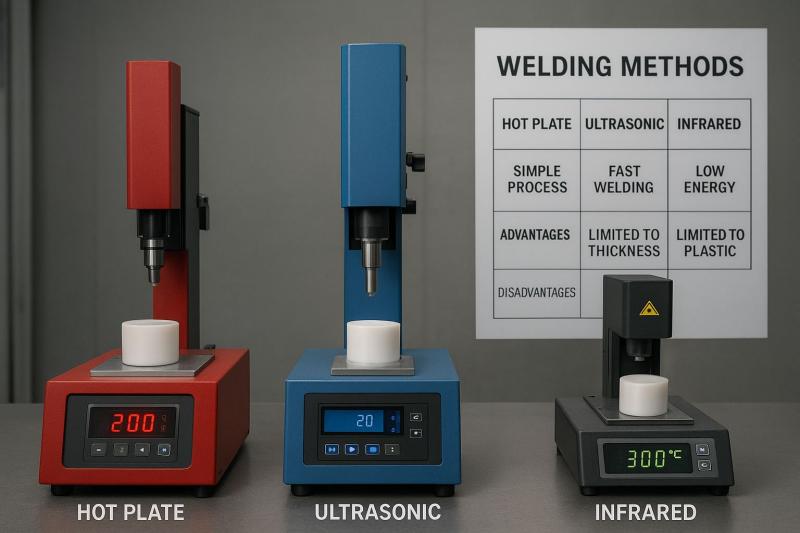
5. Technology Comparison: Choosing Your PTFE Welding Weapon
How does hot plate welding stack up against the alternatives for Teflon? The choice significantly impacts your product's performance, cost, and production speed.
| Method | Advantages | Disadvantages | Best For |
|---|---|---|---|
| Hot Plate Welding | Strongest bonds, excellent for complex geometries, superior hermetic seals | Slower cycles, higher energy use, requires PTFE coatings | Chemical tanks, medical housings, large/curved parts |
| Ultrasonic Welding | Extremely fast (1-5s), clean, no consumables | Limited to small, simple shapes; poor energy transmission in PTFE | Small medical components, electrical insulators |
| Infrared Welding | Non-contact heating, good for flat surfaces | Uneven absorption can cause hotspots; higher equipment cost | Large, flat sheets or panels |
The Verdict: For critical, thick, or geometrically complex PTFE components that demand leak-proof integrity, hot plate welding is the undisputed champion. Its controlled conduction overcomes the material's limitations that frustrate other methods.
6.A 5-Step Framework for Selecting Your Teflon Hot Plate Welder
Navigating the market for a hot plate welder Teflon can be daunting. Follow this proven framework to make a confident decision.
Step 1: Diagnose Your Application
Start with a clear understanding of your part. What are the dimensions? What is the wall thickness? What is the annual volume? A part with thin, complex curves has different needs than a thick, flat seal.
Step 2: Define Your Must-Have Features
For Teflon, certain features are non-negotiable:
·PTFE-Coated Platens: This is the most critical feature to prevent sticking.
·Precise Temperature Control: Look for systems that guarantee ±2°C stability across the entire platen surface.
·Servo or Hydraulic Actuation: For the consistent, programmable pressure required for PTFE.
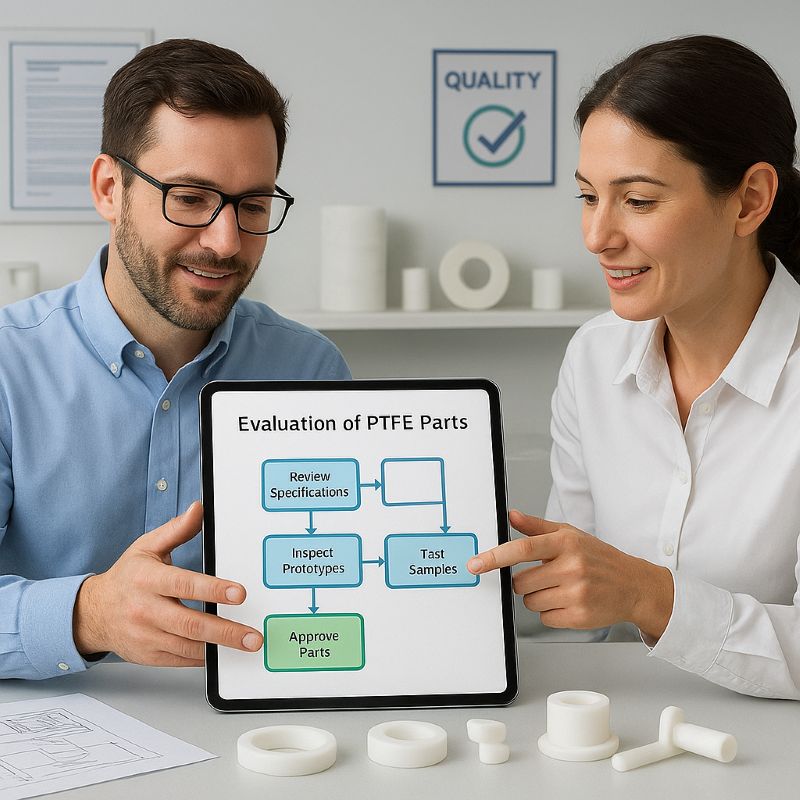
Step 3: Prototype and Validate
Step 4: Evaluate the Total Cost of Ownership (TCO)
Look beyond the initial hot plate welding machine price. Factor in:
·Energy Consumption: PTFE welding is energy-intensive.
·Coating Maintenance: PTFE coatings wear and will need recoating.
·Service and Support: Ensure quick access to spare parts and technical expertise.
Step 5: Choose a Partner, Not Just a Supplier
The right manufacturer will act as a long-term partner. They should offer deep application engineering support, comprehensive training, and responsive after-sales service. Ask for case studies and customer references.
7.Beyond Standard: Customized Teflon Welding Solutions
Sometimes, an off-the-shelf hot plate welding machine isn't enough. Complex geometries, extreme performance requirements, or high-volume production often demand a tailored approach.
Case Study: Solving for a 3D Curved Automotive Pipe
The Challenge: A manufacturer of PTFE fluid lines for electric vehicles was experiencing a 25% leak rate. The complex, curved geometry of the pipe caused inconsistent heat and pressure from a standard single-zone platen.
Our Custom Solution: We engineered a custom hot plate welder with a multi-zone platen. Each zone could be independently controlled for temperature and pressure, conforming perfectly to the pipe's contours. Adaptive pressure profiling ensured even force distribution throughout the joining phase.
The Result: The leak rate plummeted from 25% to under 1%. The production line achieved a 22% throughput increase due to fewer rejects and a faster, optimized cycle. The ROI was achieved in just 9 months.
When to Consider Customization:
·Your parts have complex 3D curves.
·You are welding dissimilar materials or materials with fillers.
·Your production volume is very high, and efficiency gains are critical.
·Standard machines cannot meet your stringent quality or traceability standards.
8.Client Insight: A Testimonial on Transitioning to Teflon-Specific Welding
"For years, we struggled with adapting a general-purpose hot plate welder to our PTFE medical manifold production. We faced constant sticking, which required frequent downtime for platen cleaning and recoating. The variability in our weld quality was a major headache during FDA audits."
"Working with Dizo Sonics to implement a dedicated hot plate welder Teflon system was a game-changer. The integrated PTFA-coated platens and their proprietary temperature control algorithm eliminated sticking entirely. But the real value was the process validation support. They provided us with a fully documented Welding Procedure Specification (WPS) that made our ISO 13485 audit the smoothest we've ever had. Our scrap rate is now consistently below 2%, and we have the data to prove our process is in control."
--- Production Engineering Manager, Leading Medical Device OEM
9.Frequently Asked Questions About Hot Plate Welding Teflon
Q: What is the best hot plate welder for Teflon?
A: The "best" machine is the one that matches your specific application, but it must have essential features: high-grade PTFE-coated platens, temperature control with ±2°C stability, and a pressure system capable of precise application (0.2-0.5 MPa). Brands that specialize in plastic welding, like Dizo Sonics, often provide the necessary application support.
Q: We keep getting residue buildup on our platens. How can we stop PTFE from sticking?
A: Sticking is a sure sign you need a proper PTFE coating. If you already have one and are experiencing buildup, the coating may be worn and require recoating. Implement a regular cleaning schedule with a brass wire brush and approved solvents, and ensure your dwell time and temperature are not excessively high.
Q: What is the typical hot plate welding machine price for a Teflon-capable system?
A: Entry-level, basic pneumatic systems start around $50,000. Fully automated, servo-driven hot plate welder Teflon systems with advanced controls and multi-zone platens can range from $120,000 to $200,000. The investment is significant but is justified by dramatic reductions in scrap and rework.
Q: How do I find a hot plate welder Teflon for sale near me?
A: Search for industrial plastic welding equipment suppliers in your region. However, for a specialized process like this, it's often better to prioritize expertise over proximity. Many leading manufacturers, including Dizo Sonics, have a global service network and can support remote installations effectively.

10. Conclusion: Mastering the Art and Science of PTFE Welding
Welding Teflon with a hot plate welder is a disciplined blend of material science, precise engineering, and practical experience. It requires respecting the material's boundaries while leveraging the unique capabilities of a well-tuned machine.
The path to success is clear:
- Understand the Material: Acknowledge PTFE's high melt point and poor conductivity.
- Control the Process: Master the trifecta of temperature, pressure, and time.
- Choose the Right Tool: Invest in a hot plate welding machine built with PTFE's challenges in mind, from its anti-stick platens to its stellar temperature stability.
- Validate and Document: Especially for regulated industries, prove your process and keep records.
By following the data-driven practices and real-world insights in this guide, you can transform the challenge of Teflon hot plate welding from a source of production headaches into a reliable, repeatable, and competitive advantage.
Ready to Tackle Your Toughest PTFE Welding Challenges?
Stop battling sticking platens and inconsistent seals. Schedule a free, no-obligation process audit with our engineering team
This guide is based on the latest industry standards, including AWS, ASTM, and DVS guidelines, and is informed by the proprietary application data and real-world case studies from Dizo Sonics. Last updated: November 2025.