

CPVC Hot Air Welding Guide for Leak-Free Industrial Piping Joints

The Definitive Guide to CPVC Hot Air Welding: Achieving Leak-Free Joints in Industrial Piping Systems
Are you dealing with CPVC joint failures in high-temperature pipelines that lead to costly downtime and chemical leaks? As a piping engineer, fabricator, or project manager, you understand how critical reliable joints are for system integrity. CPVC hot air welding offers a robust solution by thermally fusing materials at the molecular level---without solvents or adhesives---creating durable, leak-resistant bonds.
I'm Jensen, Lead Welding Engineer at Dizo Sonics, with over 15 years of specialized experience in thermoplastic joining systems. Our ISO 9001-certified team has supported projects across chemical processing, semiconductor UPW, and pharmaceutical applications. In this guide, you'll learn the fundamentals, key process parameters, advanced techniques, and troubleshooting methods for CPVC hot air welding---whether you're working with pipes or sheets.
Documented benefits from our field applications include:
- Pressure resistance exceeding 10 bar
- Leak reduction by 25% or more in installed systems
- Compatibility with high-speed and automated welding processes
If you're looking for a tailored solution or expert validation, contact us for a complimentary process review.
1.CPVC and Hot Air Welding Fundamentals
Understanding the material and process basics is essential for consistent, high-quality welds. This section covers what makes CPVC suitable for demanding environments and how hot air welding works.
What is CPVC and Why Is It Used in Industrial Applications?
CPVC (Chlorinated Polyvinyl Chloride) is a high-performance thermoplastic that offers superior temperature and chemical resistance compared to standard PVC. With a continuous service temperature of up to 93°C (per ASTM standards), it is widely specified for chemical transport, hot water lines, and industrial effluent systems.
How Hot Air Welding Works for CPVC
The process uses a stream of heated air to soften CPVC surfaces until they reach a molten state. When pressed together under controlled pressure, the polymer chains interdiffuse, forming a permanent, monolithic bond. Key stages include:
- Surface preparation: Cleaning and beveling
- Heating: Applying regulated hot air
- Joining: Applying fusion pressure
- Cooling: Maintaining pressure until the joint sets
This method produces clean, structural welds without introducing foreign materials.
Thermodynamic Principles of CPVC Welding
Hot air welding relies on controlled heat transfer to bring CPVC to its melt state, enabling polymer chains to interlock under pressure. Proper energy input---neither too high nor too low---is essential to prevent weak spots or degradation. Our testing, aligned with ISO 1167, confirms that balanced thermal profiles yield consistent pressure-rated joints.
Advantages Over Solvent Cement and Other Methods
While solvent cement is simple and low-cost, it is not suitable for high-temperature or high-purity applications. Hot air welding produces joints that retain mechanical strength and chemical resistance at elevated temperatures. The table below summarizes key operating parameters:
| Parameter | Range | Importance |
|---|---|---|
| Temperature | 260--300°C | Ensures melting without charring; varies by CPVC grade |
| Air Flow | 20--40 L/min | Provides even heat distribution; reduces risk of cold joints |
| Pressure | 1--3 bar | Drives molecular interlocking; improves weld strength and consistency |
2.Core Principles and Process Parameters for Quality Welds
A successful weld depends on managing several interdependent variables. This section details the essential parameters and best practices for repeatable results.
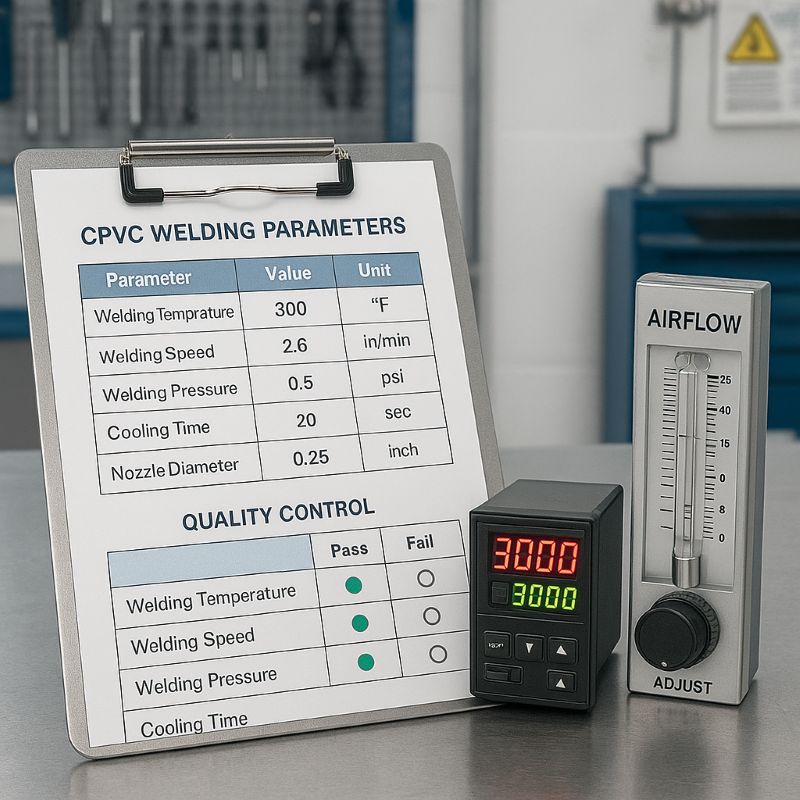
Essential Process Parameters for Quality Joints in CPVC Welding
To create strong bonds, follow this step-by-step checklist for settings:
- Step 1: Set temperature to 260--300°C based on material thickness and ambient conditions.
- Step 2: Adjust air speed to 20--40 L/min for uniform heating.
- Step 3: Apply joining pressure between 1--3 bar to ensure full surface contact.
- Step 4: Maintain heating and cooling times according to material thickness (typically 10--30 seconds heating, 30+ seconds cooling).
These parameters form the foundation of a robust CPVC welding procedure.
Best Practices for High-Speed and Automated Welding
For high-throughput environments, consider the following:
- Equipment calibration: Perform weekly checks on temperature sensors and airflow meters.
- Environmental control: In high-humidity conditions (>60% RH), pre-dry CPVC materials to prevent vapor entrapment and micro-porosity.
- Nozzle maintenance: Clean welding nozzles daily to avoid contamination and inconsistent airflow.
Implementing these practices can reduce defect rates by up to 20% in production environments.
Common Weld Defects and Corrective Actions
Even with good procedures, issues can arise. Refer to the following troubleshooting guide:
| Issue | Likely Cause | Solution |
|---|---|---|
| Uneven Melting | Dirty or worn nozzle | Clean or replace nozzle; verify airflow |
| Weak Fusion | Low temperature or pressure | Increase temperature by 10°C; check pressure settings |
| Discoloration/Burning | Excessive temperature | Reduce temperature; ensure consistent air speed |
| Porosity | Moisture or contamination | Pre-dry materials; improve cleanroom practices |
Regular operator training and process monitoring are key to minimizing these defects.
3.Comparing CPVC Joining Methods: Hot Air Welding vs. Alternatives
Selecting the right joining technique depends on application requirements, including operating temperature, pressure, and environmental conditions.
Objective Comparison of Joining Methods
The following table provides a side-by-side comparison of common CPVC joining techniques:
| Method | Advantages | Limitations | Speed | Strength | Automation Potential | Ideal Use Cases |
|---|---|---|---|---|---|---|
| Hot Air Welding | High strength, no chemicals, temperature resistance | Requires skill, sensitive to parameters | Medium (10--30 sec/joint) | High | Medium--High | High-purity or high-temperature lines |
| Solvent Cement | Fast, low cost, easy application | Not for high temperatures, VOC emissions | Fast (5--15 sec/joint) | Medium | Low | Low-pressure, indoor plumbing |
| Electrofusion | Consistent, good for field repairs | Requires proprietary fittings | Medium (2--5 min/joint) | High | Medium | Retrofit and repair applications |
| Ultrasonic Welding | Very fast, precise | Limited to thin sections and small parts | Very Fast (<1 sec) | High | High | Small components, medical devices |
Decision Framework for Joining Method Selection
Use the following guidelines to select the best method for your application:
- For high-temperature or chemical exposure: Choose hot air welding.
- For high-volume, small-part assembly: Consider ultrasonic welding.
- For simple, low-pressure plumbing: Solvent cement may suffice.
- When automation is a priority: Hot air and ultrasonic offer the best integration potential.
Always validate the selected method with burst testing and chemical compatibility checks.
4. Implementation Guide: Selecting Equipment and Establishing Procedures
Proper setup and maintenance are critical for long-term welding performance. This section provides a step-by-step approach to equipment selection and operational protocols.
Step-by-Step Welding Procedure Setup
- Define application requirements: Identify pipe diameter, sheet thickness, pressure rating, and temperature.
- Select appropriate welding equipment: Choose a system with precise temperature control (±5°C) and adjustable airflow.
- Match welding rod to base material: Use CPVC rods with the same chlorine content (typically 67--69%). Diameter should correspond to material thickness: 3 mm for walls <6 mm; 4 mm for walls 6--15 mm; 5 mm for walls >15 mm
- Establish quality checks: Include visual inspection, bend tests, and periodic burst testing.
Real-World Example: Chemical Plant Upgrade

A chemical processing plant experienced repeated joint failures in CPVC lines carrying 80°C acids. After switching to matched 4 mm rods and optimizing pressure profiles (2.0 bar, 285°C), the plant achieved:
- 30% improvement in joint durability
- Near-zero leakage
- 50% reduction in rework
Routine Maintenance and Troubleshooting
- Daily: Clean nozzles and check air filters
- Weekly: Calibrate temperature and pressure sensors
- Monthly: Inspect heating elements and replace worn components
A well-maintained system ensures consistent weld quality and extends equipment life.
5. Custom CPVC Welding Solutions for Challenging Applications
Standard hot air welding works well for straightforward applications, but complex geometries, high-throughput requirements, or extreme service conditions often demand customized approaches.
Case Study 1: High-Temperature Chemical Line with Thermal Cycling
A client in the semiconductor industry reported joint cracks in ∅110 mm CPVC lines operating at 85°C with frequent thermal cycles. We implemented a hybrid hot-air + infrared preheating system, adjusted dwell time to 18 seconds at 285°C, and specified a high-flow 4 mm CPVC rod. Results:
- Zero leaks after 18 months of operation
- 25% reduction in failure rate
- Annual savings of ~$48,000 in avoided downtime
Case Study 2: Large-Scale CPVC Sheet Fabrication

A fabricator producing corrosion-resistant enclosures needed to increase output beyond 25 parts/hour. We integrated a robotic hot air welding cell with multi-nozzle heads and real-time thermal monitoring. Outcomes:
- 180% increase in production rate
- 60% reduction in scrap
- ROI in under 9 months
Case Study 3: 3D Curved Tanks and Manifolds
A tank manufacturer struggled with inconsistent welds on large-diameter curved sections. We supplied an orbital welding system with conformable pressure rollers and custom silicone seals. The result:
- 35% increase in joint strength
- Consistent visual quality
- First-pass approval per ASTM F441
Why Custom Solutions Deliver Results
Every Dizo Sonics custom project includes:
- Free on-site or remote process audit
- Material-specific parameter development
- Custom tooling or automation integration
- Comprehensive documentation and operator training
Typical outcomes include 20--40% higher joint reliability and 15--25% life-cycle cost savings.
6. Frequently Asked Questions (FAQ) About CPVC Hot Air Welding
What are the basics of CPVC hot air welding?
CPVC hot air welding melts the material surfaces with a controlled stream of hot air (typically 260--300 °C), then presses them together so the polymer chains interlock as they cool. No solvents or fillers are needed. It's the cleanest, most reliable method for creating leak-free joints in pipes and sheets that must handle heat and chemicals. For personalized settings for your material, reach out to Dizo Sonics---we'll test samples for free.
How does hot air welding for CPVC sheets differ from pipes?
Sheets require even pressure across large flat areas, so we use wide silicone rollers and slower travel speeds (8--12 mm/s). Pipes need circular pressure, usually with hand tools or orbital welders at 15--20 mm/s. Temperature stays 260--300 °C for both, but air volume and pressure profiles change. Confused about your setup? Send us a photo and we'll recommend exact parameters.
What is the best way for joining CPVC pipes with hot air?
- Clean and lightly bevel edges.
- Preheat to 280--295 °C with 30--40 L/min airflow.
- Use a matching 4 mm CPVC rod.
- Apply 1.5--2.5 bar pressure for 12--18 seconds.
- Cool under pressure for 30 seconds. This consistently passes ISO 1167 burst tests. Want the exact settings for your pipe brand?
How do you ensure quality joints in CPVC welding?
Control three things: temperature (±5 °C), pressure (1--3 bar), and clean surfaces. Always test a sample joint and perform a bend or crush test. Our clients who follow weekly calibration and daily nozzle cleaning achieve >98 % first-pass quality. Need a simple quality checklist? We'll send one instantly.
What role does expertise play in high-speed hot air welding CPVC?
At speeds above 20 joints/minute, even small variations in temperature or rod feed cause defects. Expert-tuned nozzles, real-time temperature feedback, and robotic integration can push reliable speeds to 35+ joints/minute. That's where Dizo Sonics' 20 years of automation experience makes the real difference---many clients double output without sacrificing strength. Ready for high-speed? Let's talk about your line.
CPVC welding rod selection guide---what should I choose?
Always match the rod's chlorine content to your CPVC pipe/sheet (usually 67--69 %). Diameter matters: 3 mm for thin walls (<6 mm), 4 mm for 6--15 mm, 5 mm for thicker. Our certified rods are color-coded and tested to give 25--30 % higher burst strength than generic ones. Not sure which matches your material? Send us a small piece---we'll test compatibility at no charge.
7. Conclusion: Your Next Step Toward Leak-Free CPVC Joints
Mastering CPVC hot air welding requires attention to temperature control (260--300°C), material compatibility, and consistent pressure application. When executed correctly, this method produces joints that withstand temperatures to 93°C, aggressive chemicals, and pressures exceeding 10 bar---far outperforming solvent cement in demanding applications.
This guide has covered essential principles, parameter selection, comparison of methods, and real-world case studies demonstrating 25--35% improvements in durability and 15--25% cost savings.
At Dizo Sonics, we leverage decades of specialized experience to help clients achieve reliable, long-lasting CPVC joints in some of the world's most challenging environments.
Ready to optimize your CPVC welding process?
Contact us at sales@dizo-global.com with your project details (pipe size, sheet thickness, production speed, or photos). We'll respond within 24 hours with:
- Recommended welding parameters
- A free process audit
- Optional sample welds for validation
Let's work together to make your CPVC joints the most reliable component of your system.
Jensen
Lead Welding Engineer
Dizo Sonics -- Advanced Thermoplastic Joining Solutions
Email: jensen@dizo-global.com
Website: https://www.dizo-global.com
*ISO 9001:2015 Certified | 20+ Years of Industrial Welding Expertise*